
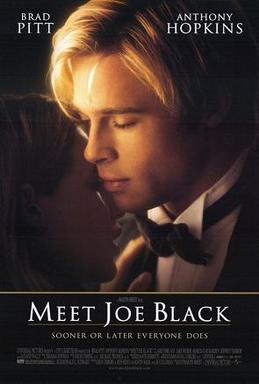
Behind the film
- Year
- 1998
- Director
- Martin Brest
- Writers
- Ron Osborn, Jeff Reno, Kevin Wade, Bo Goldman
- Genres
- Romance, Fantasy, Drama
- Production
- Universal Pictures
- Country
- United States
- Cast
- Brad Pitt, Anthony Hopkins, Claire Forlani, Jake Weber, Marcia Gay Harden, Jeffrey Tambor, David S. Howard, Marylouise Burke
About the film
Contains story spoilers.
Media owner Bill Parrish approaches his sixty-fifth birthday when Death takes the body of a young man his daughter Susan met in a café. Calling himself Joe Black, Death postpones Bill's end in exchange for an introduction to human life. Susan grows close to Joe, while her partner Drew manipulates a corporate merger and has Bill removed as chairman. Joe intends to take Susan with him, but Bill challenges his understanding of love, and he relents. Joe exposes Drew's scheme, restoring Bill's position. At the birthday party, Bill says his farewells and leaves with Death across a bridge. The original young man returns alone, with no understanding of the intervening experience. Susan reconnects with him, recognising that Joe has gone while the possibility of another beginning remains.
Martin Brest stages the fantasy inside a world Bill has spent a lifetime learning to influence. Anthony Hopkins gives the businessman a command that feels habitual: he expects to understand a conversation's terms and have some say in its outcome. Death introduces a limit none of those habits can negotiate away. The resulting relationship is compelling because Bill does not instantly become serene or wise. He has concerns, irritations and attachments that remain practical even while the larger question becomes unavoidable. His visitor gives ordinary situations a new pressure. A family gathering or a business discussion can still matter on its own scale, but Bill must experience it while knowing that continued authority over a room is different from authority over the time left to enter it.
Brad Pitt's performance distinguishes the young man's easy social presence from Joe's unfamiliarity with ordinary experience. Death possesses an absolute position in relation to human lives, yet that position has not supplied an understanding of living one. The contrast allows small pleasures to become discoveries. Something people habitually pass over can occupy his full attention, making the everyday seem briefly strange again. The comedy grows from that mismatch of enormous power and limited familiarity, but it also prepares the film's emotional argument. Knowing what will happen to a person is not equivalent to knowing what their experience means. Joe must learn through contact with people whose feelings have a complexity his original purpose does not require him to recognise.
Claire Forlani's Susan gives that education its most difficult dimension. Her attraction involves an apparent continuity of appearance that conceals a fundamental difference of identity. The situation makes a romantic connection unstable in a way neither ordinary reassurance nor physical recognition can fully address. What does someone respond to when a familiar face begins behaving like a different person? The film allows Susan's feeling to be sincere without giving her complete knowledge of its circumstances. That gap matters because intimacy cannot be understood solely from the more powerful participant's point of view. Joe's discovery of desire introduces a responsibility to consider another person's life, not merely the intensity of what he has begun to feel about it.
The family around Bill supplies several different forms of attachment. Marcia Gay Harden's Allison and Jeffrey Tambor's Quince bring desires for recognition that are less immediately grand than the central romance but no less human. A parent's affection may be real while appearing uneven to the children who receive it, and being included in a successful family does not remove uncertainty about one's place. Those relationships make Bill's life more than a record of acquisitions. He has become important to people in ways that cannot be measured entirely through professional achievement. The family scenes give the impending farewell its weight by showing the unfinished work of reassurance, forgiveness and appreciation that can remain beneath a household's familiar routines.
Jake Weber's Drew brings calculation into that intimate world. His corporate ambition uses relationships as resources, giving the film another way to test the difference between valuing someone and valuing what access to them provides. Bill's business position can be contested through procedures, persuasion and appearances of practicality, while personal loyalties are being quietly altered underneath. The corporate story does not operate merely as an unrelated inconvenience beside the fantasy. It provides a recognisable version of the struggle over possession and control. People try to secure a desired future by arranging other people's choices, sometimes assuming that a convincing explanation of advantage is enough to justify the arrangement.
The film's spacious settings reinforce that struggle without granting wealth a solution to it. Large rooms and carefully managed occasions express a life in which resources can shape circumstances, yet the distance between people remains emotional as well as physical. Bill can provide an impressive environment without ensuring that every person inside it feels understood. Brest lets conversations occupy time, giving reactions room to develop rather than immediately converting each exchange into the next event. That pace suits a story about noticing what may soon be unavailable. An interruption, a hesitation or a look can acquire significance because the film permits it to remain present, letting awareness of mortality change the attention given to otherwise familiar social gestures.
Love eventually becomes the point at which Joe's power must be questioned most directly. Wanting to keep someone close can feel like proof of attachment, but the film asks whether attachment also requires accepting a life that continues beyond one's own preferred arrangement. Its fantasy makes that conflict unusually literal while leaving the emotional problem recognisable. The resolution combines loss with renewed possibility, and those experiences are not interchangeable. A beginning does not replace everything a farewell removes. Meet Joe Black finds its larger meaning in that coexistence: valuing a life involves its pleasures, its complicated bonds and its limits, including the recognition that affection cannot justify possessing the entire future of another person.