
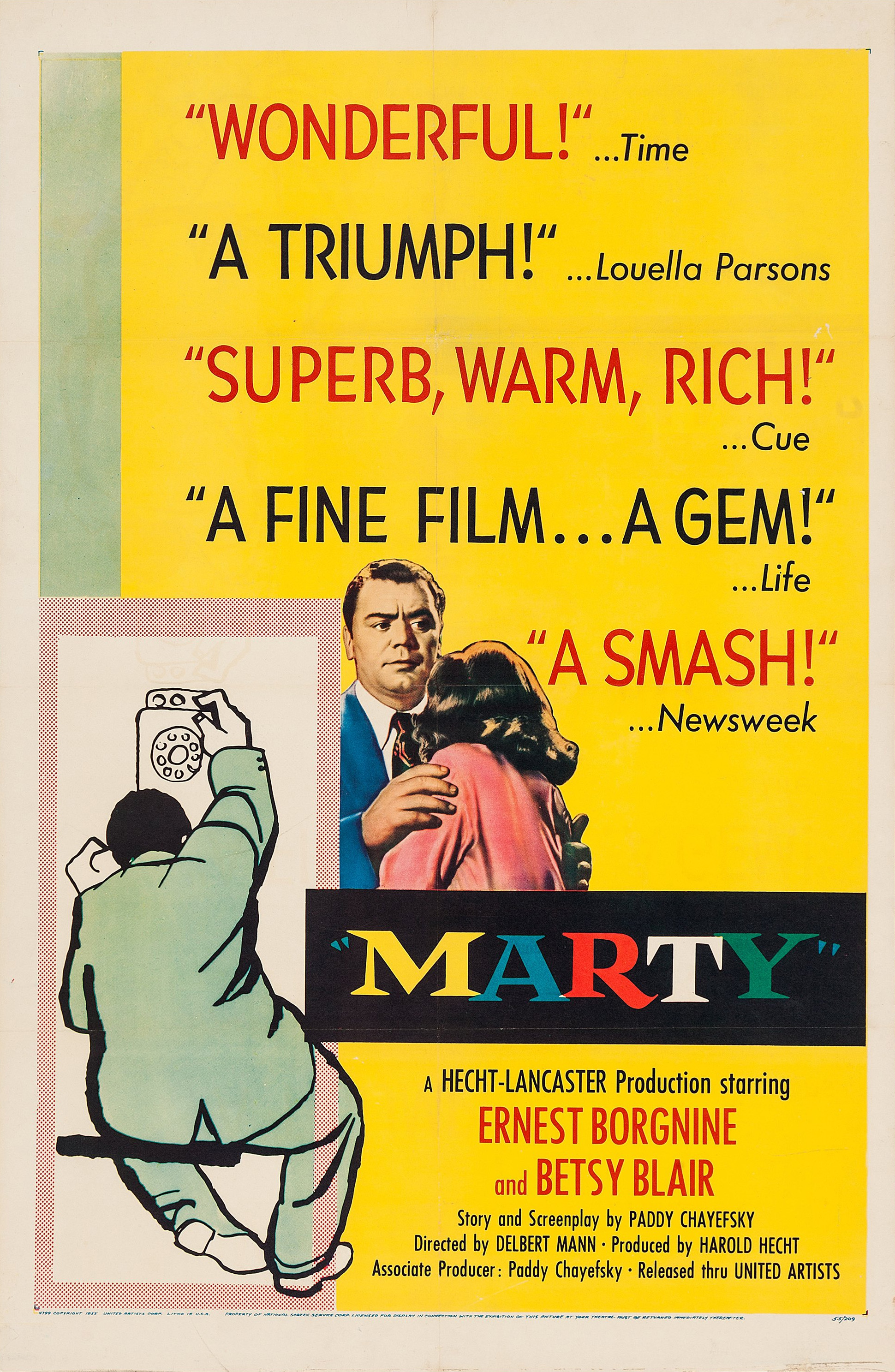
Behind the film
- Year
- 1955
- Director
- Delbert Mann
- Writers
- Paddy Chayefsky
- Genres
- Romantic drama
- Production
- Hecht-Lancaster Productions
- Country
- United States
- Cast
- Ernest Borgnine, Betsy Blair, Esther Minciotti, Joe Mantell, Augusta Ciolli, Karen Steele, Jerry Paris, Frank Sutton
About the film
Contains story spoilers.
Marty makes the possibility of an ordinary date feel like a significant change in somebody's life. Its central man has been reminded often enough that he ought to marry, yet those reminders have not helped him find the companionship they presume is readily available. The film begins from the distance between a public expectation and a private experience. People can keep telling a person to change while also maintaining the habits that make change difficult. Delbert Mann's drama gives Marty a chance to recognise that contradiction, then asks whether he can act on an evening that has made him happy even when others refuse to value it.
Marty Piletti is a thirty-four-year-old butcher living with his mother in the Bronx. At a ballroom he meets Clara, a teacher abandoned by her date. They talk, dance and spend the evening together, sharing hopes and agreeing to meet again. His mother then fears being left behind, while his friends belittle Clara. Marty yields to their pressure and fails to make the promised call. Another lonely evening changes his mind: he recognises that their disapproval has led him away from someone he likes. He goes to a telephone and calls her. The film ends at renewed contact, leaving the relationship's future open while making the decision to pursue it decisive.
Ernest Borgnine's Marty is not asked to become a more fashionable person before his wish for affection can matter. His work, body and manner belong to the life the film follows, rather than a starting disguise that romance will remove. That gives the story a different kind of wish fulfilment from a transformation plot. The possibility comes through being heard by another person, with conversation supplying a space in which his expectations can become less defeated. The film allows social awkwardness and dignity to occupy the same character. A person can be uncomfortable approaching others without having nothing to offer when an approach finally becomes mutual.
Betsy Blair's Clara matters because the meeting is not solely an opportunity granted to Marty. She has also been hurt by an environment that treats people as quickly assessable prospects. Their connection lets each encounter someone who is willing to stay long enough for another kind of knowledge to emerge. That makes time and attention useful dramatic resources. A conversation can become important because it is not cut short by the judgment that normally ends an encounter. The film's romance begins with that modest change in behaviour, giving the audience a reason to care about the connection before any larger commitment has been made.
The mother's reaction makes affection capable of creating pressure as well as support. Wanting a child to marry can sound generous until marriage threatens to alter the parent's own place in the household. The film allows that conflict to emerge without reducing the mother to someone who never cared. Fear can change what she tells Marty, encouraging her to defend the familiar arrangement at the cost of something he wants. That is a recognisable difficulty within family life: advice may be sincerely expressed while also serving the adviser. Marty has to distinguish being loyal to his mother from letting her uncertainty determine every possible future.
His friends supply another version of the same resistance. A group can encourage a member to look for companionship in the abstract, then become hostile when a specific relationship might take him away. Their judgments about Clara offer an apparently independent reason to dismiss her, but the consequences favour keeping the group unchanged. The story makes that influence visible through Marty's return to the routine he already knows is unsatisfying. The pressure does not need an explicit threat to work. Familiarity, shared habits and the desire to remain accepted can be enough to make a person abandon a decision he had previously felt able to make.
Paddy Chayefsky adapted his own television play for the screen, preserving a scale in which domestic conversation and an evening out can carry the central conflict. The film does not need a villain with a plan to make the obstacle substantial. Several people have ordinary reasons for wanting things to remain as they are, and their combined influence can still close a route to happiness. The setting matters because Marty has to move through that social network after the first pleasant encounter ends. A romance cannot remain only the privacy of two people talking; it has to find room within the relationships and expectations already surrounding them.
The final call is therefore an act of judgment rather than proof that every problem has been solved. Marty chooses to place his experience beside the opinions he has been given and finds the experience more persuasive. Clara's response can begin another conversation, but the film does not need to show a wedding to establish the importance of making contact again. Its hope lies in the decision to stop treating other people's dismissal as the full measure of a person. Marty gives an ordinary man permission to pursue an ordinary pleasure, making that small movement feel substantial because it has required him to disagree with the people whose approval normally organises his life.