
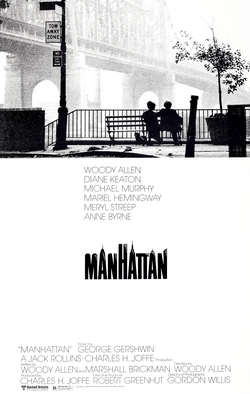
Behind the film
- Year
- 1979
- Director
- Woody Allen
- Writers
- Woody Allen, Marshall Brickman
- Runtime
- 1h 36m
- Genres
- Romantic comedy, Drama
- Production
- Jack Rollins & Charles H. Joffe Productions
- Country
- United States
- Cast
- Woody Allen, Diane Keaton, Michael Murphy, Mariel Hemingway, Meryl Streep, Anne Byrne, Karen Ludwig, Michael O'Donoghue
About the film
Contains story spoilers.
Forty-two-year-old comedy writer Isaac Davis dates seventeen-year-old student Tracy while trying to begin a novel and worrying about his former wife Jill's book about their marriage. His married friend Yale is involved with Mary, whom Isaac initially dislikes. Attraction develops between Isaac and Mary; after Yale ends their affair, Isaac leaves Tracy to pursue her. Mary eventually returns to Yale, provoking Isaac's angry accusations of hypocrisy. Alone again, Isaac realises that he misses Tracy and hurries to her building, asking her to abandon her planned stay in London. She insists on going and tells him to have faith in people. The film closes without securing their future, leaving his desire for reassurance beside her intention to grow beyond the life he would prefer to preserve.
The opening establishes a tension between describing a place and describing oneself. Isaac wants language that will turn his city into something meaningful, but his revisions also reveal a man choosing the image through which he hopes to be understood. The city becomes a resource for self-presentation: sophistication, romance and cultural seriousness can all be claimed by association. Woody Allen and Marshall Brickman's screenplay makes that verbal confidence a doubtful guide to conduct. Isaac can diagnose shallowness around him while remaining less willing to examine his own preferences. The problem is particularly revealing because insight and self-deception do not occupy separate personalities. They can coexist comfortably in the same eloquent sentence.
Gordon Willis's black-and-white photography and the use of George Gershwin's music give New York an elegance that exceeds the characters' behaviour. The contrast is central to the film's appeal and discomfort. A setting can invite romantic feeling without validating the decisions made inside it. Streets, buildings and shared spaces offer the possibility of a life more expansive than any one relationship, yet Isaac often treats that possibility as confirmation of his personal story. The images give viewers room to appreciate the city independently of him. Beauty therefore has an ambiguous role: it can reveal something valuable, or become a flattering frame that makes an inadequate explanation seem convincing.
Tracy's age is essential to understanding the relationship rather than a detail to smooth away. Mariel Hemingway's character is a school student with a future still taking shape, while Isaac is an established adult with considerable control over how their situation is described. His apparent concern for her opportunities does not erase that imbalance. The film makes his desire to keep a reassuring version of her especially revealing. Affection becomes possessive when another person's growth starts to look like a threat. Her composure can challenge his assumptions without transforming their unequal circumstances into an equal partnership. That tension remains part of the story even when the romantic framing invites a softer response.
Diane Keaton's Mary belongs to the same argumentative cultural world as Isaac. Their first friction gives them something to push against, allowing taste and judgment to become a form of flirtation. But being able to disagree entertainingly does not guarantee that two people want the same kind of commitment. Their connection is shaped by another relationship, so it never develops in an emotionally empty space. The film's overlapping attractions make certainty difficult: someone can feel sincere in the present while carrying desires that will later redirect them. Isaac's difficulty is not simply that he misreads Mary. It is that he expects the account which currently suits him to become the stable meaning of the relationship.
Yale's place in the friendship exposes the convenience of selective principles. Michael Murphy's character can offer reasons for his choices, and Isaac can object to those reasons when they begin to hurt him. The distance between a moral position and a personally useful position becomes hard to maintain. Friendship gives the men knowledge of each other, but it also creates room for indulgence and withheld judgment. The audience can notice how standards tighten once the consequences become immediate. That is a specific kind of comic embarrassment: the person making the sharpest accusation may have tolerated an equivalent failing when it belonged to somebody else's life. Intelligence provides vocabulary without ensuring consistency.
Jill's account of the former marriage threatens Isaac because it gives someone else authority over a history he would like to control. Meryl Streep's character makes self-narration a contested activity rather than a privilege belonging to the central speaker. The anxiety attached to another person's book is revealing in a film whose opening already shows Isaac arranging language around his own image. A private relationship contains more than one memory, and the right to describe it does not necessarily belong to its most articulate participant. The resulting discomfort connects romantic disappointment to authorship: being able to write a persuasive version of events does not make that version complete or free of self-interest.
The ending offers an encounter rather than a settled resolution. Isaac wants reassurance quickly, whereas another person's future runs on a timetable he cannot simply revise. That difference gives the closing exchange weight beyond the question of whether a romance might resume. Manhattan keeps asking how far charm, taste and intellectual agility can carry someone who resists the implications of other people's independence. Its city portrait remains inviting, while its social portrait makes the invitation uneasy. The characters can enjoy art, friendship and affection without automatically learning how to treat each other well. The film's richest contradiction is that the beauty of a life and the responsibility required to live it remain separate achievements.