
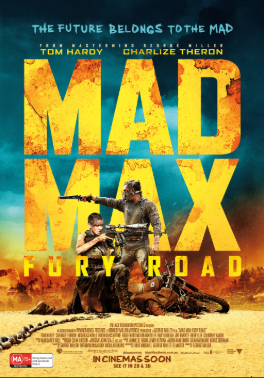
Behind the film
- Year
- 2015
- Director
- George Miller
- Writers
- George Miller, Nicholas Lathouris, Brendan McCarthy
- Runtime
- 2h 0m
- Genres
- Action, Adventure, Science fiction, Dystopian
- Production
- Kennedy Miller Mitchell, RatPac-Dune Entertainment, Village Roadshow Pictures
- Country
- Australia, United States
- Cast
- Tom Hardy, Charlize Theron, Nicholas Hoult, Josh Helman, Nathan Jones, Zoë Kravitz, Rosie Huntington-Whiteley, Riley Keough
About the film
Contains story spoilers.
Mad Max: Fury Road opens with Max Rockatansky trying to survive alone in a landscape where nearly everything has become a resource to seize. He is captured by the War Boys, the pale, fanatically obedient soldiers of Immortan Joe, and kept as a blood donor for Nux, a young driver who believes dying in battle may earn him a place in Valhalla. Max’s body is treated as equipment, just like the cars, fuel and weapons around him. The situation changes when Imperator Furiosa drives a heavily armoured War Rig away from Joe’s Citadel, carrying a group of women he has kept as wives. What looks like a transport mission becomes an escape with a whole society pursuing them.
The Wasteland has a blunt economy. Joe controls water from the Citadel and distributes it in brief bursts to the desperate crowd below, making basic survival depend on obedience. Gasoline and ammunition are also political power, so the pursuit pulls in the people who control the Bullet Farm and Gas Town. The War Boys’ belief system gives the machinery a ritual edge: they decorate their vehicles, shout battle cries and imagine violence as a route to honour. Miller does not pause for a detailed history of how everything collapsed. Instead, the world is explained through its rules in action: who can hoard, who must beg, and how quickly scarcity becomes a weapon.
Furiosa is not simply a guide hired to help Max. She has made the escape possible by risking her position inside Joe’s system, and her connection to the women gives the journey its purpose. The group includes Splendid, Toast, Capable, the Dag and Cheedo, each with different ways of responding to danger and captivity. Max initially treats them as temporary allies and considers leaving, while Furiosa focuses on reaching the Green Place of Many Mothers, the homeland she remembers. Their goals overlap because both are trying to get beyond Joe’s reach, but trust grows slowly. Furiosa’s one-armed driving and her command of the War Rig tell us how much of her identity has been shaped by surviving this world.
Nux’s place beside Max makes the chase more than a contest between pursuers and escapees. He has been raised to think that sacrifice for Joe is the highest form of life, and he wants his first major run to prove that he belongs. When his pursuit fails and the escapees take him along, his certainty is unsettled by ordinary human contact, especially Capable’s patience. Max, meanwhile, begins to understand that helping these people is not a distraction from survival. After he sees Furiosa risk herself and the women keep moving despite their fear, he returns to the group with a plan. The film lets changed behaviour emerge from choices under pressure rather than from long explanations.
The chase briefly leads to the Vuvalini, the older women who survived after the Green Place was lost. Their arrival reveals that Furiosa’s remembered home no longer exists as she knew it. The news is devastating because the escape has been aimed toward a destination that has vanished. Max proposes a reversal: instead of fleeing deeper into the Wasteland, they should take the Citadel, where clean water and growing space could sustain people. This turns the structure of the movie back on itself. The road has carried the characters away from the source of control; now they must return through it, transforming flight into an attempt to change who holds power.
That return also clarifies Max’s position. He is still a drifter, not a conventional leader asking for a throne, but he contributes experience and practical judgment when the others need a route through the pursuing forces. Furiosa takes the hardest personal risk, confronting Joe directly, while the women use the War Rig and the gathered allies to keep the chase from becoming a simple one-way slaughter. Nux, once desperate to die gloriously, chooses to help stop the pursuing vehicles even though it costs him his life. The moment completes his change without erasing the damage his belief system caused. What matters is the final action he chooses for other people.
The filmmaking makes geography and direction unusually easy to follow amid the noise. John Seale’s camera holds the vehicles near the centre of the wide frame, so movement across the desert remains readable, and the repeated outward rushes and returns give the chase a clear path. Engines, percussion and Junkie XL’s score turn the convoy into a moving soundscape, while the different silhouettes of the War Rig and pursuit vehicles make each machine feel connected to the group using it. The action is energetic, but the point of each manoeuvre stays visible: defend a person, clear a route, reach a vehicle or prevent the enemy from taking back control.
When Furiosa returns to the Citadel with Max and the women, the crowd lifts them upward and Joe’s regime collapses with him. Max gives Furiosa a quiet gesture of acknowledgement, then disappears into the crowd rather than taking a place beside her as ruler. The ending offers an opening, not a full reconstruction of society: people gain access to water and the fortress changes hands, while the Wasteland beyond remains dangerous and uncertain. The film’s arc is therefore less about Max winning a personal victory than about a solitary survivor becoming willing to help others create a possibility he will not stay to own. The chase ends at the source of power, where the survivors can decide what it becomes.