
Behind the film
- Year
- 1931
- Director
- Fritz Lang
- Writers
- Thea von Harbou, Fritz Lang
- Genres
- Thriller, Film noir, Drama
- Production
- Nero-Film
- Country
- Germany, Weimar Republic
- Cast
- Gustaf Gründgens, Peter Lorre, Otto Wernicke, Theodor Loos, Inge Landgut, Ellen Widmann, Friedrich Gnaß, Fritz Odemar
About the film
Contains story spoilers.
M makes a city's response to violence as important as the search for the person responsible. Fritz Lang's 1931 film enters through children and everyday routines, establishing the vulnerability of ordinary life before expanding into institutions, streets and organised surveillance. Its dread comes partly from a widening field of attention: a crime affects not only a victim and an investigator but families, neighbours, businesses and people whose own activities make police scrutiny unwelcome. The film's central question gradually changes from where the murderer can be found to what the people who find him will consider themselves entitled to do.
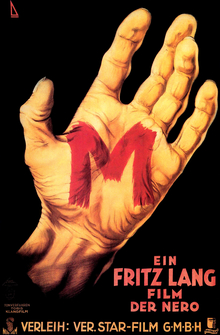
Children are being murdered in Berlin, and both the police and the criminal underworld organise searches. A blind balloon seller recognises Hans Beckert's whistle. Beggars track him, mark his coat with an M and help the criminals corner him in an office building. Brought before their improvised tribunal, Beckert pleads that he cannot control his compulsion. The criminals demand his death; his defender disputes their authority and the justice of that response. Police intervene before the mob kills him. A formal court scene follows without revealing its verdict, and grieving mothers insist that punishment cannot restore their children. Detection supplies a suspect, but the story withholds a reassuring conclusion about the loss.
The parallel searches give the film a structure more unusual than a single investigator's progress through clues. Police and criminals work on opposite sides of the law, yet each group can organise people, share information and turn streets into a network. Their meetings expose common methods without making their motives identical. The criminals' interest in ending disruption to their business complicates the protection they claim to offer. Lang uses that overlap to unsettle a comfortable division between disciplined authority and disorderly wrongdoing. Organisation alone says little about the legitimacy of the power it enables, or about what those who possess it intend to protect.
Sound provides a particularly precise answer to the problem of recognition. Beckert's whistle can identify a presence before a face is visible, making listening a form of knowledge with consequences for the pursuit. A blind character's recognition challenges the assumption that the most useful evidence must be visual. The chalk letter then turns that audible clue into something watchers can see and follow. These are film-specific devices rather than general instructions about investigation. Their connection demonstrates how the medium can transfer information between senses, characters and viewers, making a repeated sound feel increasingly charged without explaining its significance afresh every time.
The chase that follows becomes a lesson in point of view. The criminals pursue Beckert through an office building, searching rooms and stairwells while the film tracks the movement of people across floors. The building is not just a backdrop; its doors, windows and passages determine whether he can hide. Lang uses long movements and carefully connected spaces to make the audience understand the search as geometry. Tension comes from knowing that the pursuers are closing in, while Beckert's awareness of them remains incomplete.
Peter Lorre's Beckert makes the tribunal difficult to reduce to a satisfying exposure of evil. His distressed account of compulsion does not reverse the gravity of the crimes or require the audience to excuse them. It introduces a question about responsibility inside a setting whose judges have already decided what outcome they want. The performance places terror and the demand to be heard alongside the knowledge of terrible harm. That discomfort is deliberate. The movie can recognise a person's desperation without treating it as a diagnosis, a defence it has proved, or a reason to forget the families whose losses brought the pursuit into existence.
The improvised court changes the relationship between spectatorship and punishment. A crowd organised around certainty can make a proceeding look authoritative even when it has no lawful standing. Beckert's defender exposes that weakness, but the argument does not give anyone an easy escape from the demand to prevent further harm. Lang keeps the competing claims visible: protection, vengeance, culpability and the limits of private judgment. The eventual arrival of the police ends an immediate threat to the prisoner without establishing that institutions can repair everything the film has shown. An orderly transition to legal process cannot undo the absence with which the story began.
The final return to grieving mothers prevents the hunt from becoming the only measure of the film's meaning. Finding a culprit answers an urgent practical question, but the answer does not recover the lives lost. This is why withholding the formal verdict matters: the movie resists making a sentence the emotional solution to a community's fear and pain. Its fictional city remains a place where people must decide how to live with one another after the spectacle of pursuit ends. M uses the resources of an early sound film to make that unresolved responsibility audible, spatial and public, rather than enclosing it in a single detective's achievement.