
Behind the film
- Year
- 1970
- Director
- Arthur Hiller
- Writers
- Erich Segal
- Genres
- Romance, Drama
- Production
- Paramount Pictures
- Country
- United States
- Cast
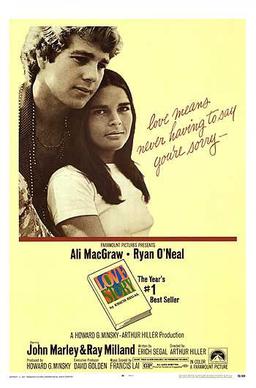
- Ali MacGraw, Ryan O'Neal, John Marley, Ray Milland, Tommy Lee Jones, Sydney Walker, Russell Nype, Katharine Balfour
About the film
Contains story spoilers.
Harvard student Oliver Barrett IV meets Radcliffe music student Jenny Cavilleri. Their attraction crosses a class divide: his father opposes the marriage and withdraws support, while her father Phil welcomes him. Jenny gives up a Paris scholarship, marries Oliver and teaches while he attends law school. After graduation, they move to New York and plan a family. Medical tests reveal Jenny is terminally ill. Oliver initially conceals the diagnosis, but she learns it herself. He borrows money from his estranged father for care without explaining why. Jenny reassures Oliver that she does not regret their life together, then dies in his embrace. Outside the hospital, his father finally understands the request. Oliver responds with Jenny's remembered language of love and walks alone to the skating rink.
Arthur Hiller's film begins from loss, so the romance unfolds beneath knowledge that its future will not remain open indefinitely. That structure changes the function of the early scenes. They are not simply steps towards an outcome the audience hopes to secure; they become a record of a particular person's presence and of how two lives start organising themselves around each other. The approach gives ordinary pleasures a second meaning without requiring every moment to announce impending tragedy. A joke, an argument or a comfortable exchange can matter because it belongs to a relationship whose texture is being remembered. The story's emotional force depends on allowing that texture to develop before the illness becomes its dominant circumstance.
Ali MacGraw's Jenny does not enter as someone quietly impressed by Oliver's position. Her wit gives the courtship a lively resistance, challenging the assumption that wealth ought to make its owner automatically interesting. That matters to the relationship's balance. Ryan O'Neal's Oliver has advantages, but advantage cannot purchase the particular recognition he wants from her. Their teasing permits attraction to coexist with independence, making affection something negotiated between people rather than bestowed by the more privileged one. Jenny's directness also gives the later drama a voice that can resist being spoken for. The character's significance is not confined to how much she means to Oliver; her own responses establish the terms on which their life together is understood.
Oliver's conflict with his father turns the romance into a question about adulthood. Financial dependence allows parental authority to extend into decisions a grown child regards as his own, while resistance can become bound up with a desire to prove independence. Ray Milland's elder Barrett gives that authority a formal presence, one associated with standards Oliver experiences as restrictive. The film keeps the conflict personal rather than treating class as an abstract subject only discussed by strangers. Expectations are conveyed through family relationships, making departure from them emotionally expensive even when Oliver believes the departure necessary. Choosing Jenny becomes a declaration, but declarations do not immediately supply the resources or maturity required to sustain the life they announce.
John Marley's Phil offers a contrasting form of fatherhood. His affection is less invested in maintaining a prescribed social order, giving the couple another example of what support can look like. Yet the difference does not mean family ties become uncomplicated as soon as someone is kind. A parent can welcome a child's choice while still holding wishes, concerns and a history of loss. Phil's place in the story makes Jenny's background tangible beyond a label of working-class independence. She belongs to a relationship that existed before Oliver and continues to matter after marriage. The film's emotional world is consequently broader than a couple separating themselves from everyone else; their choices alter bonds whose significance does not disappear merely because a new household has begun.
The shared life makes love material through work and constraint. The ability to choose each other is only one part of the relationship; daily arrangements determine how that choice is lived. Erich Segal's screenplay keeps attention on the unequal circumstances surrounding a supposedly equal commitment. Time, money and aspirations become things the pair must distribute, and the distribution gives affection a practical cost. That does not automatically make sacrifice noble or regrettable. It makes it a decision whose meaning belongs partly to the person making it. Jenny's voice is important because an outsider's account of what she has surrendered cannot fully establish how she understands the life she has chosen.
Illness changes the kind of control Oliver can imagine exercising. Earlier obstacles invite action: he can disagree, work, study or seek a different arrangement. The later crisis cannot be met with the same confidence that effort will produce the desired outcome. That change gives his love a difficult task. Wanting to protect Jenny may lead him to manage information or circumstances, while her own awareness asks him to remain present with something neither can solve. The drama is interested in the distance between caring for a person and trying to control the terms under which they encounter reality. It lets fear complicate loving behaviour without making fear the final authority over what the other person is permitted to know.
Francis Lai's score gives the film an openly romantic emotional language, joining Hiller's direction in allowing feeling to occupy the foreground. The sincerity matters because the story is not attempting to outwit its own sadness. Its famous assurance about love and apology belongs to the characters' experience, a phrase invested with memory rather than a universal instruction for every relationship. The ending preserves the difference between a life shared and the loneliness that follows its loss. Family understanding may become possible, but it cannot restore what is gone. Love Story leaves Oliver with the significance of the person he knew, showing how affection can remain central to a life even when it no longer offers a future that two people can enter together.