
Behind the film
- Year
- 2003
- Director
- Richard Curtis
- Writers
- Richard Curtis
- Runtime
- 2h 15m (home-video version)
- Genres
- Romantic comedy, Christmas, Tragicomedy
- Production
- Working Title Films, DNA Films, Universal Pictures
- Country
- United Kingdom, United States, France
- Cast
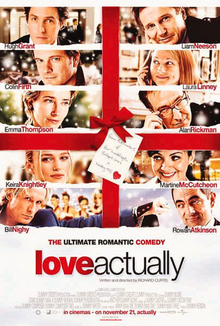
- Hugh Grant, Emma Thompson, Alan Rickman, Liam Neeson, Colin Firth, Laura Linney, Bill Nighy, Keira Knightley
About the film
Contains story spoilers.
Love Actually spreads its story across London in the five weeks before Christmas, using the approaching holiday to bring very different relationships into the same frame. Richard Curtis’s film opens with people greeting one another at Heathrow, then moves into private situations that are much harder to read from the outside. A wedding looks joyful, a political appointment looks impressive, and a family appears to be preparing for an ordinary Christmas. Behind those public events are concealed attachments, grief and decisions that will alter what home means. Some characters know one another directly: Prime Minister David is Karen’s brother, and Karen knows Daniel, whose wife has died. Other connections emerge through workplaces, a school performance and the airport.
David’s arrival at Downing Street introduces a romance complicated by position and embarrassment. He is attracted to Natalie, a member of the household staff, but handles the feeling badly after seeing the visiting American president behave inappropriately toward her. Natalie is moved away from his immediate workplace, leaving her affected by a decision made from above. A Christmas card eventually prompts David to look for her, knocking on doors in her neighbourhood before finding her family. They reach a school nativity performance where their kiss is accidentally exposed to the audience. The scene gives the relationship a very public beginning, in contrast with the guarded way David has tried to manage it inside his official residence.
Karen’s household supplies a much less comfortable Christmas revelation. Her husband Harry is encouraged by the attention of his colleague Mia, who makes clear that she expects a gift. Karen discovers an expensive necklace and assumes it is for her, only to receive a Joni Mitchell CD instead. Alone in her bedroom, she tries to absorb what that difference means before returning to the family celebration. Later she asks Harry whether the discovery should make her feel foolish or change her understanding of the marriage. The film does not establish that a single confrontation has repaired them. Their later airport meeting is civil, but carries uncertainty that sits beside the more triumphant reunions happening around it.
Daniel and his stepson Sam are learning to live after the death of Sam’s mother. Daniel initially worries that the boy’s silence is entirely about bereavement, then discovers he is also in love with schoolmate Joanna. Sam learns the drums so he can be part of her Christmas performance, giving the pair a project to work on together. When Joanna is about to fly back to America, they hurry to Heathrow, where Sam makes a last attempt to speak to her. Another relationship develops across a language barrier: writer Jamie, hurt by his girlfriend’s affair with his brother, retreats to France and meets Portuguese housekeeper Aurélia. Their attachment grows through gestures, work and a mishap with his manuscript before either can explain it fluently.
The film also includes feelings that cannot easily turn into a shared future. Mark has been distant toward Juliet, his best friend Peter’s new wife, because he is secretly in love with her. His wedding footage exposes the attachment through what he chose to film. He later visits with cue cards to confess without drawing Peter into the conversation, and Juliet briefly kisses him before returning inside. At Harry’s company, Sarah finally has a chance to be with Karl, but repeated calls from her brother Michael interrupt the evening. Her responsibility toward him occupies emotional space that attraction cannot simply displace. These stories leave different kinds of unfinished business, rather than making every confession the beginning of a couple.
Billy Mack’s Christmas single provides a running comic thread whose ending belongs to friendship. He promotes a seasonal novelty record with blunt irreverence, while manager Joe patiently tries to keep the campaign together. After the song succeeds, Billy chooses to spend Christmas with Joe instead of remaining at a celebrity party. His recognition is about the person who has been there through his working life. Meanwhile, film stand-ins John and Judy are comfortable with the simulated intimacy their job requires but shy about arranging a real date. Colin takes his frustration with British dating to America and receives the exaggerated welcome he hoped for. The contrast between these stories lets affection appear as loyalty, awkwardness and comic fantasy as well as grand romance.
Christmas brings several threads together at the school concert, but the closing airport sequence happens later, allowing the film to show what followed the holiday’s declarations. Jamie has learned enough Portuguese to propose to Aurélia, who has been learning English herself. David and Natalie are openly reunited, Sam sees Joanna again, and Harry returns to a family whose confidence he has damaged. The ensemble format makes those outcomes coexist instead of asking one to settle the meaning of all the others. Music, rehearsal, shopping and journeys supply ordinary occasions for people to reveal themselves. Curtis’s London is deliberately crowded with coincidences, yet the varied endings keep the season from promising that every attachment will be rewarded in the same way.