
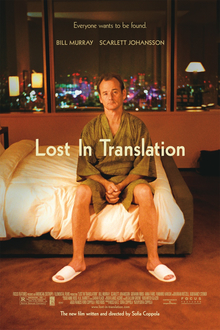
Behind the film
- Year
- 2003
- Director
- Sofia Coppola
- Writers
- Sofia Coppola
- Runtime
- 1h 42m (home-video version)
- Genres
- Romantic comedy, Independent, Drama
- Production
- American Zoetrope, Tohokushinsha Film
- Country
- United States, Japan
- Cast
- Bill Murray, Scarlett Johansson, Giovanni Ribisi, Anna Faris, Fumihiro Hayashi, Akiko Takeshita, Catherine Lambert, Matthew Minami
About the film
Contains story spoilers.
Lost in Translation follows two Americans occupying the same Tokyo hotel at very different points in their lives. Bob Harris is an established actor being paid to appear in a whisky campaign. Charlotte is a recent graduate accompanying her photographer husband John, whose work keeps drawing him away. Neither can sleep properly, and neither feels that the life waiting beyond the trip is as secure as it should be. The hotel provides comfort without much purpose: rooms, lifts, a swimming pool and a bar become places to pass time rather than destinations. Their first encounters are almost incidental, but repeated recognition gives each a familiar face in surroundings where they feel unusually detached.
Bob’s work makes that detachment comic before it becomes personal. On the commercial set, an elaborate direction in Japanese is reduced to a brief instruction by the interpreter, leaving him unsure how much he has missed. A publicity appearance puts him inside an energetic television performance he can barely follow. He is valued as an image, while the people paying for that image do not need to know what he thinks of the assignment. Calls and messages from his wife bring household decisions and marital frustration into the hotel room. Even from the other side of the world, he remains part of a family routine that seems to carry on without needing his attention in the way it once did.
Charlotte has more time and fewer demands, but that freedom does not give her a direction. She watches the city from her window, visits places on her own and struggles to explain why she feels so unsettled. John is affectionate yet absorbed in his work, and his easy conversation with actress Kelly makes Charlotte feel more distant from the world he moves through. Her uncertainty is not simply about whether she loves him. She is also trying to imagine who she might become after education, at an age when other people’s careers can look like evidence that they have already answered the question. Bob’s tired familiarity with professional success gives her someone who can hear that uncertainty without treating it as a quick problem to fix.
Their friendship grows when they leave the hotel together. Charlotte invites Bob out with friends while John is away on assignment, and the evening moves through crowded nightlife and karaoke. Singing gives them a way to perform feelings indirectly, in contrast with the awkward explanations they have been making in private. Bob can be playful without the obligations of an advertising shoot, and Charlotte becomes more active than the person watching through glass at the hotel. Their connection then settles into smaller shared moments: drinks, television and a conversation while lying together unable to sleep. They discuss marriage, children and the difficulty of knowing what to do next, but the talk provides company more readily than certainty.
The relationship is close enough that an unexpected interruption hurts. After a strained call with his wife, Bob spends a night with a singer from the hotel bar. Charlotte hears the woman in his room the next morning, and their lunch together becomes uncomfortable. Neither has established a clear set of commitments to the other, yet the discovery exposes how much she had begun to rely on their private understanding. The film allows that jealousy to exist without converting it into a conventional demand that Bob choose between two partners. They meet again and recover some of their ease, knowing his departure is approaching. A final evening at the bar now carries a deadline that their earlier wandering did not have.
The goodbye in the hotel is sincere but incomplete, conducted in a public place where the encounter cannot easily have the privacy it needs. On the way to the airport, Bob sees Charlotte walking through a crowd and stops the car. He finds her, embraces her and whispers into her ear before they kiss and part. The words are not made intelligible to the audience, so the scene does not supply a secret explanation of their future or a promise that they will meet again. What changes is the manner of leaving: they have a moment that belongs to them rather than to the hotel’s traffic. Bob continues his journey, and Charlotte remains in Tokyo, each returning to circumstances the friendship has illuminated without resolving.
Sofia Coppola writes and directs, with Bill Murray and Scarlett Johansson making pauses, glances and uneven conversations carry much of the relationship. Lance Acord’s photography places the hotel’s quiet interiors above a busy city, giving the characters both a view and a distance from it. The film’s Tokyo is experienced through visitors who often lack the language and attention to understand people around them; their confusion is part of their perspective, rather than a complete description of the city. Music helps move between that insulated hotel life and evenings outside. The story has few large external obstacles because its changes happen through an accumulation of time spent together. A temporary friendship becomes significant precisely while the trip, the work and the marriages remain ordinary facts that will continue after the final embrace.