
Behind the film
- Year
- 2012
- Director
- Rian Johnson
- Writers
- Rian Johnson
- Runtime
- 1h 58m
- Genres
- Science fiction, Crime thriller, Action, Dystopian
- Production
- TriStar Pictures
- Country
- United States, People's Republic of China
- Cast
- Joseph Gordon-Levitt, Bruce Willis, Emily Blunt, Paul Dano, Noah Segan, Jeff Daniels, Pierce Gagnon
About the film
Contains story spoilers.
Looper makes an encounter with your future self a conflict rather than an opportunity to receive useful advice. The two Joes possess a connection that nobody else can share, yet that connection does not give them the same priorities. One has lived through experiences the other still considers possibilities. Each therefore sees something incomplete in the man across from him, and neither can simply transfer his understanding to the other. The time-travel device becomes a way of giving self-interest two bodies, forcing a person to confront how differently the future can look once its comforts or losses have actually been lived.
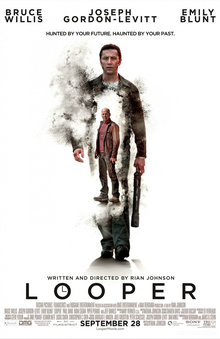
Rian Johnson wrote and directed the 2012 film, with Joseph Gordon-Levitt as the younger Joe, Bruce Willis as his older self and Emily Blunt as Sara. Its criminal future sends victims into an earlier era for execution. The arrangement makes a speculative technology part of an ugly routine rather than a promise of exploration. For the protagonist, extraordinary possibilities have been reduced to employment, payment and the expectation of a limited working life. That starting point matters because the story's moral problem emerges from a system he has accepted as ordinary, not from a discovery that suddenly makes an otherwise innocent life dangerous.
In 2044, Joe fails to kill his older self and is hunted by his employer's men. Older Joe wants to prevent the future death of his wife, killed during a roundup of loopers, by murdering the child who will become the crime boss known as the Rainmaker. Younger Joe reaches Sara's farm and encounters her telekinetically powerful son Cid. When the older man threatens them, Joe recognises that killing Sara could create the trauma behind Cid's violent future. He kills himself, erasing his older self and interrupting that immediate chain of harm. The ending leaves the child alive with his mother.
The younger man's difficulty is that a future self can make a demand sound both personal and alien. The grief belongs to somebody he will become, but it concerns a relationship he has not yet formed. He cannot respond to it with the older man's emotional certainty, and the older man cannot regard his younger counterpart's present priorities as sufficient. Their conflict makes continuity feel unstable. Being connected across time does not mean that a person's earlier and later choices will agree, particularly when each version treats the part of life available to him as the part that matters most.
Older Joe's determination places a remembered loss against people whose lives remain open. To him, preventing the future supplies a reason to act before its cause has fully emerged. The danger lies in treating a possibility as an established identity, so that a child becomes the object of punishment for an adult he has not yet become. The film's ethical pressure does not require a complete solution to every paradox in its time travel. It requires attention to what certainty permits somebody to do once he believes he knows enough about the future to judge a person in the present.
Sara's role gives that present a form the pursuit has threatened to overlook. The farm is a household rather than a location on a plan, and the child is part of a relationship that cannot be understood solely through the danger he might represent. Care becomes a competing way of responding to uncertainty. Where the older Joe wants to remove a possible outcome, the family relationship offers conditions under which an outcome might change. That difference makes the quieter part of the film essential to its resolution, because somebody has to recognise a life before deciding what its future is entitled to contain.
The contrast between criminal routine and domestic vulnerability also changes the scale of the action. Violence that began as work acquires consequences that cannot be settled through completing an assignment. The two Joes are drawn towards different definitions of what completion would mean, while the people around them face risks created by an argument they never chose to enter. Johnson keeps the speculative premise connected to that imbalance. The person attempting to correct his own history can become a threat to another person's history, making the imagined repair dependent on somebody else's loss.
The final act ends the pursuit by refusing to let the older man's certainty continue governing it. It is a tragic fictional resolution, not a model for handling grief or a claim that self-destruction repairs real lives. Within the story, the choice changes Joe's relationship to his own future: instead of protecting the version he has imagined, he prevents that version from imposing its loss on a family. Looper closes around responsibility in the present, making its most consequential alteration concern the treatment of people who still have a future rather than the restoration of somebody who believes his future has already been taken.