
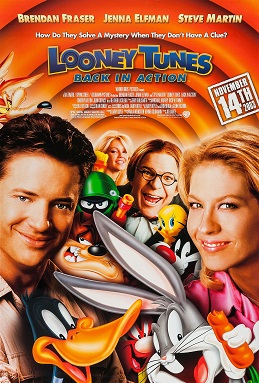
Behind the film
- Year
- 2003
- Director
- Joe Dante
- Writers
- Larry Doyle
- Genres
- Science fiction, Spy, Parody, Fantasy
- Production
- Warner Bros. Entertainment
- Country
- United States, Germany
- Cast
- Brendan Fraser, Jenna Elfman, Steve Martin, Timothy Dalton, Heather Locklear, Joan Cusack, Joe Alaskey, Bill Goldberg
About the film
Contains story spoilers.
Tired of playing the villain opposite Bugs Bunny, Daffy demands his own film and is fired by Warner Bros. executive Kate Houghton. Security guard and aspiring stuntman DJ Drake escorts him off the lot, but their chase damages the studio water tower and gets DJ fired too. At home, DJ learns that his father, actor Damian Drake, is a secret agent captured by Acme's chairman. A message sends DJ and Daffy after the Blue Monkey diamond; Kate and Bugs join the pursuit. Clues lead them from Las Vegas to the Louvre and then an African temple, where the Chairman secures the diamond and plans to turn humanity into monkeys. The heroes foil his satellite weapon, rescue Damian and return to Warner Bros., where they discover their adventure was staged as a film. Bugs promises Daffy equal billing before the picture interrupts its own sign-off.
The live-action and animated worlds share the same screen without asking the audience to choose which one is real. The Warner Bros. lot is both an actual workplace for Kate and DJ and an environment in which cartoon characters can appear as colleagues, performers or sources of trouble. That arrangement allows the film to joke about studio authority while still treating the characters' emotional conflicts as meaningful. Daffy wants creative recognition; Kate faces pressure to protect the studio's work; DJ wants the chance to become a stunt performer. Their motives differ, but the workplace turns them into partners before any international conspiracy enters the picture.
Daffy's resentment is a useful engine because the movie understands that he is funny in a way that can also make him hard to share a frame with. He is tired of being cast as the antagonist, yet his attempts to leave the role often create fresh disorder. The film allows his need for recognition to stand beside his vanity rather than resolving one into the other. Bugs, by contrast, can seem effortlessly in control, and the contrast gives their familiar rivalry a new question: can they work together without making Daffy permanently secondary? Their comic rhythm depends on that imbalance: Bugs can wait for a straight man's impatience to become ridiculous, while Daffy tries to force the scene to acknowledge him. The promise at the end has weight because the story has kept that imbalance visible throughout.
Joe Dante builds the adventure from references to movie language and cartoon logic. The spy plot gives the characters a route through familiar action-film spaces, while animated physics repeatedly bend those spaces into jokes. A chase can pass through a painting or a studio boundary without needing to establish realistic consequences first. The live performers provide a physical anchor for those transitions; Brendan Fraser's earnest stuntman persona lets the animated characters act as if his reactions are normal. Jenna Elfman's Kate often supplies the opposite energy, trying to impose an executive's sense of order on a world that refuses to stay in one medium.
The movie's geography becomes a playground for different kinds of visual comedy. The Warner lot introduces doors, stages and workplace routines, while the journey moves through a casino, an art museum and an imagined African setting. These places are not simply backdrops for the diamond chase. Each gives the animation a new visual vocabulary, especially in the Louvre sequence, where paintings become spaces a character can enter and disrupt. The film enjoys the collision between a recognizable institution and a cartoon's permission to ignore the rules of architecture, gravity and perspective.
The animation must match live-action timing closely enough that a pause or glance can carry a joke across the divide. Daffy's movements are sharp and elastic, while Bugs often relies on a calmer stillness that makes the sudden gag more effective. The contrast resembles the different rhythms of their personalities: Daffy pushes for attention, Bugs waits for the situation to reveal its absurdity. The animators and performers have to coordinate eye-lines, object handling and reaction time so that a character who is not physically present still feels like a partner in the scene. A hand reaching for a prop or a human actor turning to listen supplies a shared beat that makes the impossible interaction feel composed rather than pasted together. The resulting craft keeps the comedy grounded in interaction rather than treating the cartoon figures as overlays.
The self-aware studio setting gives recognition two meanings. A performer wants to be noticed, while an audience wants to recognise the personality that made the performer familiar. Those wishes can conflict when familiarity becomes a permanent limit on what a character is allowed to do. Daffy's resentment keeps that conflict lively because his desire for fairness remains tangled with an enormous appetite for attention. The film need not make him modest to take his frustration seriously. Its comic world allows rivalry and cooperation to occupy the same frame, with the live-action adventure supplying another place to test their balance. What makes the mixture understandable is interaction: each impossible event still has someone wanting something, someone obstructing it and someone finding a joke in the collision.