
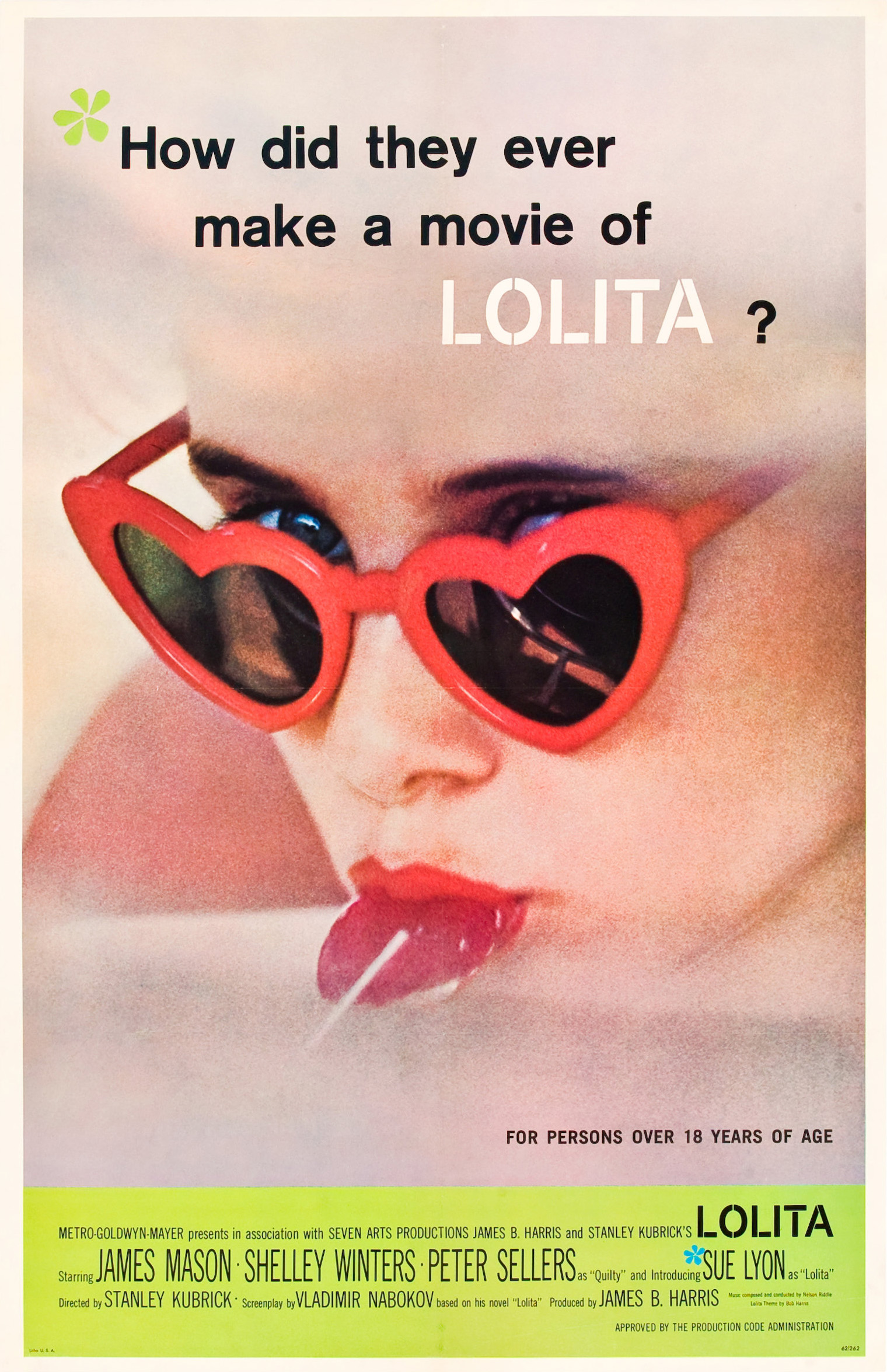
Behind the film
- Year
- 1962
- Director
- Stanley Kubrick
- Writers
- Vladimir Nabokov
- Runtime
- 2h 32m
- Genres
- Romance, Comedy drama, Drama
- Production
- Seven Arts Productions
- Country
- United Kingdom, United States
- Cast
- James Mason, Shelley Winters, Sue Lyon, Peter Sellers, Lois Maxwell, Marianne Stone, Cec Linder, Shirley Douglas
About the film
Contains story spoilers.
The film begins with Humbert killing Clare Quilty, then returns to his arrival at Charlotte Haze’s home. He marries Charlotte to remain near her adolescent daughter Dolores. Charlotte discovers his diary, runs into the road and dies in an accident. Humbert collects Dolores from camp, initially conceals the death and begins an abusive relationship while travelling publicly as her guardian. At Beardsley, his jealous control intensifies, and Quilty intrudes under disguises. Dolores disappears from hospital with Quilty. Years later, now married and pregnant, she asks Humbert for money and explains that Quilty exploited her hopes before she refused his demands. She rejects Humbert’s wish to resume their relationship. He gives her the proceeds from her mother’s house and seeks Quilty. A final notice states Humbert dies awaiting trial.
Stanley Kubrick makes Humbert’s respectable presentation part of the story’s difficulty. James Mason gives him fluency, formality and the ability to make distress sound like an unusually refined feeling. Those qualities can attract attention to the speaker’s predicament while obscuring the conditions he has imposed on someone else. The film’s central challenge is therefore how to listen without mistaking eloquence for innocence. An adult’s account of wanting something may be emotionally elaborate and still conceal a refusal to recognise another person’s independence. Humbert’s cultured manner does not exist apart from the abuse; it helps him arrange an account in which his own disappointment occupies the centre.
Charlotte’s household gives that arrangement an ordinary social setting. Shelley Winters makes the wish for companionship awkward and vulnerable, so the home cannot be reduced to a convenient stopping place in Humbert’s travels. Different people imagine different futures within it, and their assumptions allow him to pursue a purpose he has not honestly disclosed. The discomfort of the domestic comedy comes partly from that unequal knowledge. An audience can see how much a misunderstanding matters while the people participating in it continue to negotiate invitations, attention and approval. The apparently small social transaction carries weight because somebody is using it to obtain access under false pretences.
Sue Lyon’s Dolores must be understood separately from the identity Humbert’s attention assigns her. The nickname in the title can encourage a reader or viewer to encounter a figure already shaped by his fantasy, while the character has a name, a mother and a life that cannot be exhausted by that framing. The film does not offer an uncomplicated escape from the adult perspective, making the distinction especially necessary. Apparent confidence or adolescent defiance cannot create equality with a guardian who controls money, movement and access to other people. The dramatic problem lies in that power, not in treating the child as responsible for an adult’s behaviour.
Peter Sellers’s Quilty destabilises Humbert through performance of another kind. A shifting manner can make an exchange funny while leaving its purpose difficult to locate, and Humbert cannot rely on his usual confidence when someone else controls the conversation’s terms. The result is an uneasy competition between adults skilled at presentation. Their differences do not establish one as a morally reassuring alternative to the other. Each can treat another person’s life as material for his own purposes. Sellers’s comic unpredictability makes that danger appear through evasions and changes of register, showing how entertainment can prevent a listener from obtaining a straightforward answer.
The journey across apparently respectable spaces exposes the limits of appearances. A guardian and child can pass through a public environment under a recognisable description that discourages further questions. Hotels, roads and schools offer forms of ordinary legitimacy without necessarily providing knowledge of what is happening inside a relationship. Kubrick allows that gap to become part of the world rather than a single character’s secret. A setting can look socially supervised while leaving the vulnerable person without an effective witness. The film’s black-and-white photography, credited to Oswald Morris, gives the outward order a clarity that does not make the relationships beneath it equally clear.
Its comedy is troubling because laughter and judgment need not arrive together. A ridiculous adult can still exercise damaging power, and a scene’s wit does not remove the consequences of what it conceals. Kubrick’s use of awkwardness lets the audience recognise vanity, embarrassment and social performance without granting those recognitions the status of justice. The film is an adaptation with Vladimir Nabokov’s credited screenplay, not a neutral case history or a complete substitute for the novel’s narrative voice. Its particular balance of satire and restricted perspective determines what can be seen directly, and what the audience has to identify beneath the explanation an adult offers.
The later refusal gives Dolores a future Humbert cannot author simply by wanting it. That boundary matters more than his ability to describe loss convincingly. A story organised around an abusive person can make his emotional collapse seem like its final significance, but the damage is not measured only by what he ultimately suffers. His ending cannot retroactively turn control into devotion, and violence against a rival cannot restore the life he has constrained. The film’s difficult legacy within its own story is the persistence of an adult’s preferred account after its justification has failed. Understanding the perspective requires seeing what it excludes, particularly the independence of the person it has tried to possess.