
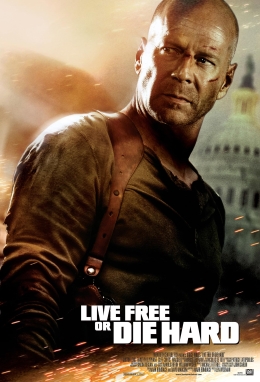
Behind the film
- Year
- 2007
- Director
- Len Wiseman
- Writers
- Mark Bomback
- Genres
- Action, Action thriller, Buddy, Buddy cop
- Production
- Cheyenne Enterprises, RatPac-Dune Entertainment, Ingenious Media
- Country
- United States
- Cast
- Bruce Willis, Justin Long, Timothy Olyphant, Cliff Curtis, Maggie Q, Mary Elizabeth Winstead, Kevin Smith, Edoardo Costa
About the film
Contains story spoilers.
John McClane starts Live Free or Die Hard with a task small enough to look inconvenient rather than heroic: collect a hacker wanted for questioning and deliver him to the authorities. The apartment becomes a target before the handover can happen, and McClane is suddenly responsible for keeping Matt Farrell alive. Len Wiseman’s 2007 film uses that encounter to bring a familiar detective into a crisis whose mechanisms he does not understand. Bruce Willis’s McClane can recognise a threat and absorb punishment, but the attack spreading across the country needs knowledge that Justin Long’s younger, initially reluctant companion supplies. Their partnership begins with necessity and becomes the film’s most useful form of resistance.
The hacker is not an innocent bystander to every part of the operation. Farrell has contributed code without understanding its intended use, and the people assembling the attack are now eliminating contributors. That makes his expertise both valuable and dangerous. McClane’s immediate job is physical: move, protect, find someone who can explain what is happening. Farrell can identify a larger pattern in the failures around them, but explaining the pattern does not give him control over it. The film’s humour comes from that difference in experience. McClane is unimpressed by the younger man’s assumptions about the world, while Farrell cannot initially imagine volunteering for the ordeals the detective treats as the unavoidable part of stopping someone.
Thomas Gabriel, played by Timothy Olyphant, directs the disruption with the confidence of an expert whose earlier warnings were dismissed. His history inside the government gives him knowledge of weaknesses that he now intends to exploit rather than repair. Traffic systems, communications and financial infrastructure become connected parts of the crisis, allowing a remote decision to produce immediate danger on an ordinary street. The attacks are also theatrical: the public needs to believe that normal authority can no longer function. Gabriel’s resentment supplies a personal explanation for the spectacle, but it does not fully explain the scheme. Destruction is being used to make another operation possible while the people responding are looking elsewhere.
McClane and Farrell’s journey repeatedly turns abstract failures into places they have to cross. Roads become traps, access points become guarded spaces and attempts to obtain help expose them to new attacks. Maggie Q’s Mai combines operational competence with a direct physical threat, making the antagonists more than a set of unseen voices issuing instructions. The power-station confrontation puts McClane’s persistence against a setting filled with machinery and falling hazards. Farrell cannot solve that fight from behind a keyboard, and McClane cannot understand the wider attack by winning it. The action keeps requiring both men to survive the immediate problem before they can make use of what the other knows.
Their visit to the hacker known as Warlock supplies an important connection between Farrell’s earlier work and the government’s emergency arrangements. The system intended to protect records during a catastrophic failure has become the target of the failure Gabriel is creating. The aim is financial theft, with national disruption supplying cover and triggering access to what the attackers want. Kevin Smith’s Warlock also shifts the atmosphere briefly toward an eccentric domestic refuge, though it cannot remain separate from the crisis. The film gives information a practical consequence: a clearer explanation changes where McClane and Farrell need to go and what they must prevent, rather than merely confirming that the villain is clever.
Gabriel’s kidnapping of McClane’s daughter Lucy makes the confrontation personal in a different way. Mary Elizabeth Winstead gives Lucy enough of her father’s stubbornness to resist becoming merely a passive hostage, while her presence leaves him vulnerable to a threat he cannot brush aside. Farrell’s attempt to obstruct the stolen data increases the pressure on both captives. McClane’s pursuit includes a military aircraft attack directed against the vehicle he is driving, turning Gabriel’s control of systems into overwhelming force. By the time the chase reaches its final enclosed confrontation, the national operation and the family rescue have become parts of the same problem: stop the transfer without allowing the people being used as leverage to die.
The final exchange makes McClane’s willingness to take damage decisive, while Farrell also acts rather than leaving the physical danger entirely to his protector. The rescue concludes with exhausted survivors, not a suggestion that McClane has become a computer expert or that Farrell is suddenly comfortable living like him. Their connection works because they have learned to trust different kinds of competence. McClane’s grumbling and bluntness remain, but the film has made clear why he continues when the assignment becomes absurdly larger than anything promised. Someone is still in danger, and the fact that the surrounding system is failing does not remove his responsibility to respond.
Mark Bomback’s screenplay brings the series’ individual-versus-organised-threat structure into a world increasingly dependent on connected technology. Simon Duggan’s photography and the large set pieces emphasise concrete consequences: disrupted roads, industrial spaces and machinery turned against people. Marco Beltrami’s score keeps the pursuit urgent while the exchanges between Willis and Long provide brief relief. The cyberattack is a thriller construction rather than a realistic procedural guide, and the film’s appeal depends on its escalating physical imagination. Underneath that scale is the smaller relationship established at the apartment door: a man sent to collect a stranger stays with him long enough for both to discover that neither can finish the job alone.