
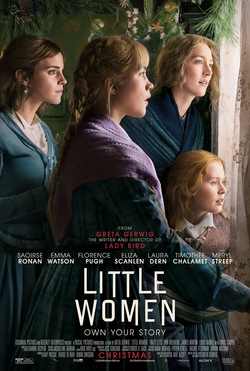
Behind the film
- Year
- 2019
- Director
- Greta Gerwig
- Writers
- Greta Gerwig
- Genres
- Drama
- Production
- Columbia Pictures, Di Novi Pictures, Sony Pictures
- Country
- United States
- Cast
- Saoirse Ronan, Emma Watson, Florence Pugh, Eliza Scanlen, Laura Dern, Timothée Chalamet, Meryl Streep, Louis Garrel
About the film
Contains story spoilers.
Little Women begins from the understanding that a family can be deeply connected without supplying one shared answer to how its members should live. The March sisters want different things, and their closeness makes those differences consequential rather than incidental. Growing up does not simply mean finding a correct path and leaving the others behind. It means negotiating affection alongside choices that may be difficult for a sister to understand. Greta Gerwig's adaptation gives that process the shape of recollection, placing childhood and adulthood near each other so that a later decision can remain connected to the hopes and conflicts from which it emerged.
Gerwig wrote and directed the 2019 film, drawing on Louisa May Alcott's novel and other writing. Saoirse Ronan plays Jo, Emma Watson plays Meg, Florence Pugh plays Amy and Eliza Scanlen plays Beth. Laura Dern plays Marmee, Timothée Chalamet plays Laurie and Meryl Streep plays Aunt March. The film moves between the sisters' younger and older lives instead of presenting their growth as a single uninterrupted progression. That structure lets an audience recognise an earlier possibility inside a later circumstance. A household activity can carry warmth and sadness at once because the viewer knows something its participants have not yet had to learn.
Jo pursues writing while her sisters navigate art, marriage and family life. She refuses Laurie, who later marries Amy; Beth's death changes the household, and Jo turns towards writing its story. A publisher demands a marriage ending while Jo negotiates ownership and payment. The closing movement combines a romantic resolution, a school and the making of her book. The relationship between the narrated ending and Jo's own life remains open to interpretation. That ambiguity makes authorship part of the drama rather than treating publication as a simple reward placed after every personal question has already been settled.
The movement through time is especially important to the family scenes. What appears to be an ordinary moment of togetherness can acquire weight through its relation to a later absence. The past is not merely an explanation delivered before the real story starts. It remains an active comparison, allowing the same home to contain versions of life that cannot all continue. This gives memory a formal role in the film. A viewer is asked to hold several emotional positions together, recognising the pleasure of an earlier experience without being allowed to forget the later experience that changes what remembering it will mean.
Jo's ambition is not simply a preference for writing over romance. It concerns the possibility of directing a life whose available roles have already been shaped by other people's expectations. Yet the film does not make independence a prize that only one sister can win by adopting Jo's choices. Meg's desire for marriage and Amy's account of artistic ambition introduce different negotiations with the same social environment. The important question becomes whether a choice can be respected as someone's own rather than measured only against another person's ideal. The sisters' arguments are valuable because love does not prevent them from mistaking their preferred future for the future another sister ought to want.
Money gives those preferences practical limits. An artistic ambition requires time and opportunity, while marriage can carry financial consequences that are difficult to separate from affection. The film makes those pressures part of the conversation rather than an embarrassment to be removed from it. A person can care about love and still understand that a household must be supported, just as a writer can care about a story and still need to be paid. This gives the world a material shape beneath its remembered warmth. The sisters are not making choices in an empty space where sufficient conviction guarantees that every possibility will become equally accessible.
Beth's place within the family asks for another kind of attention. The life with the least emphasis on public ambition need not become the least significant life. Her presence belongs to the household's relationships, and her loss changes what those relationships can continue to contain. The adaptation's time structure makes that change felt through comparison rather than through a single announcement. An earlier recovery and a later death cannot be merged into one reassuring account. The family has to live with the difference, and Jo's writing becomes one way to give a shared history form without pretending that form can return the person who helped make it.
The negotiation over the book's ending joins the sisters' personal possibilities to the possibilities allowed by a market. A story about women can still be asked to finish according to rules supplied by somebody controlling its publication. Jo's bargaining therefore makes the final object consequential: the book belongs to creative labour as well as to emotional remembrance. Little Women keeps its romantic ending alongside the possibility that an ending has been constructed to satisfy an expectation. That tension gives the film room to celebrate a family and question how its story is packaged, leaving authorship visible as another part of deciding what a life can mean.