
Behind the film
- Year
- 2012
- Director
- Ang Lee
- Writers
- David Magee
- Runtime
- 2h 7m
- Genres
- Fantasy, Drama, Adventure, Magic realist
- Production
- 20th Century Studios, Rhythm and Hues Studios
- Country
- United States
- Cast
- Suraj Sharma, Irrfan Khan, Tabu, Rafe Spall, Gérard Depardieu, Adil Hussain
About the film
Contains story spoilers.
Life of Pi is framed as a story being told. An adult Pi Patel speaks with a writer who has heard that Pi’s life could inspire a novel, then returns to his childhood in Pondicherry. Pi’s father runs a zoo, so the boy grows up around animals and learns early that affection does not make a wild animal safe. He is also curious about religion, exploring Hinduism, Christianity and Islam rather than choosing only one. His family plans to move to Canada and bring some of the zoo’s animals with them, turning the first part of the film into a passage from a familiar home toward a journey whose destination will become uncertain.
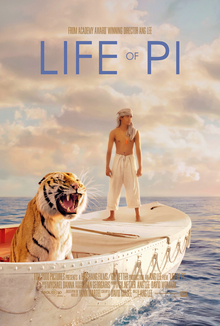
During the crossing, a violent storm sinks the ship. Pi reaches a lifeboat, where a zebra, an orangutan and a hyena are also aboard; the hyena kills the other animals before a Bengal tiger named Richard Parker emerges from beneath the boat’s tarpaulin and kills the hyena. Pi is left sharing the small craft with a predator that could kill him. He climbs onto a makeshift raft attached to the lifeboat and tries to keep distance while managing supplies, weather and thirst. The danger is not abstract: the boat is a cramped space with one animal at its center, and Pi has to respond to Richard Parker’s behavior rather than simply wish the tiger away.
Pi finds emergency supplies and studies how to fish, collect rainwater and keep the boat usable. He marks a boundary between the raft and the lifeboat, learning that survival will depend on a workable arrangement rather than a single confrontation. The film’s ocean imagery gives the days different moods, from calm surfaces and luminous night skies to storms that threaten to overturn everything. Pi uses a whistle and food to condition Richard Parker to stay within the tiger’s space. That routine is dangerous, but it also structures the journey. For Pi, caring for the tiger and protecting himself become linked; he cannot simply abandon the other living creature without placing himself at further risk.
The voyage includes moments that seem to break the normal rules of the ocean. A ship appears in the darkness and passes without seeing them. Later, Pi and Richard Parker reach a floating island where meerkats swarm among trees and fresh water is available. Pi discovers that the island becomes carnivorous at night, with human remains inside one of its flowers, and leaves again with the tiger. These episodes complicate a straightforward survival tale: the natural world can offer food and shelter, then reveal a danger that makes staying impossible. The island gives Pi a temporary reprieve, but the film does not let it become a stable home or the answer to his ordeal.
Eventually the boat reaches the coast of Mexico. Richard Parker leaves the beach and disappears into the forest without looking back, while Pi is found and taken to a hospital. Insurance investigators interview him about the sinking, but they are unsatisfied with the account of the tiger, animals and strange island. Pi then tells a second story in which the animals correspond to people from the ship: a sailor, his mother, the cook and Pi himself. The human version is much more violent, describing the cook killing the sailor and Pi’s mother before Pi kills the cook. The writer listening to Pi recognizes the possible relationship between the two stories, but the movie does not provide a neutral outside witness who can settle which one is true.
Pi asks the writer which story he prefers. The writer chooses the animal story, and Pi connects that choice to the question of belief. A copy of the insurance report says Pi survived in the company of an adult Bengal tiger, but the film leaves the choice of account with the listener. This is not a puzzle with a hidden solution that the ending reveals; it is a story about what people choose to believe when certainty is unavailable. The visual effects make the tiger and ocean vivid enough to inhabit, while the frame narrative keeps reminding us that all of it is being remembered and retold. Pi’s survival matters, but the final exchange shifts attention to how he makes a life and meaning from what happened.
Pi’s childhood already involves choosing how to tell a story about himself. Named Piscine Molitor after a swimming pool, he adopts the mathematical nickname Pi to escape the mockery his name attracts at school. His interest in several religions similarly frustrates the expectation that one answer should exclude the others. His father’s lesson with Richard Parker is harsher: making Pi watch the tiger kill a goat forces him to recognise an animal’s hunger beneath its beautiful appearance. At sea, that distinction becomes practical. When Richard Parker jumps into the water, Pi briefly has the chance to leave him there, yet helps him back aboard. A whale later destroys the raft and supplies, removing the separate space Pi had built for safety. The arrangement between boy and tiger must keep changing with what the ocean leaves available. The final human account does not explain the ship’s sinking any better than the animal story, so satisfying the investigators is a different problem from recovering a complete truth.