
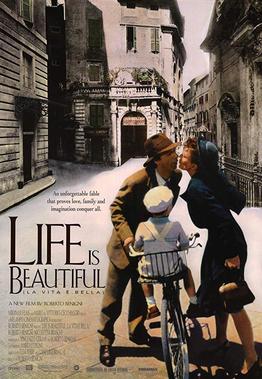
Behind the film
- Year
- 1997
- Director
- Roberto Benigni
- Writers
- Vincenzo Cerami, Roberto Benigni
- Runtime
- 2h 4m
- Genres
- Comedy, Drama
- Production
- Melampo Cinematografica, Cecchi Gori Group, Miramax
- Country
- Italy
- Cast
- Roberto Benigni, Nicoletta Braschi, Giorgio Cantarini, Giustino Durano, Horst Buchholz, Marisa Paredes, Amerigo Fontani, Sergio Bustric
About the film
Contains story spoilers.
The film opens in 1939 as Guido Orefice arrives in Arezzo with his friend Ferruccio and finds work at his uncle Eliseo’s hotel. Guido is quick with jokes, coincidences, and improvised performances, and he uses that energy to keep moving through a town governed by rigid social expectations. He falls for Dora, a schoolteacher who is engaged to the wealthy official Rodolfo. Their encounters are framed like a comic courtship: Guido appears in disguises, turns accidents into gestures, and makes space for spontaneity inside a world that expects everyone to know their place.
Dora’s attraction to Guido grows even though their social positions and religious backgrounds differ. At her engagement party, Guido arrives on his uncle’s horse and carries her away from the life already arranged for her. They marry, open a bookstore, and have a son, Giosuè. The first part has the light movement of a romantic comedy, with Guido’s inventions making ordinary encounters feel enchanted. That tone is not a promise that the world is safe; it gives the family a specific warmth that makes the later political violence register as the destruction of a lived home rather than an abstract change in setting.
By 1944, German forces occupy northern Italy. Guido, Eliseo, and Giosuè are arrested on the boy’s birthday and transported by train to a concentration camp. Dora insists on boarding the train after she discovers her family has been taken, though the camp separates women from men and she is unable to see them there. Guido quickly understands that Giosuè cannot be told the full truth without exposing him to terror, so he invents a game: tasks earn points, and the first to reach a thousand wins a tank. The explanation is a desperate, loving fiction inside the film’s depiction of a real historical system of persecution and mass murder.
The game gives Guido a way to translate orders and danger into rules his son can follow. He tells Giosuè that crying, asking for his mother, or saying he is hungry loses points, while remaining hidden earns them. Guido also uses the camp’s loudspeaker to send Dora messages, assuring her that he and the boy are still alive. His improvisations cannot control the camp or protect every person around them: Eliseo is murdered, and Giosuè narrowly avoids being sent with the children ordered to shower because he refuses to bathe. The film’s comedy belongs to Guido’s performance for his child; the violence and coercion outside it remain real within the story.
Guido’s ingenuity sometimes depends on exploiting small openings rather than overcoming the machinery around him. When German officers and their families visit, he arranges for Giosuè to be mistaken for one of their children and fed while Guido serves the officers. The boy nearly gives himself away by thanking a server in Italian, so Guido quickly teaches the German children the phrase too. Scenes like this show how the game is sustained moment by moment: Giosuè can follow its rules, but Guido must continually invent explanations for new threats. The film keeps the father’s performance tied to practical actions—hiding, feeding, translating, and reassuring—rather than treating imagination as magical protection.
As Allied forces approach, the camp descends into confusion. Guido tells Giosuè to hide until everyone has left, presenting it as the final challenge for the promised tank. He goes looking for Dora, but a German soldier catches him and leads him away to be shot. On the way, Guido passes the place where Giosuè is concealed and gives him one last playful wink, maintaining the game until he is out of sight. The next morning, Giosuè emerges as American soldiers arrive with a Sherman tank. He believes he has won, rides with a soldier, and then sees Dora in the departing group and reunites with her.
That two-part construction also shapes how the film handles point of view. In the first half, Guido's jokes work because Dora and the people around him can answer back; his comic improvisations are social, not simply a private voice-over. In the camp, the game becomes a one-sided performance that Giosue can understand only through his father's explanations. The same quickness that once won Dora's affection now has to answer immediate questions about food, work, and hiding. By keeping the boy's understanding limited, the film lets viewers see both the tenderness of Guido's invention and the brutal gap between the story he tells and the world the adults know.
The adult Giosuè’s narration frames the ending as a memory of what his father did to preserve his childhood under impossible conditions. Roberto Benigni’s film is a fictional story set against Nazi persecution; it is not a literal Holocaust biography or an instructional account of camp life. The sharp change from courtship comedy to camp drama gives Guido’s performance its emotional shape, but the game remains a child’s protective fiction, not a description of how prisoners could master the Nazi system. The closing image belongs to the son’s memory of care and survival, while the historical reality around it must remain distinct.