
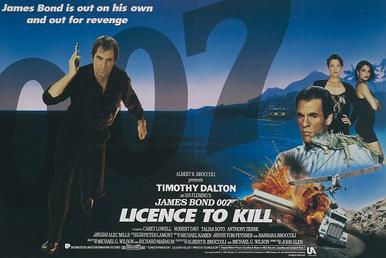
Behind the film
- Year
- 1989
- Director
- John Glen
- Writers
- Michael G. Wilson, Richard Maibaum
- Runtime
- 2h 13m
- Genres
- Action, Spy
- Production
- Eon Productions, Metro-Goldwyn-Mayer
- Country
- United Kingdom, Mexico, United States
- Cast
- Timothy Dalton, Carey Lowell, Robert Davi, Talisa Soto, Anthony Zerbe, Frank McRae, Everett McGill, Benicio del Toro
About the film
Contains story spoilers.
Licence to Kill opens with James Bond and his friend Felix Leiter helping the DEA capture drug lord Franz Sanchez on the way to Felix’s wedding in Key West. The mission is interrupted by the personal ceremony: the two men parachute down to the church in time for it. Sanchez then escapes custody by bribing a DEA agent, and his men attack Felix and his new wife Della. Felix is left gravely injured, and Della is killed. Bond discovers the attack after the wedding and abandons the official path of service to find Sanchez.
Bond begins his pursuit with Felix’s friend Sharkey, tracing Sanchez’s business through a marine research center where cocaine is hidden and a ship used for smuggling. M attempts to divert Bond to another assignment, but Bond refuses; M suspends him and revokes his licence to kill. Q later provides unofficial help, and Bond crosses paths with Pam Bouvier, a pilot and DEA informant. He works his way into Sanchez’s circle by posing as an assassin, while Pam, Q and Sanchez’s girlfriend Lupe help him set rival members of the organization against one another.
The scheme takes Bond from a smuggling vessel to Sanchez’s headquarters, which is disguised as a religious institute. The operation dissolves cocaine into petrol and sells the mixture through a network of intermediaries. Bond’s cover is compromised when Dario recognizes him during a presentation to prospective customers. Pam arrives in time to help, the base burns, and Sanchez escapes with several tanker trucks carrying the drug-fuel mixture. Bond pursues the convoy by aircraft, and the chase through the desert leaves Sanchez increasingly isolated from his men.
The final confrontation ends with Sanchez soaked in fuel after the last tanker crashes. Bond shows him the cigarette lighter Felix and Della gave him as a best-man gift, then ignites Sanchez. Sanchez stumbles into the wrecked tanker and dies in the explosion. Pam arrives after the fight and takes Bond away. Later, the surviving Felix phones with M’s offer to take Bond back. Bond chooses Pam over Lupe at the closing party. The revenge has been pursued outside official authority, but the film makes a return to service available afterward.
The film’s most significant change to the Bond formula is its emotional starting point. The wedding turns Felix’s injury and Della’s death from distant mission details into a rupture in a friendship that had been part of Bond’s professional life. Dalton’s performance gives Bond a hard focus, but the film does not make the revenge effortless or entirely private. Q and Pam are necessary to the operation, and Lupe becomes an important source of access within Sanchez’s organization. Bond’s anger may propel the story, yet the scheme depends on cooperation and observation.
Sanchez’s empire is designed around fluidity: cocaine can move through a research center, a ship, a processing plant and a fuel distribution chain. The business disguises itself as ordinary commerce, while the religious institute masks a violent workplace. The visual contrast between sterile laboratory spaces, hotel interiors, waterways and desert roads gives each part of Bond’s infiltration a different pressure. When he is welcomed into the inner circle, the performance becomes more dangerous because he has to look like a man who has severed the ties that brought him there. That tradecraft has a personal cost because every false identity asks Bond to behave as if Felix’s injury were only a useful pretext. Yet the film repeatedly returns the audience to the friendship through physical keepsakes and acts of aid. Q’s presence provides familiar equipment and affection, while Pam’s competence keeps the mission from becoming a lone-man fantasy. The revenge plot therefore retains relationships as its stakes even when Bond works outside his service.
John Glen’s action direction shifts between close personal danger and large mechanical spectacle. The opening capture of Sanchez uses a Coast Guard helicopter and a line attached to his aircraft; later, the tanker chase uses the open road and the vehicles themselves as the scene’s geometry. The film’s locations in Mexico and the United States supply a warmer, expansive landscape than the London offices associated with Bond’s institutional identity. That geography is not a vacation from the plot; it creates a world in which Bond must improvise without the standard machinery of MI6.
The film remains an adaptation of the Bond screen character rather than a direct rendering of one Fleming novel. Its plot combines a new revenge story with elements and names familiar from the novels, while keeping Felix’s attack, Pam’s role and Sanchez’s fuel operation specific to this movie. Robert Davi makes Sanchez personable enough to recruit people and ruthless enough to destroy them, which allows Bond’s false loyalty to remain plausible for a time. The final lighter recalls the wedding even as it ends the hunt, binding the conclusion to the friendship that began the film. Its small flame closes an adventure built around large machinery and a personal promise.