
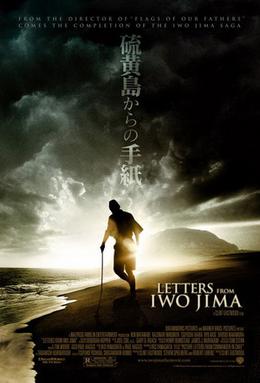
Behind the film
- Year
- 2006
- Director
- Clint Eastwood
- Writers
- Iris Yamashita
- Genres
- War, Drama, Historical
- Production
- DreamWorks, Malpaso Productions, Amblin Entertainment
- Country
- United States
- Cast
- Ken Watanabe, Kazunari Ninomiya, Tsuyoshi Ihara, Ryō Kase, Shidō Nakamura, Hiroshi Watanabe, Takumi Bando, Yuki Matsuzaki
About the film
Contains story spoilers.
As American forces approach Iwo Jima, conscripted baker Saigo digs defences while General Kuribayashi reorganises the island's preparations around tunnels. Officers disagree over strategy, obedience and whether survival can remain honourable. During the invasion, Saigo and Shimizu resist orders to die and try to continue fighting. Shimizu eventually surrenders but is killed by American guards. Kuribayashi sends Saigo to destroy documents before leading a final attack. Saigo preserves the soldiers' letters instead. He later finds the mortally wounded general, who takes his own life, and buries him. Captured after attacking Marines, Saigo survives. A present-day excavation reveals the buried letters. The film's historical battle is thus approached through imagined private lives as well as through dramatised versions of real commanders.
Letters from Iwo Jima makes a military position feel like a place where individual futures are being steadily taken away. The island has strategic meaning, but the people assigned to defend it carry attachments that cannot be expressed through a battle map. Clint Eastwood's Japanese-language film approaches the conflict from the defending soldiers' perspective, asking the audience to spend time inside that threatened world rather than encounter it only as the objective of an advancing force. The change of viewpoint does not make war humane. It makes the people enduring its demands harder to reduce to the uniform through which an enemy would recognise them.
Ken Watanabe's Kuribayashi possesses authority without complete command over what authority is supposed to mean. He must work inside a military culture whose inherited expectations may conflict with practical judgment. The performance gives thoughtfulness an active presence, allowing consideration to seem like part of leadership rather than hesitation before leadership begins. His position also has a tragic limit: greater attention to his men's lives cannot create resources or a future simply by willing them into existence. The film places an intelligent commander within circumstances that intelligence cannot redeem, making tactical competence and human responsibility related but far from interchangeable.
Kazunari Ninomiya's Saigo supplies another measure of the same situation. A soldier whose identity begins elsewhere brings an ordinary life's scale into a setting dominated by collective obligation. His responses can seem irreverent within the military hierarchy while remaining intelligible as the responses of a person who wants to live. That difference makes patriotism difficult to use as a complete explanation of behaviour. Affection, fear and the desire to return have their own force. The film's emotional attention to Saigo prevents the larger conflict from becoming only a conversation among exceptional leaders about the most meaningful manner of meeting defeat.
The tunnel environment makes the island's apparent solidity deceptive. Underground space offers protection while also restricting movement, sight and contact with the world beyond it. Bodies have to share the same constricted conditions, and choices acquire urgency because escape routes and information are limited. The visual palette keeps grandeur at a distance, allowing dirt, shadow and exposed physical effort to dominate the experience. This is a war film whose environment frequently denies the expansive view through which battle might become an impressive spectacle. A defensible position can also become a place where people feel themselves disappearing from the future.
The title gives correspondence an importance that military documents cannot replace. A letter addresses somebody particular, allowing a person to speak through a relationship rather than through rank. That difference changes the meaning of the voices the film asks its audience to hear. Someone's fear or affection need not be remarkable to be worth preserving. In an institution that demands collective purpose, a private message records the existence of a life with another centre. The film's emphasis on such messages places remembrance beside strategy, asking what survives of a battle when the people involved can no longer explain themselves in person.
The screenplay by Iris Yamashita draws together fictional characters and historical figures; its intimate conversations should be understood as dramatisation rather than a recovered transcript of the campaign. It also resists treating one nationality as a guarantee of humane conduct. The story places competing judgments within armies and individual encounters, letting official affiliation remain insufficient as a description of character. That approach gives the film's compassion a difficult setting. Seeing someone as human does not ensure that another person will spare him, and recognition can arrive in circumstances where practical mercy remains uncertain or has already become impossible.
As a companion to Flags of Our Fathers, the film contributes a different angle on a battle more often represented through American imagery. Its concern is less with providing a complete military history than with the distance between public duty and private existence. The surviving trace of a message becomes meaningful because the usual measures of victory and defeat cannot account for everything it contains. Letters from Iwo Jima leaves the audience with a world where loss is immense and individual recognition remains limited, yet still matters. Its sombre direction asks how remembering specific people can complicate the stories nations tell about the sacrifices demanded in their names.