
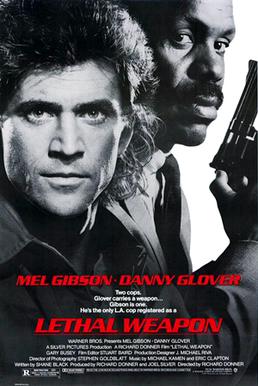
Behind the film
- Year
- 1987
- Director
- Richard Donner
- Writers
- Shane Black
- Genres
- Crime, Action, Thriller, Buddy
- Production
- Silver Pictures
- Country
- United States
- Cast
- Mel Gibson, Danny Glover, Gary Busey, Mitchell Ryan, Tom Atkins, Darlene Love, Traci Wolfe, Mary Ellen Trainor
About the film
Contains story spoilers.
Detectives Martin Riggs and Roger Murtaugh investigate Amanda Hunsaker's death and discover she was poisoned. A witness's home explodes, linking the case to mercenaries. Amanda's father Michael reveals that former military operatives now run Shadow Company's drug trade and murdered her to silence him; Joshua kills him. After surviving a shooting, Riggs pretends to be dead. The criminals kidnap Murtaugh's daughter Rianne and capture both detectives during the attempted rescue. Riggs escapes torture and frees them. McAllister dies in an exploding car, but Joshua heads for Murtaugh's house. Riggs defeats him without killing him; when Joshua seizes a gun, both detectives shoot him. Riggs later joins the family's Christmas dinner and gives Murtaugh the bullet he had kept for suicide, signalling a changed desire to live.
The partnership makes risk personal before the criminal plot makes it spectacular. Danny Glover's Murtaugh has a life that can be disrupted by danger, while Mel Gibson's Riggs approaches danger from a position in which continuing to live has become uncertain. Their difference is therefore more substantial than a disagreement over professional technique. What looks like courage to one observer may be distress to another, and an apparently cautious response can be an expression of attachment rather than a failure of nerve. The film lets those interpretations collide inside the work the men have to do together. A successful partnership requires more than recognising that each can be useful. They have to discover what the other's behaviour means, including meanings that a convenient stereotype would allow them to ignore.
Riggs's volatility gives the title its uncomfortable force. A person can be valued for what he can accomplish while that value conceals how badly he is struggling. The film's action world creates situations in which unusual willingness to take a risk can appear professionally advantageous, but the advantage is inseparable from a damaged relationship with survival. That makes Murtaugh's growing attention important. Recognising competence is not enough if it leaves the person carrying that competence entirely alone. The story gives friendship a practical place inside the action rather than treating it as a reward added after the action is complete. The presence of somebody willing to stay engaged can change how an immediate danger is approached, even without supplying a simple explanation or instant solution for the underlying pain.
Murtaugh's household provides another account of what strength can look like. Darlene Love's Trish and the children make his world more than a private motivation for an officer's public heroism. The family is an ongoing collection of relationships with its own demands and humour. That makes the home a meaningful contrast with Riggs's isolation. A life can contain irritation, responsibility and affection at the same time; its value need not depend on being an ideal refuge untouched by inconvenience. The film's Christmas setting sharpens that difference between visible celebration and private loneliness. A person surrounded by signs of togetherness may become more aware of what is missing, while an invitation into somebody else's ordinary life can matter precisely because it is ordinary and can continue beyond the crisis.
The antagonists make the men's shared military background acquire a second meaning. Skill developed in one setting can be carried into another without preserving the purpose once used to justify it. Gary Busey's Joshua and Mitchell Ryan's McAllister give that transformation a threatening presence, connecting disciplined capability with an organisation built around exploitation. Their role creates a contrast between men who use experience to protect others and men who turn experience into an entitlement to dominate. The film's criminal machinery belongs to its fiction rather than to a comprehensive account of actual covert activity. Its dramatic usefulness lies in making a history of violence remain active in the present, influencing how people recognise one another and what they believe their abilities permit them to do.
Richard Donner's action depends on a relationship the audience can follow through shifts in scale. An investigation becomes pursuit, then a threat to the family, but the movement remains attached to the pair's developing confidence in one another. That attachment makes a set piece more than a demonstration that a protagonist can withstand punishment. The men have to understand when to act, when to rely on the other and what failure would mean beyond an immediate defeat. Their contrasting temperaments also give the comedy a role in sustaining the relationship. It allows the partnership to remain a conversation between particular people rather than a smooth arrangement of complementary action skills.
Shane Black's screenplay gives those exchanges a world whose violence and sentiment are closely connected. The emotional movement does not require the men to become identical or to abandon every habit that initially made them difficult company. A workable bond can preserve difference while changing the meaning of the difference. Murtaugh's caution becomes something Riggs can recognise as care, while Riggs's intensity becomes something Murtaugh has to understand rather than dismiss. The fictional policing and confrontations should not be treated as practical procedure or clinical guidance. The story is interested in a dramatic possibility: that professional proximity can become genuine attention, and that genuine attention can make a person's future feel less closed than it did when the assignment began.
Lethal Weapon ends by giving survival a social place. Its resolution matters through the relationship it leaves available, not solely through the criminal threat it removes. That is what makes the film's mixture of hard action and domestic warmth coherent. The violence tests a bond whose significance extends beyond violence. Riggs's ability to act was present from the beginning; the more difficult development concerns what he might want to remain alive for. Murtaugh's contribution is to open an ordinary world in which that question can receive an answer. The film gives the buddy partnership an emotional weight beneath its familiar disagreements, making trust something expressed through continued presence as well as through the willingness to stand beside someone in danger.