
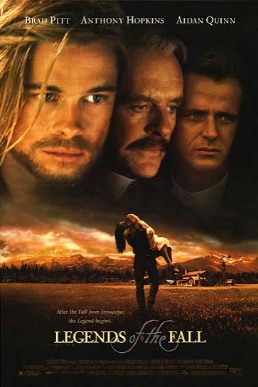
Behind the film
- Year
- 1994
- Director
- Edward Zwick
- Writers
- Susan Shilliday, Bill Wittliff
- Genres
- Romance, Drama, War, Western
- Production
- TriStar Pictures, Bedford Falls Productions
- Country
- United States
- Cast
- Brad Pitt, Anthony Hopkins, Aidan Quinn, Julia Ormond, Henry Thomas, Gordon Tootoosis, Tantoo Cardinal, Karina Lombard
About the film
Contains story spoilers.
Legends of the Fall presents a family whose attachment is strongest precisely where its ability to live peacefully together is weakest. The Ludlow brothers belong to the same place and history, but belonging does not supply agreement about duty, ambition or love. Their differences become harder to contain as events draw them away from the ranch and back again. The film's sweep comes from following those attachments over time, allowing a decision that seems immediate to continue shaping other lives years later. It is a family drama in which distance changes a conflict without necessarily ending it.
Edward Zwick directs the 1994 adaptation of Jim Harrison's novella, with a screenplay by Susan Shilliday and Bill Wittliff. Anthony Hopkins plays William Ludlow, and Brad Pitt, Aidan Quinn and Henry Thomas play Tristan, Alfred and Samuel. Julia Ormond plays Susannah. Montana gives the family a landscape that can seem separate from the institutions William distrusts, yet separation is never complete. The story repeatedly brings larger pressures into the household through the choices of its members. A place can become a refuge without becoming a guarantee that the people living there will remain untouched by the world beyond it.
Samuel brings Susannah home before the brothers enter the First World War. His death fractures the family, and Tristan's relationship with Susannah later breaks under grief and absence. She marries Alfred. Tristan returns and marries Isabel Two, whose death brings another cycle of retaliation. Susannah dies by suicide; a final violent confrontation allows Alfred to reconcile with his father and brother. Tristan survives into old age before dying in a struggle with a bear. The story's long span offers endurance, but endurance is repeatedly accompanied by losses the family's renewed connections cannot reverse.
Tristan's place in the film makes freedom an attractive and dangerous idea. Refusing an ordinary path can look like strength, particularly beside people who accommodate institutions and expectations. Yet independence also has effects on the people waiting for the independent person to return. The narrative invites a distinction between being unable to live conventionally and being released from obligations. Those are not the same condition. A romantic account of restlessness can make an absence seem meaningful from the traveller's perspective while leaving somebody else to organise their life around a promise that no longer offers reliable direction.
Alfred provides a contrasting response to the same inheritance. Ambition within the established world can appear less dramatic than departure from it, but it supplies its own pressures and compromises. The brothers' rivalry is therefore not solely a contest over a woman. It also involves different claims about what kind of life deserves respect. The family can mistake visibility for virtue, rewarding the person whose choices fit its preferred story while failing to recognise the difficulty of another path. That imbalance helps explain how shared origins can produce resentment. Being understood at home may depend on resembling the version of you that home wants to keep.
Susannah's relationships expose the cost of organising a family legend around its men. Her hopes must survive encounters with choices whose motives extend beyond her and whose consequences arrive inside her life. Treating her only as the object of rivalry would repeat the limitation the drama makes available for examination. Her attachment matters because it is an experience, not merely a reason for brothers to quarrel. The film's tragedy can be read through the failure of other people's longing to provide a stable place for hers. Affection does not become protective simply because it is intense or sincerely felt.
The recurring violence complicates the apparent distance between the ranch and the world William rejects. A household built as an alternative to betrayal can still answer injury with actions that create fresh danger. Personal loyalty makes those actions understandable within the family's perspective, but understanding a motive does not make retaliation a durable solution. The story's cycles leave survivors carrying both the original harm and the consequences of what followed it. That is why reconciliation cannot be treated as a return to innocence. The family can recover a relationship while retaining a history that changes what recovering it means. Violence thus becomes part of the family inheritance even when its members believe themselves to be defending that inheritance.
The final account of Tristan's life belongs to the film's legendary register rather than a claim that one temperament has been vindicated above all others. Longevity does not settle the moral balance of every earlier decision, and a dramatic death does not reimburse the people lost along the way. Legends of the Fall offers a sweeping portrait of a family that repeatedly finds connection through damaged loyalties. Its world is defined by the pull of home, the desire to escape and the difficulty of returning as though nothing has changed. The legend preserves those contradictions because a simpler account would lose the people who lived inside them.