
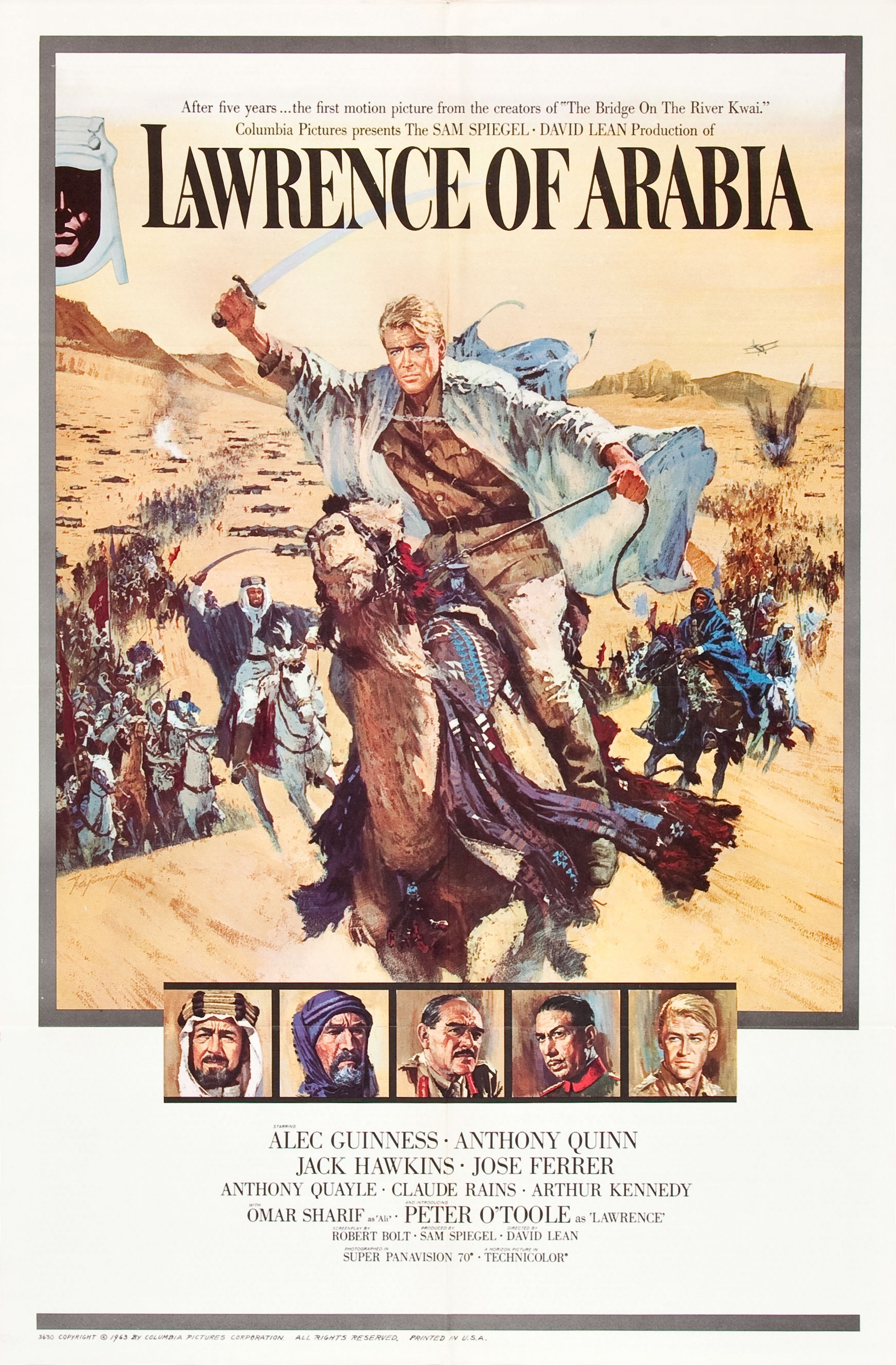
Behind the film
- Year
- 1962
- Director
- David Lean
- Writers
- Robert Bolt, Michael Wilson
- Genres
- War, Biographical, Drama, Adventure
- Production
- Horizon Pictures
- Country
- United Kingdom, United States
- Cast
- Peter O'Toole, Alec Guinness, Anthony Quinn, Omar Sharif, Jack Hawkins, Anthony Quayle, Claude Rains, Jose Ferrer
About the film
Contains story spoilers.
The film opens in 1935, when T. E. Lawrence dies in a motorcycle crash, then shifts to the First World War and the Arab Revolt against Ottoman rule. Lawrence is a British lieutenant whose irreverence and education make him an awkward fit in the army. Mr. Dryden of the Arab Bureau sends him to meet Colonel Harry Brighton and Prince Feisal. Lawrence’s first journey exposes the tensions between the British and Arab forces: his guide is killed by Sherif Ali for drinking from a well, and Lawrence initially sees the act through a narrow judgment of Ali rather than the competing loyalties around them.
Feisal is impressed by Lawrence’s knowledge of the Quran and his relative candor about British interests. Lawrence argues for a surprise attack on Aqaba, a port the British command considers too difficult to take from the desert side. Feisal gives him only fifty men, and Lawrence recruits the teenage orphans Daud and Farraj as attendants. The march across the Nefud tests both the military plan and the relationships inside the group. When Gasim becomes lost, Lawrence rides back into the desert to rescue him, winning the trust of Feisal’s men. He also persuades Auda Abu Tayi to join by promising a Turkish gold hoard at Aqaba.
The promise turns bitter when the group reaches Aqaba and finds no gold. Earlier, Lawrence has had to execute Gasim to prevent fighting between Feisal's men and Auda's followers. As they continue toward Cairo, Daud is swallowed by quicksand; Farraj survives the journey. Lawrence's actions help secure the port but leave him changed by the violence he has justified. In Cairo, he arrives dressed in Arab clothing and insists that Farraj be served alongside him in the officers’ bar. General Allenby promotes him and supplies money and weapons for a guerrilla campaign. Lawrence asks whether Britain intends to dominate Arabia and whether Feisal's army will receive artillery; Allenby reassures him dishonestly on both counts.
Lawrence leads raids against the Turks, and American journalist Jackson Bentley turns his exploits into a public story. The attention makes Lawrence famous while also encouraging him to see himself as a figure larger than the campaign. Ali urges caution, but Lawrence keeps pushing forward. Farraj is injured during a raid, and Lawrence kills him to prevent the Turks from capturing and torturing him. Soon Lawrence is captured while scouting in Deraa. The Turkish Bey humiliates and beats him; the film implies a sexual assault. Ali is waiting nearby and helps Lawrence leave after the ordeal, but Lawrence returns shaken and less certain that courage or self-command can protect him from the forces he has been using.
Dryden reveals the Sykes–Picot agreement, under which Britain and France plan to divide influence in the region. Allenby urges Lawrence to return and support the advance on Damascus, and Lawrence agrees despite feeling betrayed. He recruits an Arab force by promising that taking the city first may give them leverage to demand independence. When the army encounters retreating Turkish soldiers who have massacred Tafas, a survivor demands that no prisoners be taken. Ali argues that the army should continue to Damascus, but the man charges and is killed; Lawrence then adopts the cry and the Arab fighters massacre the Turks. The sequence marks a devastating shift from his earlier claims about restraint.
The Arabs reach Damascus ahead of the British and try to run the city without outside support. Rivalries and practical failures make the effort unstable: public utilities fail, hospitals are understaffed, and the tribal leaders cannot agree on administration. Feisal eventually accepts British support instead of the independence Lawrence had imagined. Lawrence returns to the British Army, is promoted to colonel, and is ordered home. As he leaves Damascus, he watches the Arabs depart and sees a motorcyclist pass, echoing the frame at the beginning. The campaign has brought military victories but not the political future he tried to secure.
The narrative repeatedly links Lawrence's shifting self-image to the way other people use his successes. Bentley's reports turn him into a public figure, Allenby treats him as an effective instrument, and Feisal needs the resources he can obtain from British command. Lawrence sometimes believes that those interests can be made to serve Arab independence, even after he has heard about the secret agreement dividing influence. The desert crossings and raids create the appearance of a personal legend, but the final attempt to govern Damascus reveals how little military prestige can settle questions of authority, supply, and competing political aims. His departure therefore follows a failure of the project, not merely exhaustion from travel.
David Lean presents the desert as both a vast physical environment and a shifting political landscape, where distance, water, and supply lines determine what can be attempted. The film’s epic scale sits beside Lawrence’s unstable self-image: he is at once an officer, an intermediary, a celebrity, and a man increasingly uncomfortable with the violence he has led. It is a dramatization of a historical figure and events, not a neutral record of the Arab Revolt; the film reshapes people, motives, and chronology for its story. Its ending leaves Lawrence between military service and the Arab cause, with the limits of his influence made plain.