
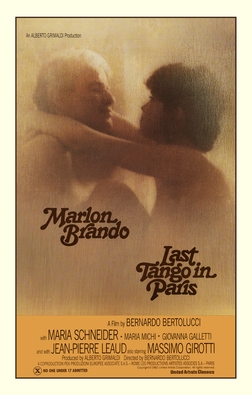
Behind the film
- Year
- 1972
- Director
- Bernardo Bertolucci
- Writers
- Bernardo Bertolucci, Franco Arcalli
- Genres
- Drama, Romance, Erotic
- Production
- Produzioni Europee Associati
- Country
- France, Italy
- Cast
- Marlon Brando, Maria Schneider, Jean-Pierre Léaud, Massimo Girotti, Maria Michi, Catherine Allégret, Giovanna Galletti, Darling Légitimus
About the film
Contains story spoilers.
Last Tango in Paris centres on an apartment that offers the appearance of being outside ordinary life. Paul and Jeanne meet while looking at the property, and their affair begins before they establish the usual knowledge two people might have of one another. Paul is a middle-aged American whose wife has recently died by suicide; Jeanne is a young Parisian engaged to a filmmaker. Marlon Brando and Maria Schneider play people at very different points in their lives, with neither difference removed by their physical proximity. Bernardo Bertolucci sets their encounters against a city that keeps existing beyond the room. The proposed refuge depends on pretending that names, attachments and histories can be excluded, although those things are already shaping how both characters behave.
Paul insists on anonymity. It gives him a way of being with someone without having to explain his marriage, his grief or himself, but it also gives him authority over the terms of their relationship. Jeanne's curiosity and emotional involvement do not fit comfortably inside that rule. The apartment therefore becomes more than a discreet meeting place: its emptiness allows Paul to declare what matters and what should remain unspoken. Brando's performance moves between aggression, damaged humour and moments when the effort of maintaining that control becomes visible. A person can be in pain and still exercise power over someone else. The film repeatedly brings those realities into the same encounter, making sympathy for his bereavement insufficient as an explanation of his treatment of Jeanne.
Outside the apartment, Jeanne is involved with Tom, played by Jean-Pierre Léaud, who is making a film around their relationship. His camera produces a very different kind of enclosure. Where Paul wants no information, Tom wants to organise life into something that can be recorded and presented. Jeanne moves between a man who excludes her public identity and one who turns intimacy into material for his own project. Schneider gives her responses an unpredictability that prevents those arrangements from making her entirely legible. Her interests do not always align neatly with either man's intentions. The contrast between the filmed courtship and the private affair also complicates the apparent separation of public and secret selves: both spaces contain someone else's ideas about what she should be.
Paul's life at the hotel he shared with Rosa supplies the history that anonymity cannot abolish. The routines and people surrounding her death show that their marriage had an existence he did not fully understand. His encounter with her lover, Marcel, makes another man's place in that life concrete, instead of leaving betrayal as an abstract grievance. Brando's scenes around Rosa's body make grief change direction within a single conversation, passing through accusation, tenderness and the desire for an answer that cannot come. The film does not offer a clean explanation that would settle her death or his response. That absence helps explain his attraction to a room with fewer apparent obligations, but the relief remains temporary because an unexplained loss is still a loss.
The affair includes sexual violence and emotional coercion. Calling every encounter an expression of mutual liberation would erase what happens to Jeanne and obscure the unequal arrangement Paul has established. The film's explicit content has a narrative role, because control and vulnerability are being exercised through the body as well as through speech. Its depiction of rape makes the boundaries of the apartment especially troubling: privacy can conceal harm while appearing to promise freedom from social expectations. Jeanne's difficulty leaving does not cancel the harm or make later pursuit welcome. The characters' feelings change without becoming a reliable guarantee of safety. Bertolucci keeps the encounters emotionally unstable, so affection, humiliation and fear can occupy the same relationship without resolving into a conventional romantic progression.
When Paul abandons the apartment without warning, Jeanne discovers how little certainty their arrangement has provided. He later approaches her again and attempts to replace anonymity with personal disclosure. The move might seem like an opening toward a more recognisable relationship, but it comes on his timetable, after he has already defined and withdrawn their earlier connection. Their visit to a tango venue brings the private dynamic into a public space with its own patterns of performance and partnership. The measured dancing around them contrasts with behaviour that is becoming increasingly difficult to contain. Jeanne refuses to continue the relationship. His decision to pursue her means the freedom to choose, supposedly protected by their unconventional affair, becomes the very thing he will not grant her.
The pursuit ends at Jeanne's home, where Paul forces his way into an apartment belonging to the life she had kept separate. She shoots him, and he dies on the balcony. Her repeated account of him as a stranger prepares a possible explanation for the police, while also returning to the anonymity that began the affair. It cannot restore the earlier arrangement or erase what they have shared. The ending leaves the disparity between private experience and public description unresolved. Jeanne knows much more than the simple story she rehearses, but the relationship never developed into mutual knowledge on equal terms. The film's final movement turns the refusal of identity from Paul's initial condition into a means by which she attempts to survive its consequences.
Vittorio Storaro's cinematography gives the interiors warm, enclosed textures, while the surrounding streets and other rooms retain the pull of a larger world. Gato Barbieri's music brings an expressive voice to scenes where the characters struggle to explain themselves. The film's formal intimacy also makes its treatment of power difficult to separate from its sensual presentation: the same room can look inviting and become oppressive. Its central question concerns what two people can actually escape by discarding ordinary introductions. Their histories remain present, and without an agreed way to recognise one another's needs, the apparent refuge becomes another place where one person's wishes can overwhelm the other's.