
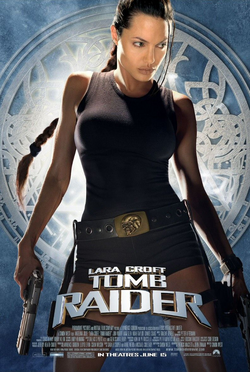
Behind the film
- Year
- 2001
- Director
- Simon West
- Writers
- Patrick Massett, John Zinman
- Genres
- Adventure, Girls with guns, Treasure hunt, Science fiction
- Production
- Mutual Film Corporation
- Country
- United Kingdom, Japan, United States, Germany
- Cast
- Angelina Jolie, Noah Taylor, Chris Barrie, Iain Glen, Jon Voight, Daniel Craig, Richard Johnson, Julian Rhind-Tutt
About the film
Contains story spoilers.
Lara Croft: Tomb Raider introduces its heroine as someone who already knows how to handle danger. Simon West's film does not build toward the moment when an ordinary person discovers extraordinary ability. It starts with competence and asks what could unsettle it. Angelina Jolie's Lara belongs to an adventure world of elaborate traps, ancient mechanisms and powerful people competing for objects whose uses extend beyond collecting. Her confidence gives the action its centre, but the story also brings her family into that competition. Something she can fight or solve may be easier to confront than something she wants badly enough to mistrust her own judgment.
A hidden clock points Lara toward the divided Triangle of Light, which can control time. Her late father's instructions ask her to destroy it. Manfred Powell and the Illuminati want its power, and the pursuit leads through Cambodia and Siberia. Lara obtains one half, then accepts a partnership with Powell when he offers the possibility of restoring her father. At the final mechanism, Powell kills fellow adventurer Alex West to force her cooperation. Lara gains control of the completed object and encounters her father, who urges her to let him go. She saves Alex, destroys the Triangle and defeats Powell after learning he killed her father. The adventure ends with her returning home rather than keeping the power she sought.
Jolie's performance gives Lara a composed physical presence. She can treat a demanding situation as something requiring attention rather than a reason to announce her bravery. That ease also changes the tone of encounters with opponents: their assumptions about who controls the exchange are not necessarily hers. The character's self-possession means the film can put movement ahead of explanation, letting an action establish capability before another person comments on it. Confidence becomes a style of inhabiting the frame. Yet the family connection gives that confidence a limit, allowing emotional desire to complicate a person whose practical responses usually appear decisive.
The manor brings several sides of Lara together in one place. It is a family residence, a base of operations and a setting where preparation can become a form of play. Noah Taylor's Bryce and Chris Barrie's Hillary give her household a social rhythm beyond solitary exploration, with technical work and everyday service sitting beside extravagant adventure. That arrangement makes the home feel tailored to her habits. When danger reaches it, the intrusion affects more than a convenient headquarters. A place associated with control and familiarity is exposed to the same struggle over objects that seems, at first, to belong elsewhere.
The film's ancient sites function as spectacular mechanisms within an invented adventure. History supplies an atmosphere of age and mystery, but the action depends on fantasy rules about alignment, hidden access and the behaviour of an extraordinary object. Reading those places as cinematic spaces helps explain their role. They present Lara with problems that combine observation, timing and movement, allowing knowledge to become visible through what she does. The resulting world has the appeal of exploration without becoming an archaeological account. Its ruins are built around dramatic possibilities, where an apparently inert environment can suddenly demand a physical response from everyone entering it.
Iain Glen's Powell turns possession into a promise of authority. The object matters to him because of what it might allow him to command, while Lara's interest becomes entangled with a particular person she has lost. Those motives make their temporary cooperation unstable even when both need access to the same places. Daniel Craig's Alex brings another kind of rivalry into the expedition, offering a competitor whose relationship with Lara has a different energy from Powell's calculated persuasion. The film can therefore vary the exchanges around its central heroine, moving between antagonism, familiarity and bargaining without treating every opposing figure as an identical obstacle.
Adapting a game character also changes the audience's relationship to her decisions. A player might solve a problem by trying again; a film has to give the action a shape that unfolds without that direct participation. Here the succession of settings and encounters keeps Lara's abilities legible through visible choices. The pleasure comes from watching someone read a situation and act on it, while the surrounding spectacle makes the stakes immediately apparent. The heroine's continuity matters across those shifts. Her personality provides a point of recognition when environments change, connecting the domestic scenes with the larger adventure through the same assured, inquisitive presence.
The personal temptation gives the ending its meaning beyond the disposal of an object. Power over time would appear to offer a way around grief, making the pursuit attractive for reasons that cannot be reduced to greed. Lara must distinguish what she can obtain from what she can responsibly keep. Jon Voight's father figure gives that distinction an intimate form, turning a warning about power into a conversation about attachment. Returning home then carries a different weight from simply finishing an assignment. She has exercised her abilities without using them to make every loss reversible, leaving the character capable of further adventure while allowing this story's emotional question to reach a conclusion.