
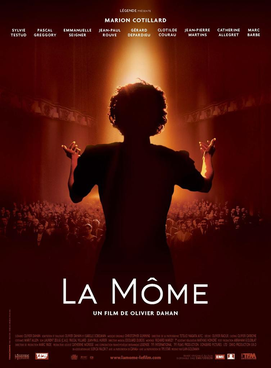
Behind the film
- Year
- 2007
- Director
- Olivier Dahan
- Writers
- Olivier Dahan, Isabelle Sobelman
- Runtime
- 2h 20m
- Genres
- Biographical, Musical, Drama, Flashback
- Production
- Légende Entreprises, TF1 International, TF1 Films Production
- Country
- France, United Kingdom, Czech Republic
- Cast
- Marion Cotillard, Sylvie Testud, Pascal Greggory, Emmanuelle Seigner, Jean-Paul Rouve, Gérard Depardieu, Clotilde Courau, Jean-Pierre Martins
About the film
Contains story spoilers.
La Vie en Rose approaches Édith Piaf through recollection rather than a straight march through dates. Childhood scenes, stages, relationships and late-life memories appear in an arrangement that uses the rhythms of fragmented remembering. The structure makes time feel emotional: one image or song can call up several periods at once. Marion Cotillard plays Piaf across these changes, altering posture, voice and physical presence so the character’s age and condition are readable even when the chronology is not. The portrait is built around the tension between the public performer and the vulnerable person whose memories remain vivid, painful and incomplete.
The story follows Piaf through unstable childhood care, street performance and a career shaped by nightclub owner Louis Leplée and songwriter Raymond Asso. Her voice brings fame, while Leplée's murder disrupts her early success. A relationship with boxer Marcel Cerdan ends when he dies in a plane crash. Later scenes place illness, addiction and rehabilitation alongside her determination to perform. The film moves between these periods rather than treating them as a continuous progression. Its closing passages connect frailty and memories of loved ones with an Olympia performance of Non, je ne regrette rien. Public resolve becomes part of the portrait without cancelling the private fear and grief surrounding it.
Cotillard's performance makes recognition possible across the film's changes in age and circumstance. Posture and gesture can connect one appearance of the singer with another even when the character's energy has altered sharply. That physical continuity matters in a narrative that does not always announce the passage between periods through a simple transition. The audience follows a person rather than merely a succession of dates. Her bodily presence can become expansive onstage and vulnerable elsewhere, giving the film two registers within the same figure. Fame enlarges the space available to a performer without ensuring that she can inhabit her private life with equal assurance.
The stage turns a private capacity into an encounter with other people. Singing requires attention to be directed toward a person whose ordinary circumstances may have offered little control over how she is seen. The film gives that exchange a power which does not depend entirely on comfortable surroundings. Performance can make a room respond even when the singer's life outside it remains unsettled. That helps explain the dramatic distinction between recognition and security. A crowd's attention is real and consequential, but it cannot remain beside the performer through every later difficulty. The public response supplies an experience rather than a permanent solution to the need for connection.
The relationships around Piaf give her career a social structure. Sylvie Testud's Mômone and Pascal Greggory's Barrier belong to a world in which another person's presence can offer companionship, friction or practical support. Emmanuelle Seigner's Titine supplies a different kind of care within the childhood passages. The film's portrait benefits from those distinctions, because a person encountered early in life need not matter in the same way as someone involved in sustaining a public career. Dependence changes its form across the story. Recognition by an audience remains only one of the ways this character is seen by others, and it cannot replace all the rest.
Music also changes the organisation of time. A song can connect an image of the singer with an earlier feeling, allowing emotional continuity to survive when the narrative moves elsewhere. The film can consequently make a later performance carry experiences the audience has already encountered without turning the scene into a spoken explanation of them. That is different from arranging every setback as a step toward a predetermined triumph. The voice remains a public emblem, while the sequence around it makes the emblem less complete as an account of the person. What can be expressed in performance is powerful without becoming everything there is to know.
The film is a biographical dramatization, and its selection of moments should not be mistaken for an exhaustive account of Piaf's life. Nonlinear arrangement gives particular experiences prominence by placing them beside one another, making association part of the portrait. Loss can be felt before the viewer has reconstructed every chronological connection, while an earlier image can acquire another meaning when it returns. This makes the life emotionally accessible through cinema's form rather than through a claim that every remembered detail has been preserved. The subject remains larger than the telling, with relationships and periods necessarily existing beyond what the movie chooses to bring into view.
Olivier Dahan’s direction and his screenplay with Isabelle Sobelman make music the connective tissue between eras, while repeated images and abrupt shifts refuse a tidy rise-and-fall biography. Cotillard’s performance gives those shifts a center: her changing physicality turns the passage of years into something visible, and her singing scenes distinguish the labor of performance from the noise around celebrity. The title points toward a familiar public emblem; the film complicates that emblem by showing the unstable, sometimes painful life it cannot summarize. Its final performance offers closure to the telling while leaving the character’s experiences jagged and unresolved. This memory-led approach shapes the viewer’s access to Piaf, inviting emotional connection while making clear that selection and arrangement are part of the portrait.