
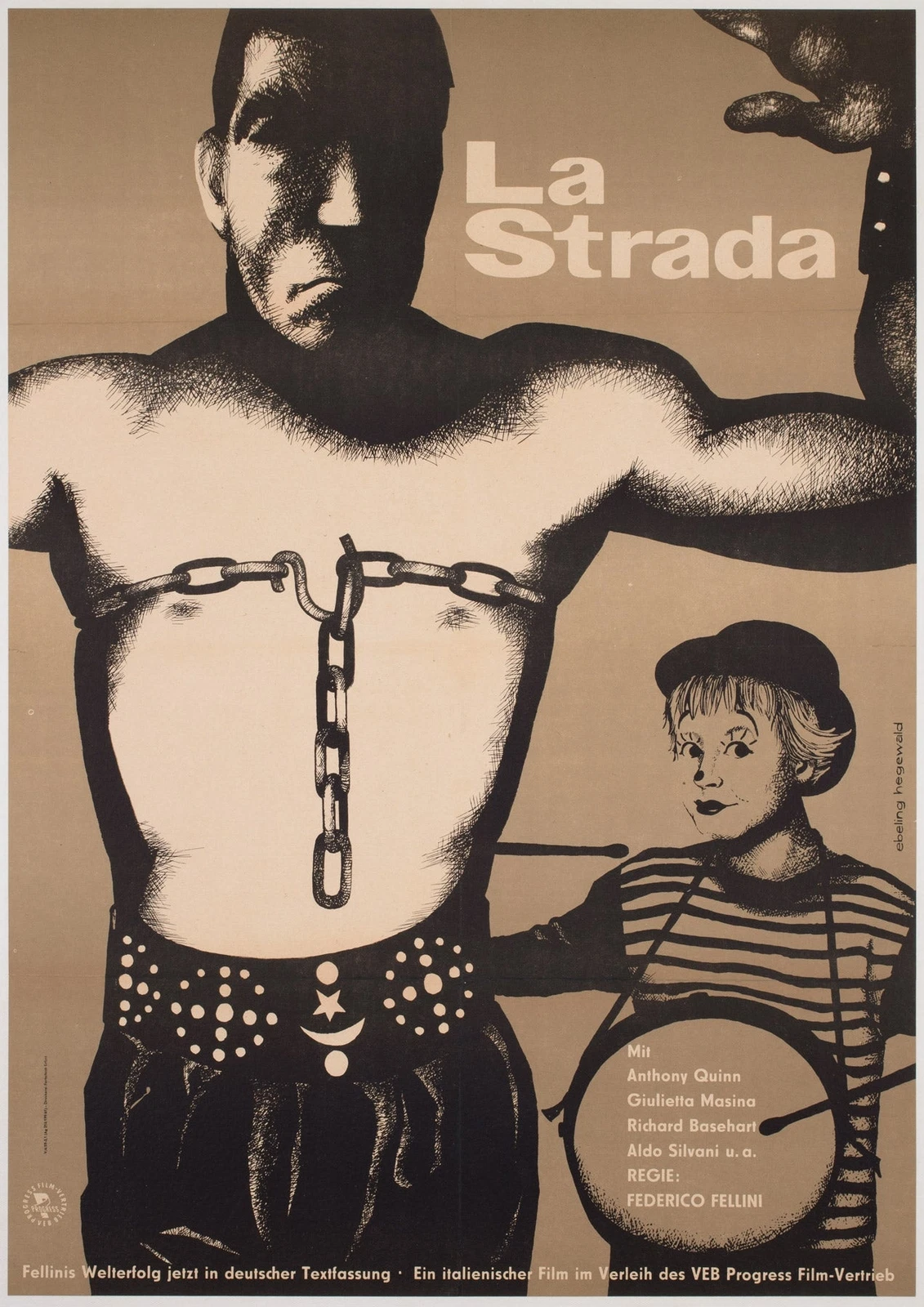
Behind the film
- Year
- 1954
- Director
- Federico Fellini
- Writers
- Federico Fellini, Tullio Pinelli, Ennio Flaiano
- Genres
- Drama
- Country
- Italy
- Cast
- Giulietta Masina, Anthony Quinn, Richard Basehart, Aldo Silvani, Marcella Rovere, Livia Venturini
About the film
Contains story spoilers.
La Strada builds a whole travelling world around an unequal partnership. Zampanò has an act, a vehicle and the power to decide where they go. Gelsomina has been sent away from a family that cannot afford to keep her, and must discover what place she occupies beside him. Their road is not a route towards a promised destination. It carries them between places where a performance might produce enough money to move on. That makes the repeated routines important: an introduction, a display of strength, a collection of coins, then another departure. Federico Fellini's film looks at what can happen to a person when the demands of earning a living become an excuse for refusing every other kind of responsibility.
Gelsomina replaces her dead sister as Zampanò's assistant after he pays their mother. He teaches her parts of his street act, but humiliates and abuses her. During their travels she encounters the Fool, a performer who suggests that even a small, apparently useless thing has a purpose. His teasing provokes Zampanò, who eventually beats him to death during a roadside encounter. Gelsomina cannot recover from witnessing it. Zampanò leaves her behind while she sleeps, with money and a trumpet. Years later he hears her familiar melody and learns that another household took her in, but she died. The knowledge follows him to the beach, where his habitual hardness finally gives way to tears.
The strongman's profession supplies a clear image of his relationship with other people. He can make a chain yield through force, and the crowd pays to see that happen. Beyond the act, however, force is an inadequate way to meet somebody's needs. Anthony Quinn's Zampanò carries his physical solidity into a life where admitting dependence appears intolerable to him. Gelsomina is useful as an assistant, but usefulness does not encompass what she brings to their companionship. The tension is not that he lacks any contact with her. It is that contact repeatedly takes forms he can control: an instruction, a demand, an act of intimidation. Mutual recognition would require him to accept something that his physical superiority cannot determine.
Giulietta Masina makes Gelsomina's presence readable through shifts in face, posture and attention. Her openness to what surrounds her creates a different relationship with the road. Places are not only possible sources of income; they contain people, ceremonies, children and things that invite curiosity. That responsiveness should not be confused with agreement to the way she is treated. Her longing to belong and her attempts to understand Zampanò exist alongside the harm he causes. The film's central imbalance becomes particularly visible when her willingness to respond meets his refusal to do so. A shared journey can put two people in the same physical space for a long time without giving them the same freedom, security or understanding of what that journey means.
The Fool introduces an alternative to the strongman's definition of value. His attention allows Gelsomina to imagine that her existence might matter beyond performing a task adequately. Yet he is not an uncomplicated rescuer waiting to take over the story. His encounters with Zampanò also contain mockery and provocation, making the travelling community something more unstable than a simple division between kind outsiders and one cruel man. The idea he offers Gelsomina remains important because it responds to a need Zampanò scarcely acknowledges. She is trying to understand why she is here and whether anybody would notice the difference if she were not. That is a question about belonging, not merely about employment or the success of an entertainment act.
Music gives that question a form that can persist when Gelsomina herself is absent. Nino Rota's score and the melody associated with her allow feeling to return through sound rather than through another direct confrontation. A tune can travel without carrying an explanation of the person who played it, yet recognition can suddenly restore that person's presence for somebody who hears it. The road has allowed Zampanò to keep moving away from consequences; sound interrupts that movement. It does not bring Gelsomina back or grant him an opportunity to make amends. Instead, it makes the absence impossible to keep treating as a practical inconvenience. His eventual response arrives after the relationship can no longer be changed, which gives the final scene its particular limit.
The 1954 Italian film uses black-and-white photography and an itinerant entertainment setting to keep material hardship close to its more fable-like questions about purpose. Fellini, Tullio Pinelli and Ennio Flaiano's writing places those questions within specific acts of neglect and violence rather than leaving them as abstract statements. The beach at the end opens the frame beyond the small spaces in which Zampanò has usually asserted control. He is no longer performing strength for a crowd or directing an assistant; there is no audience whose coins can confirm that he has succeeded. His tears show a recognition of loss, but recognition comes without restoration. The story ends with that difference intact: someone can finally understand that another person mattered after making it impossible to tell her so.