
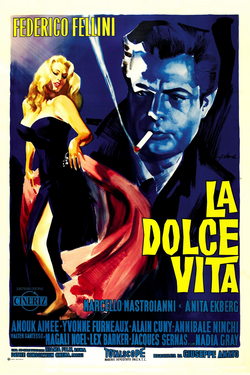
Behind the film
- Year
- 1960
- Director
- Federico Fellini
- Writers
- Federico Fellini, Ennio Flaiano, Tullio Pinelli, Brunello Rondi
- Genres
- Comedy, Drama
- Production
- Pathé
- Country
- France, Italy
- Cast
- Marcello Mastroianni, Anita Ekberg, Anouk Aimée, Yvonne Furneaux, Magali Noël, Alain Cuny, Annibale Ninchi, Walter Santesso
About the film
Contains story spoilers.
Rome is already a spectacle when La Dolce Vita begins. A helicopter carries a religious statue above the city while the journalist Marcello follows, an image that puts tradition, modern movement and public attention together before the story settles on a conversation. Federico Fellini’s 1960 film then moves through nights and mornings rather than building one conventional investigation or romance. Marcello, played by Marcello Mastroianni, can enter the places where glamour is produced and observe the people who inhabit them. The access is attractive, but it does not tell him what to do with his life. Each encounter promises another possibility and leaves him looking for something he cannot quite name.
His profession makes attention part of the problem. Celebrities, wealthy acquaintances and public events provide material for a journalist working in a world of gossip and photography. The camera can preserve a face while ignoring what the person needs, and being present is not the same as understanding. Marcello is neither simply outside that world nor securely at home within it. He participates, desires and occasionally recoils. Paparazzo and the other photographers make the pursuit of images visible as labour, competition and intrusion. The film’s crowded streets and interiors give that pursuit momentum, allowing a private moment to become another scene people gather around before its participants have chosen to expose it.
Marcello’s encounters with Maddalena and Sylvia offer different kinds of escape. Anouk Aimée’s wealthy Maddalena can move through the city with a freedom that does not remove her boredom. Anita Ekberg’s visiting film star Sylvia becomes the centre of attention wherever she goes, yet the night with Marcello leads toward an apparently private enchantment at the Trevi Fountain. That image offers beauty without permanence. The arrival of morning breaks the spell rather than converting it into a relationship. Fellini lets the sequence be seductive while placing it within a larger rhythm of interruption: Marcello can reach a remarkable moment and still have no clearer account of what should follow it.
Emma’s relationship with Marcello gives the wandering a more painful domestic counterpart. Her desire for love and stability becomes entangled with jealousy, while he resists the kind of life she imagines they should share. Yvonne Furneaux’s performance makes that conflict more than a complaint interrupting his pleasure. Emma can be wounded and demanding at the same time, and Marcello’s uncertainty does not prevent him from causing hurt. The film also follows a supposed religious manifestation that becomes a gathering of reporters, spectators and people hoping for a miracle. Faith, anxiety and the appetite for a public event are hard to separate once cameras and crowds have arrived.
Steiner seems to offer Marcello another model: an intellectual life with music, thoughtful friends, a family and a home that appears removed from the frantic pursuit outside. The gatherings invite conversations that sound more substantial than celebrity gossip, and Marcello can imagine writing seriously within such a world. Yet Steiner’s own unease complicates the image of fulfilment. His later killing of his children and death by suicide destroy the possibility of treating that household as a simple answer. Marcello is left facing a tragedy that the outward signs of culture and security had not explained. The journalists’ attention surrounding the aftermath also returns the film to its unsettling question about what observation can do to another person’s pain.
A visit from Marcello’s father offers a more ordinary missed connection. The evening becomes another excursion through nightlife, and the chance to share something meaningful slips away as the older man’s energy fails and he prepares to leave. Elsewhere, a seaside waitress named Paola interrupts Marcello’s attempt to write with a presence that feels unlike the sophisticated circles occupying his nights. These episodes matter because they provide alternatives at a human scale: family, work and an encounter outside the machinery of celebrity. None arrives as a guaranteed cure. Marcello’s difficulty lies partly in recognising an opportunity without becoming able to remain with it long enough for it to change anything.
The later party and the movement toward the beach bring fatigue into the foreground. Pleasure becomes repetitive, and Marcello’s participation looks less like exploration than a role he knows how to perform. The group encounters a strange creature hauled from the sea, another object to look at without necessarily understanding it. Across a stretch of water, Paola tries to communicate with him. He cannot hear her clearly and turns back toward his companions. Her final presence leaves the audience with a face and possibility that Marcello is moving away from, rather than an explanation that resolves the film’s symbols. The ending’s distance is emotional as well as physical.
Nino Rota’s music, Otello Martelli’s photography and Fellini’s staging give the episodes different textures without breaking their connection to Marcello’s search. Packed social spaces can feel lively and lonely at once, while dawn repeatedly changes the meaning of the night preceding it. Written by Fellini, Ennio Flaiano, Tullio Pinelli and Brunello Rondi, the film allows splendour to remain splendid even when it fails to satisfy the people chasing it. Its world contains tenderness, wit and wonder alongside cruelty and exhaustion. Understanding Marcello does not require deciding that every pleasure is false. It requires noticing how often he reaches something worth attending to and then continues onward, leaving the encounter behind before it can become a life.