
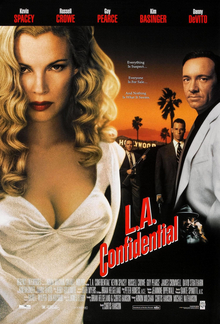
Behind the film
- Year
- 1997
- Director
- Curtis Hanson
- Writers
- Brian Helgeland, Curtis Hanson
- Runtime
- 2h 17m
- Genres
- Crime, Neo-noir, Mystery, Drama
- Production
- Regency Enterprises, Warner Bros. Entertainment
- Country
- United States
- Cast
- Kevin Spacey, Russell Crowe, Guy Pearce, Kim Basinger, Danny DeVito, James Cromwell, David Strathairn, Paolo Seganti
About the film
Contains story spoilers.
Curtis Hanson's L.A. Confidential places three officers inside a department that wants its authority to look convincing. A uniform, promotion or public arrest can supply an image of order even when the conduct behind it is violent or compromised. Ed Exley, Jack Vincennes and Bud White approach that system with different resources: institutional ambition, celebrity access and physical intimidation. Their methods make them useful to people who want more than a solved case. The mystery requires each man to recognize how the conduct he regards as his own specialty can be redirected, making cooperation depend on understanding the limits of the image he has built around himself.
Following the Bloody Christmas police scandal, Exley investigates the Nite Owl massacre, whose victims include Bud's former partner Stensland. Three suspects escape custody and die in Exley's shootout, apparently settling the case. Inconsistencies keep Exley and Bud investigating, while Jack's publicity scheme with Sid Hudgens leads to actor Matt Reynolds's murder. Jack traces links to Captain Dudley Smith, who kills him. His last words, Rollo Tomasi, are a private name Exley had shared; Smith's repetition of it exposes his involvement. Exley and Bud uncover Smith and businessman Patchett's attempt to seize Mickey Cohen's criminal empire, including the heroin behind the massacre. Smith's ambush fails, and Exley kills him. The department suppresses the truth and presents Smith as a hero, rewarding Exley for cooperation. Bud, wounded but alive, leaves with Lynn Bracken, while Exley remains inside the institution whose reputation he has helped preserve.
The officers' progress repeatedly depends on noticing what a finished public account has omitted. Closing a case produces a medal and a usable story, yet the reward can discourage further questions. Exley's concern with advancement therefore becomes inseparable from the standards he claims to enforce. Bud's connection to Lynn gives him an interest outside the department's hierarchy, but that connection can itself be manipulated through photographs and jealousy. The film makes exposure costly before its final compromise: discovering a hidden arrangement may also mean discovering how one's own choices helped it operate. Their alliance grows through that uncomfortable recognition, rather than through an assumption that they already represent the same kind of justice.
The film’s three leads are not merely different personalities assigned to the same case. Each embodies a distinct bargain with the department. Exley believes promotion and procedure can make him powerful enough to enforce standards. Vincennes borrows glamour from Hollywood to gain access and status, then learns that his arrangement makes him useful to the wrong people. Bud’s anger initially looks like a direct response to abuse, but the movie keeps asking whether a private sense of justice can excuse the force he uses. Their evolving alliance depends on each seeing a flaw in the others’ methods.
Hollywood itself is built into the plot’s machinery. Hudgens packages police work as sensational copy, and Patchett’s operation supplies women altered to resemble movie stars for clients who want an illusion tailored to them. Lynn’s resemblance to Veronica Lake makes her both a person and a product in this economy of image. The film’s title refers to a scandal magazine, and the fictional Hush-Hush publication echoes the appetite for stories that are partly true, partly arranged and always valuable to someone. Publicity is not background decoration; it changes careers and redirects investigations.
Although it uses familiar noir materials—night streets, compromised officials, private desire and a detective’s pursuit of a hidden order—the film gives its 1950s Los Angeles a brightly legible surface. Hotels, coffee shops, police offices and movie-premiere spaces are composed with period detail, yet the characters remain the central evidence. Locations such as the Formosa Restaurant and Angelino Heights help the story move between glamorous public spaces and the rooms where coercion occurs. The visual world looks orderly enough to sell an official myth, which makes its corruption more disturbing. Rather than copying the high-contrast look of older noir, the film’s frame often allows faces, furniture and streets to remain clearly visible at once. That choice suits a mystery in which the danger is often social: who controls the story, who is believed, and who can turn an arrest into entertainment. The period design enriches those scenes without concealing that the characters are making decisions in a world of recognizable institutions.
The adaptation condenses a dense crime world around three officers, giving the mystery an interlocking structure that rewards careful attention without making the case itself the only point. A scandal photo can appear to explain a relationship while concealing how it was staged; a suspect’s death may close one line of inquiry while opening another. Jerry Goldsmith’s score and Dante Spinotti’s composed widescreen images let scenes retain a smooth, almost elegant surface as their moral content grows more troubling. The polished form echoes the city’s appetite for a reassuring picture.
The ending refuses to pretend that truth automatically defeats power. Exley has enough evidence to expose the network, but the institution still decides which story it can live with, granting Smith a heroic public death and rewarding Exley’s cooperation. Bud’s departure with Lynn offers a smaller, private exit rather than reform. Their choices do not cancel the value of what they uncovered; they show the limits of exposing one conspiracy when the machinery of reputation survives. That uneasy balance is why the story’s final image feels less like a solved puzzle than a negotiated compromise.