
Behind the film
- Year
- 1998
- Director
- Karan Johar
- Writers
- Karan Johar
- Genres
- Drama, Romance, Coming-of-age, Comedy drama
- Production
- Dharma Productions
- Country
- India
- Cast
- Shah Rukh Khan, Kajol, Rani Mukerji, Salman Khan, Farida Jalal, Anupam Kher, Reema Lagoo, Himani Shivpuri
About the film
Contains story spoilers.
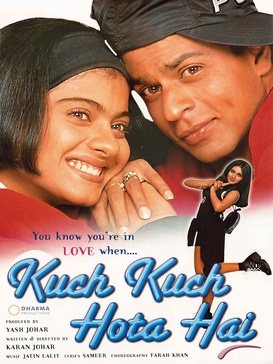
Kuch Kuch Hota Hai makes friendship the starting point of a romance that its characters do not recognise at the same time. Karan Johar's film follows the distance between enjoying someone's company and understanding what that attachment might mean to the other person. Shah Rukh Khan's Rahul and Kajol's Anjali have an ease together that initially seems secure precisely because neither has to explain it. The arrival of Rani Mukerji's Tina changes that arrangement. What one person experiences as an exciting new relationship becomes another person's quiet loss, giving the later reunion an emotional history rather than the simplicity of a first meeting.
In college, Anjali falls in love with her friend Rahul, but he falls for Tina. Anjali leaves after learning his feelings, and Rahul and Tina marry. Tina later dies following their daughter's birth, leaving letters asking the child to reunite Rahul with his former friend. Young Anjali finds her namesake at a summer camp, bringing her father into contact with the woman he has not seen for years. Their renewed closeness is complicated by the older Anjali's engagement to Aman. At the wedding, Rahul finally declares his love; Aman recognises that Anjali wants another future and withdraws. Rahul and Anjali marry, fulfilling the daughter's undertaking while Tina remains part of the family's memory.
The college setting gives the first relationship a crowded, playful social world. Affection develops among friendships, appearances and the effort to be noticed, so private feelings have to compete with a public image. Rahul's confidence does not make him perceptive about every person around him. Anjali's closeness can appear so familiar that he fails to recognise the risk involved when she hopes it might become something else. That is an important imbalance within the opening relationship. The film asks the audience to understand a feeling before the person receiving it does, creating poignancy within scenes whose surface energy remains comic and lively.
Kajol gives Anjali's change of circumstances a continuity that matters beyond changes in presentation. The returning adult carries the memory of an attachment that was not reciprocated when she first tried to acknowledge it. Seeing Rahul again therefore cannot be reduced to discovering that he now finds her attractive. The encounter brings an old vulnerability into a life where she has made other commitments. Her hesitation has that history behind it, making reunion both appealing and difficult. The character must recognise what she wants in the present without pretending that the earlier disappointment never happened or that another person's feelings carry no claim on her attention.
Tina's letters allow an absent person to shape the family's future. Mukerji's role belongs to the earlier romance, but her character's decisions continue through something she has left for her daughter. That gives memory a practical form. A child can read, interpret and act upon it, rather than merely hearing adults describe a mother she cannot remember in the same way. Tina's wish also makes the renewed relationship part of an existing family story. The film does not need Rahul to abandon every trace of his marriage to find another attachment; the past becomes one of the things drawing the living characters toward each other.
Sana Saeed's young Anjali turns that inheritance into action. Her determination makes the second part of the film less dependent on adults conveniently encountering one another by chance. She has an intention, yet her understanding of the situation remains a child's understanding. Bringing people together cannot automatically resolve their reluctance, uncertainty or obligations. This gives her efforts a mixture of confidence and emotional exposure: she can make the meeting possible but cannot control what the adults do with it. The family comedy consequently sits beside a more serious question about what a child needs from the people whose lives she is attempting to rearrange.
Salman Khan's Aman gives the final choice another human participant. He is not merely an impediment that can be removed without consequence once the preferred couple recognises its feelings. His position makes the romantic resolution require a response from someone who has imagined a different future. A wedding intensifies that difficulty because private uncertainty is arriving within a public commitment. The film gathers relationships into that setting, where recognition must become action. Aman's withdrawal allows the ceremony to change its meaning, but the emotional generosity of the act depends on acknowledging that he is relinquishing something that mattered to him.
Music gives these changing relationships space beyond ordinary conversation. The soundtrack by Jatin-Lalit can carry longing, playfulness and the shared energy of a gathering, allowing the film's emotions to occupy a larger scale than a private exchange alone. That scale suits a story moving between college friendship and a family trying to form itself again. By the end, two generations have participated in the reunion, and affection reaches across the absence left by Tina's death. Kuch Kuch Hota Hai brings its romance to a celebratory conclusion without making the earlier separation disappear. The happiness depends on the characters finally understanding a connection that once seemed too familiar to examine, then choosing to give it a different future.