
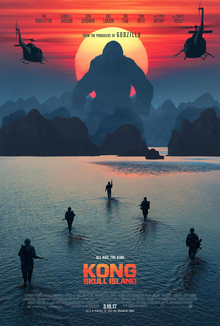
Behind the film
- Year
- 2017
- Director
- Jordan Vogt-Roberts
- Writers
- Dan Gilroy, Max Borenstein, Derek Connolly
- Genres
- Speculative fiction, Fantasy, Action
- Production
- Warner Bros. Entertainment, Legendary Pictures, Tencent Pictures
- Country
- United States
- Cast
- Tom Hiddleston, Samuel L. Jackson, John Goodman, Brie Larson, John C. Reilly, John Ortiz, Corey Hawkins, Jing Tian
About the film
Contains story spoilers.
In 1944, pilot Hank Marlow and Japanese pilot Gunpei Ikari crash on an island; a giant ape interrupts their fight. In 1973, Monarch researcher Bill Randa takes soldiers, tracker James Conrad and photographer Mason Weaver to map Skull Island with seismic charges. Kong attacks and scatters the expedition. Conrad's group meets the Iwi people and older Marlow, who explains Kong protects the island from subterranean Skullcrawlers. Colonel Packard, grieving lost men, instead pursues Kong; after learning his missing second has died, he swears revenge. Conrad and Weaver come to see Kong as protector, but Packard traps him. The largest Skullcrawler emerges, Packard is killed by Kong, and the humans help Kong defeat the creature. Survivors reach extraction; Marlow leaves after decades, while Kong remains on the island.
Skull Island is designed as a complete ecological argument. The explorers arrive with equipment intended to measure and expose a territory, but their instruments become part of the disturbance that awakens its dangers. The island's food chain does not arrange itself around human importance: the giant inhabitants have their own relations, territory and survival pressures. Kong's scale first makes him appear as an overwhelming obstacle, then the film's widening view shows how his place in that environment differs from the predators beneath it. This shift asks the characters and audience to reconsider what counts as a monster when a human expedition enters an ecosystem it does not understand.
Packard and Conrad embody sharply different legacies of war. Packard has returned from Vietnam with his unit intact but the war ending; his fixation on killing Kong gives him a target against which he can keep acting like a commander. Conrad's skill is to read a landscape and get people through it, rather than demand that it submit to his authority. Their conflict is not only tactical. Packard believes his men deserve revenge for their deaths, while Conrad comes to see that retaliating against Kong would deepen the danger for everyone. The film lets the language of military duty become a contest over whether obedience means carrying out a command or protecting the living.
Weaver's camera provides another way to look at the expedition. She is a war photographer who knows an image can bear witness, but witnessing does not automatically make her neutral or safe. The equipment she carries is lighter than the soldiers' weapons, yet it makes her an observer inside a mission whose consequences she has to interpret. Her attention to the island and Kong contributes to the group's changing perspective, not because she can solve every danger with a photograph, but because she is willing to question the story the armed men tell themselves. The film uses her role to distinguish observation from conquest.
Marlow changes the island's sense of time. He arrived as a young pilot in another war and has spent decades learning how its people and dangers fit together. His friendship with Ikari cuts across the conflict that brought both men there, making his history an alternative to Packard's loyalty to a military unit. Marlow's adaptation is comic in its practical details, but it also shows how a person can survive by accepting that the island is not a temporary battlefield waiting for his departure. His presence supplies local knowledge while reminding the expedition that its own arrival is only one brief episode in a much longer story.
The film's framing repeatedly makes human figures small against the island's vertical forms, tangled plants, cliffs and immense creatures. Helicopters and formations give the soldiers a temporary sense of control, then the opening attack breaks that geometry apart. Later, the landscape is not just background for the monsters: routes, rivers and open ground determine which groups can reunite and what choices they can make. The contrast between a clean military plan and a visually dense environment helps the action remain readable while conveying how little of the terrain the expedition commands.
The film also repositions the familiar Kong figure. He is neither simply a captive attraction nor a giant villain destroying a human settlement; in this story he is a territorial protector whose violence is tied to the presence of threats below the island's surface. The human characters do not become harmless because they recognize that fact. They have already caused damage and continue to carry weapons and conflicting plans. That unresolved imbalance gives the creature adventure a distinctive shape: understanding Kong alters the mission's moral map, but it does not erase the danger or make the human visitors innocent.
The 1973 setting folds the end of one conflict into the opening of another kind of discovery, and the soundtrack and period imagery keep the expedition rooted in a specific moment rather than in a timeless monster-showcase. Yet the film avoids making the human group a single unified point of view. Soldier, scientist, tracker, photographer and stranded veteran understand the island through different histories. Those differences give the journey its movement: the main question is not merely whether the team can survive, but whether the survivors can stop treating every unfamiliar force as something to destroy.