
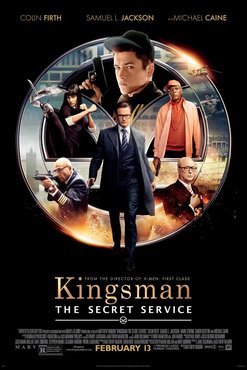
Behind the film
- Year
- 2014
- Director
- Matthew Vaughn
- Writers
- Jane Goldman, Matthew Vaughn
- Runtime
- 2h 7m
- Genres
- Spy, Action, Comedy, Action comedy
- Production
- Marv Studios, 20th Century Studios
- Country
- United States, United Kingdom
- Cast
- Taron Egerton, Colin Firth, Samuel L. Jackson, Mark Strong, Michael Caine, Sofia Boutella, Sophie Cookson, Jack Davenport
About the film
Contains story spoilers.
Eggsy Unwin is recruited by Harry Hart into Kingsman, a secret intelligence organization disguised behind a London tailoring house. Eggsy trains alongside Roxy under Merlin, but fails a final test when he refuses to shoot his dog, unaware that the gun contains blanks. Harry investigates billionaire Richmond Valentine after a scientist’s implanted chip explodes and Kingsman links the signal to free SIM cards distributed worldwide. Valentine activates a signal that makes people violently aggressive; Harry is caught in its effect at a Kentucky church and later shot. Eggsy discovers that agency leader Chester King supports Valentine’s plan and kills him with poison before joining Merlin and Roxy to stop the launch. After Roxy disables a satellite, Valentine replaces it and the signal activates. Eggsy infiltrates the bunker, Merlin triggers a failsafe in the protective chips, and Eggsy kills Valentine with Gazelle’s bladed prosthesis. Roxy becomes Lancelot, Eggsy succeeds Harry as Galahad, and the mid-credits scene brings him back to confront Dean and help his family leave home.
The tailoring-house premise lets the film turn clothing into both camouflage and social access. A suit signals a practiced code; the same room that offers a fitting can conceal surveillance equipment and weapons. Eggsy’s recruitment therefore carries more than a career change. He moves into a space whose manners suggest inherited privilege, while his own background has taught him to read pressure and threat quickly. The contrast gives his growth a class dimension without requiring him to abandon his family or pretend that the organization’s style is morally superior.
The training course keeps returning to a distinction between obedience and judgment. Eggsy’s refusal to shoot the puppy costs him the position because the institution treats obedience as a requirement, yet the audience has been shown why he makes the choice. This moment gives an emotional logic to the character that the later crisis needs: he may be impatient with formal rules, but he does not accept every instruction as ethical just because it comes from an authority. Roxy’s success and Eggsy’s failure are not treated as simple proof that one is braver than the other; they set different temperaments inside the team.
Valentine’s environmental justification reframes the spy plot as a conflict about who claims the right to decide which lives count. He presents a world problem as a reason for mass violence, while privately arranging protection for a chosen group. The free SIM cards make his plan depend on public participation: people accept the device before understanding its hidden function. That mechanism gives the film’s satire an everyday entry point. The villain is not a conqueror arriving from outside, but a powerful person whose technology is already welcomed as a gift.
Harry’s church sequence is a tonal hinge. The film lets the signal’s effects overwhelm an experienced agent rather than keeping him immune as a moral observer. It turns a familiar spy into part of the violence and undercuts the idea that skill can always preserve control. The frenetic staging and sudden shifts in who is acting against whom make the scene deliberately excessive; later action keeps that heightened register. Yet the plot uses the event to expose Valentine’s threat and Harry’s vulnerability, not only to display choreography.
The final operation makes the organization’s equipment answerable to its own flaw. The protective chips were designed for Valentine’s selected guests, but Merlin’s failsafe turns that protection into a weakness. Eggsy’s improvisation and Roxy’s satellite work matter because the established leadership has already failed ethically. The climax’s gadgets, secret identities and combat set-pieces draw on spy conventions, while their outcomes hinge on questions about trust and responsibility. This balance keeps the film from becoming merely a sequence of elegant devices.
Eggsy’s closing move toward his family reframes the meaning of his new position. Kingsman provides a path away from Dean’s control, but the film does not treat Eggsy’s earlier life as something to erase. His mother and half-sister remain central to his sense of responsibility, and the mid-credits scene makes that connection explicit. The organization’s code becomes valuable insofar as it helps him protect people, rather than because the code itself deserves unquestioning respect.
Vaughn’s direction combines tailored silhouettes and gadget close-ups with accelerated fights and deliberately broad comedy. The abrupt changes in tone keep the spy ritual from feeling solemn, and the choreography gives characters distinct physical vocabularies: Gazelle’s prosthetic blades alter distance and rhythm, while Eggsy’s style remains more improvised. Based on a comic, the film embraces an exaggerated register but shapes its own screen arc around class, recruitment and family. Its visual polish is part of the joke as well as part of the attraction; manners and expensive technology cannot guarantee good judgment. The film’s own style is part of how it questions the prestige attached to secret institutions. It plays the audience’s expectation of spy glamour against its effects.