
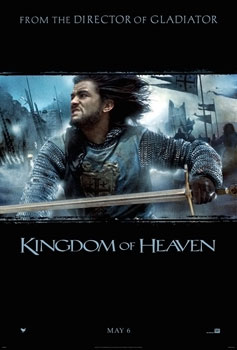
Behind the film
- Year
- 2005
- Director
- Ridley Scott
- Writers
- William Monahan
- Genres
- Epic, Drama, War, Action
- Production
- 20th Century Studios, Scott Free Productions, Babelsberg Studio
- Country
- United Kingdom, Germany, United States
- Cast
- Orlando Bloom, Eva Green, Jeremy Irons, Edward Norton, Liam Neeson, Brendan Gleeson, Marton Csokas, Ghassan Massoud
About the film
Contains story spoilers.
Balian is a blacksmith in medieval France, grieving the recent death of his wife. Crusaders arrive and their leader, Baron Godfrey, reveals that he is Balian’s father, asking him to travel to Jerusalem. Balian refuses at first. After discovering that the local priest ordered his wife’s body beheaded and stole her crucifix, Balian kills him and burns the smithy. He then joins Godfrey’s company, seeking redemption for himself and his wife. The film begins with a private loss and a decision to leave home, then widens toward a political struggle over the fragile peace between Jerusalem’s Christian rulers and Saladin.
On the road to Messina, Godfrey’s party fights soldiers sent by his nephew to arrest Balian. An arrow wounds Godfrey. Before dying, he knights Balian and names him Baron of Ibelin, charging him to protect the helpless. Balian sails for the Holy Land, but a storm destroys his ship; he survives and walks through the desert. He fights a Muslim cavalier over a horse, kills him, but spares the cavalier’s enslaved guide. The guide leads him to Jerusalem, where Balian frees him. That small decision becomes important later: the man is Imad ad-Din, Saladin’s chancellor, and he remembers the mercy when Balian is captured.
Balian meets King Baldwin IV, whose leprosy is concealed beneath a mask, and Tiberias, the Marshal of Jerusalem. He inherits an estate at Ibelin and uses his engineering knowledge to help its people irrigate the land. Princess Sibylla, Guy de Lusignan’s wife, visits him and they become lovers. Guy and Reynald of Châtillon threaten the truce by attacking Muslim caravans. When Saladin marches against Reynald’s castle, Baldwin asks Balian to defend the nearby villagers. Balian leads the defense despite being outnumbered. The Crusaders lose, but Imad releases Balian in gratitude for having been spared earlier, showing how a single encounter can cross the religious and military divisions of the plot.
Baldwin and Saladin negotiate a truce, while Baldwin urges Balian to marry Sibylla and take command of the army. Balian refuses because he will not make Guy's execution the price of peace. After Baldwin dies, Guy becomes king, and the restraints on his appetite for war fall away. Reynald's violence supplies another provocation. Balian warns against marching away from Jerusalem's water supply, but Guy ignores him. Saladin defeats the exhausted Crusaders, captures Guy, and executes Reynald. With the kingdom's army destroyed, Jerusalem faces a siege. Tiberias withdraws to Cyprus, while Balian remains with civilians who cannot simply abandon the city and start elsewhere.
Balian organizes Jerusalem's defenses and resists Saladin's siege, but his responsibility extends beyond holding a wall. The people sheltered inside would pay for a refusal to surrender with no prospect of relief. When the two commanders negotiate, Balian threatens to destroy the city rather than allow a massacre; Saladin offers safe passage in exchange for its surrender. Balian accepts. Sibylla leaves with him and returns to France, where he takes up the work of a blacksmith again. An English king later seeks the defender of Jerusalem for another crusade. Balian declines, bringing his journey back to the ordinary identity he had before inherited rank pulled him into this struggle.
The film presents its Crusader characters as compromised rather than uniformly heroic: Guy’s appetite for war endangers the people he claims to rule, while Balian’s blacksmith’s skill becomes useful in irrigation and siege defense. The masked Baldwin and Saladin’s measured negotiations give the conflict figures who can see the cost of escalation. Although the story uses historical names and the setting of the Crusader kingdom, many characters and relationships are fictionalized; Balian’s romantic and family story is not a record of biography. Its movement from a village forge to the walls of Jerusalem keeps asking how an individual can protect ordinary people when leaders turn faith and authority into war.
The Hospitaller gives Balian a quieter companion to the rulers and soldiers competing for his allegiance. Conversations about belief take place alongside doubts, exhaustion, and practical decisions rather than resolving the conflict through an easy claim that one army is righteous. Balian has gone to Jerusalem looking for an answer to grief, but its politics offer no simple spiritual cure. The people who speak most confidently about divine permission can also be the quickest to endanger strangers. His father's charge to protect the helpless becomes a more usable obligation: something he can attempt even when he cannot settle the meaning of suffering or reconcile competing religious claims.
Baldwin's mask makes the strain of kingship visible through concealment. The office seems composed while the body behind it is failing, and the fragile agreement he sustains will not survive merely because others inherit his title. Saladin, played by Ghassan Massoud, is given the measured authority of a commander who can negotiate as well as fight. Against those figures, Balian's uncertainty and practical background remain significant. He cannot command a kingdom into permanence, but he can recognize the difference between defending its people and defending a ruler's pride. The scale of Jerusalem makes that distinction concrete: towers, roads, and crowds reveal how many lives are involved in what the powerful call a cause.