
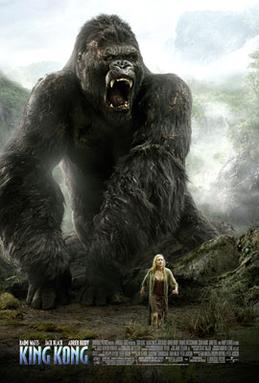
Behind the film
- Year
- 2005
- Director
- Peter Jackson
- Writers
- Fran Walsh, Philippa Boyens, Peter Jackson
- Genres
- Adventure, Drama, Action, Romance
- Production
- Universal Pictures, WingNut Films
- Country
- United States, New Zealand
- Cast
- Naomi Watts, Jack Black, Adrien Brody, Thomas Kretschmann, Colin Hanks, Jamie Bell, Andy Serkis, Evan Parke
About the film
Contains story spoilers.
Peter Jackson’s King Kong gives its expedition a city to escape before it gives it an island to explore. New York in 1933 is full of shuttered opportunities, desperate job seekers and entertainment that promises more glamour than the people making it can afford. Ann Darrow is a vaudeville performer whose theatre has closed. Filmmaker Carl Denham is also approaching a dead end, but responds by treating other people’s doubts as something to manoeuvre around. He recruits Ann for a picture, knowing that her admiration for playwright Jack Driscoll will help persuade her. What looks like a chance to work becomes a voyage whose true destination Carl has deliberately concealed.
The ship Venture carries a mixture of sailors and film workers, each with a different reason to resent the journey. Captain Englehorn wants to protect his vessel, Carl wants footage, and Jack finds himself aboard longer than he intended. Ann and Jack develop an attachment during the passage, giving her an ally whose interest is personal rather than commercial. Jack Black plays Carl as a man able to turn a setback into another sales pitch without pausing to consider whom it might cost. His insistence on reaching Skull Island continues after the trip has become dangerous. The film’s early attention to money and employment makes that decision part of a continuing habit, rather than a sudden descent into greed.
Skull Island is introduced through fog, rocks and an enormous wall that separates a human settlement from the interior. The expedition’s first encounter with the inhabitants becomes violent, and Ann is later abducted to be offered to Kong. Jackson presents the island through the outsiders’ fear, using a stylised hostile community and a landscape that seems to overwhelm every attempt to understand it. Beyond the wall, the rescuers encounter an environment where ordinary human scale offers no protection. Dense vegetation, steep ravines and prehistoric animals repeatedly break the group apart. Their firearms and equipment are useful in moments, but cannot give them command of the place they have entered.
Ann’s experience differs from that of the men pursuing her. Kong is initially terrifying, yet her attempts to entertain him with movements from her stage routine create a connection. Naomi Watts gives these scenes a practical progression: Ann watches for reactions, discovers something that interests him and gradually stops responding only with fear. Kong’s protection of her against enormous predators adds another layer to their relationship. The fights remain dangerous even when he is winning, with Ann caught among bodies and branches whose movements she cannot control. Once the danger recedes, moments of stillness allow the creature’s curiosity and attachment to emerge without turning him into a speaking human character.
Meanwhile, the rescuers are driven through a succession of disasters. A dinosaur stampede turns the expedition into a struggle simply to stay upright and avoid being crushed. The ravine beneath a fallen log becomes an insect-filled trap, where the threat comes from things close enough to reach the men as they try to climb away. These sequences give the island a density beyond one famous monster: it contains an entire hostile food chain. Jack continues after the others have had reason to retreat, eventually finding Ann and bringing her towards the coast. Carl, having lost the footage that justified the trip, sees an opportunity to replace his unfinished film with the living creature itself.
Kong follows Ann and is subdued, then transported to New York for exhibition. The theatre turns an encounter that mattered to Ann into a packaged story controlled by Carl. Ann refuses to take part, leaving the presentation to substitute performers and props while Kong stands restrained before an audience. Cameras and commotion contribute to his escape, and the city becomes another environment in which he is pursued and surrounded. The contrast with Skull Island is sharper than a simple change of location. New York can advertise him, confine him and sell access to him, but its streets and buildings still cannot accommodate the creature without treating his presence as a crisis.
Ann finds Kong, and their reunion briefly suspends that crisis. The movement across the frozen pond in Central Park recalls the quieter moments they shared on the island: she can respond to him without the demands of a crowd or an expedition. The pursuit resumes, leading them to the Empire State Building. Aircraft circle the tower while Ann tries to remain near Kong and protect him from the attack. His height, previously a source of power, leaves him exposed above the city. After he falls, Jack reaches Ann, while Carl supplies the familiar romantic explanation for the disaster. His account passes over the decision to capture and exhibit Kong that brought them there.
Jackson wrote the screenplay with Fran Walsh and Philippa Boyens, retaining the Depression setting while expanding the relationships and the island’s physical dangers. Andy Serkis’s performance work and the digital creature’s animation give Kong distinct changes of attention, impatience and exhaustion; the scenes with Ann depend on those smaller responses as much as on scale. Adrien Brody’s Jack acts against Carl’s appetite for an audience, making rescue an undertaking pursued for one person. The film’s two kinds of performance therefore remain connected throughout: Ann’s skill establishes an unexpected rapport, while Carl’s showmanship converts living experience into merchandise. By the final tower sequence, the cost of that conversion has become impossible for Ann to ignore.