
Behind the film
- Year
- 1933
- Director
- Merian C. Cooper, Ernest B. Schoedsack
- Writers
- James Ashmore Creelman, Ruth Rose
- Genres
- Speculative fiction, Kaiju, Adventure, Horror
- Production
- RKO Pictures
- Country
- United States
- Cast
- Robert Armstrong, Fay Wray, Bruce Cabot, Frank Reicher, James Flavin, Sam Hardy, Noble Johnson, Steve Clemente
About the film
Contains story spoilers.
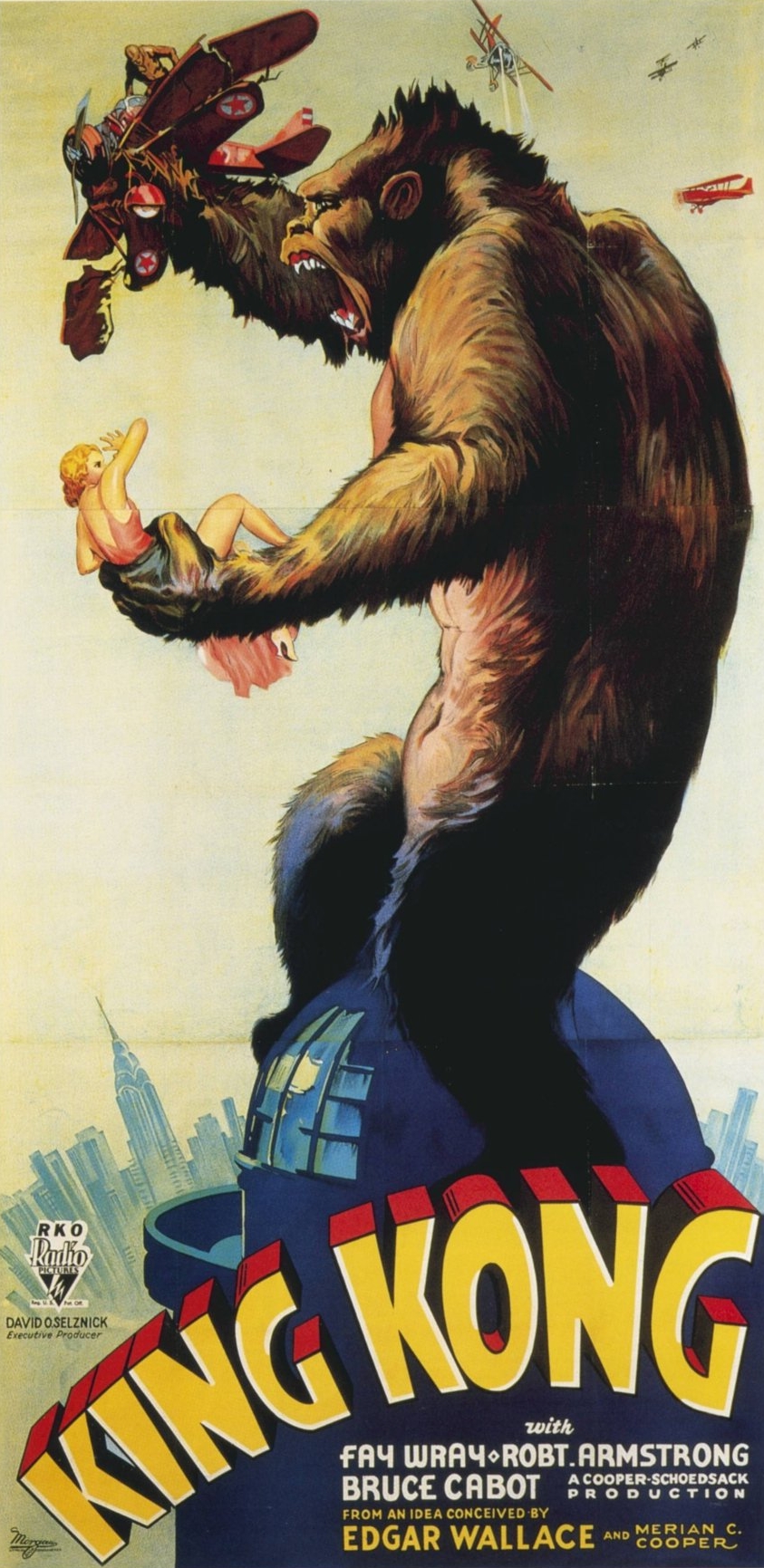
Carl Denham brings Ann Darrow aboard the Venture for a film expedition whose destination he has not fully explained. On the remote island, she is kidnapped and offered to Kong, a huge ape living beyond the settlement’s wall. Jack Driscoll follows through a landscape of prehistoric creatures and rescues her. Denham captures Kong and brings him to New York as a theatrical attraction, but the exhibition collapses when the chained creature breaks free. Kong finds Ann again and climbs the Empire State Building with her. Aircraft attack him; Ann survives, and Kong falls to the street. Denham gives the disaster a romantic explanation, even though his own decision to convert a living creature into a commercial spectacle made the ending possible. This is the original 1933 story, distinct from the later remakes and their different relationships between Ann and Kong.
Denham begins by looking for an actress, and that search reveals how his adventure is also a business arrangement. He needs a person who can occupy a role inside a film he has already imagined, while Ann needs work and food in the city where he finds her. Their different needs make his offer persuasive without making it fully informed. Robert Armstrong’s energetic confidence gives Denham the ability to sell a future before he can guarantee it, a trait that carries from the expedition to the theatre. His reaction to danger is to recognize the value of what he has discovered. That persistence drives the action, but it also narrows his capacity to ask whether something impressive should be brought into his possession at all.
The island’s wall establishes a boundary between human settlement and a world that resists ordinary control. Beyond it, size and physical force replace the familiar organisation of streets and rooms. Kong is enormous, but the creatures around him can also threaten, and the rescue party enters an environment that does not adapt itself to their intentions. The film’s miniature landscapes and animated combat make that difference legible through scale. A human figure can cross the same image as something whose movements turn a tree or cliff into an obstacle. The adventure repeatedly changes what counts as a safe distance, allowing the jungle to become a series of precarious routes rather than a backdrop through which the men can simply pass.
Willis O’Brien’s effects work gives Kong an expressive physical existence inside that miniature world. The creature needs more than size to sustain the story: movement must convey attention, aggression, curiosity and response. Stop-motion animation produces those changes by arranging small adjustments into an apparently continuous action, while the film combines different scales of construction with live performers. The technical illusion is closely tied to the drama because Kong must be both a danger the humans cannot casually defeat and a presence whose reactions the audience can follow. A display of force can therefore be followed by a smaller gesture, making the same body carry more than one emotional meaning without turning the creature into a speaking character.
Ann’s position within that spectacle differs from the more reciprocal relationship developed in the 2005 remake. Wray’s fear and vulnerability are central to the original rescue story, and Driscoll’s pursuit gives the human action its immediate purpose. Kong’s fascination does not erase the terror of being taken from the ship or handled by a creature so much larger than herself. The film also depicts the island’s inhabitants through fabricated exoticism and racial caricature, presenting their society largely as part of the danger surrounding the expedition. That portrayal belongs to the film’s construction of an imagined place, rather than an account of any real culture. Its adventure world distributes understanding unevenly, giving the visitors individual motives while reducing the people they encounter to a threatening collective.
New York transforms the dimensions of the conflict. The city can supply lights, chains, publicity and paying spectators, but none of those arrangements guarantees control over Kong. The stage frames him as an attraction before the surrounding buildings become part of his escape, turning architecture meant for human habitation into a route for another body. The Empire State Building provides a new height in place of the island’s mountain, while the aircraft bring a form of violence the earlier creatures could not. The final confrontation therefore changes the terms of the adventure: Kong’s strength can disturb the city, but industrial technology can reach him even where the crowd below cannot. His removal from one world has made him vulnerable to the rules of another.
Max Steiner’s score helps give the creature’s movement and the expedition’s danger an emotional continuity across these changes of scale. The film alternates curiosity, threat and pathos, asking the audience to invest in an attraction that its fictional showman also wants to exploit. Its final scene leaves the monster publicly visible as a body in the street, surrounded by the spectators whose interest helped bring him there. Denham’s explanation turns the outcome into a legend about beauty and desire, allowing him to tell one more compelling story. The images permit another reading alongside it: a creature has been captured, displayed and destroyed, and the person responsible remains able to decide how the event will be described.