
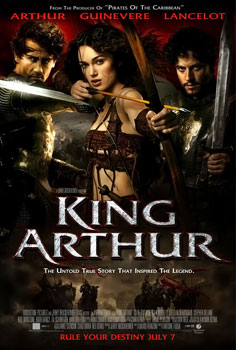
Behind the film
- Year
- 2004
- Director
- Antoine Fuqua
- Writers
- David Franzoni
- Runtime
- 2h 6m
- Genres
- Action, Drama, War, Medieval
- Production
- Touchstone Pictures, Walt Disney Studios Motion Pictures, Jerry Bruckheimer Films
- Country
- United States, United Kingdom, Ireland
- Cast
- Clive Owen, Ioan Gruffudd, Mads Mikkelsen, Joel Edgerton, Hugh Dancy, Ray Winstone, Ray Stevenson, Keira Knightley
About the film
Contains story spoilers.
King Arthur reshapes familiar legendary figures around the pressures of military service and a withdrawing empire. Antoine Fuqua's film presents Arthur as a commander whose loyalties have been formed within Rome's system, while the people around him face the prospect of being left to defend themselves. Clive Owen gives the central character a seriousness suited to that conflict. Arthur has to decide what an obligation means when the institution demanding it no longer seems capable of meeting its own responsibilities. The adventure uses its setting to make leadership a problem of judgment, not merely a title waiting for its rightful owner.
Arthur and his Sarmatian companions are due to finish their service when a bishop orders a last mission beyond Hadrian's Wall. They must rescue a Roman family before invading Saxons arrive. At the estate, Arthur discovers imprisoned people, including Guinevere, and frees them. Returning south, the group fights across a frozen lake, where Dagonet sacrifices himself. Arthur's growing disillusionment with Rome leads him to stay and defend Britain after the knights are discharged. His companions return to join him against the Saxons. Lancelot and Tristan die in the final battle, but Arthur defeats Cerdic. He marries Guinevere and is proclaimed king, while the ending remembers the absent knights rather than treating the victory as costless.
Owen's Arthur carries the difficulty of a man who takes duty seriously enough to discover its contradictions. Simply refusing orders would be one response, but the film makes his conflict more demanding by placing vulnerable people within the assignment he has been given. He cannot protect them through a neat distinction between official obligation and personal conscience. That gives his leadership a changing basis. The authority attached to a commission must compete with the authority earned by responding to the people immediately in front of him. His decisions reveal that change before the final recognition grants it a public form.
The knights make the prospect of departure emotionally complicated. Their shared experience means an official end to service is not automatically an end to the relationships formed within it. Ioan Gruffudd's Lancelot offers an important alternative to Arthur's readiness to remain, bringing concern for the group into an argument about what they still owe. The disagreement does not require one man to lack courage. It asks whether surviving long service should permit a person to leave, and whether affection for a commander can justify another risk. The film's bond among soldiers therefore includes friction, allowing loyalty to be exercised through choice rather than simple obedience.
Keira Knightley's Guinevere connects Arthur to a world his military position has helped him regard as external. Her presence makes the people of Britain active participants in the question of who should defend the island. She belongs to an adventure that gives her physical agency rather than restricting her to the role of a future king's reward. That changes the meaning of their relationship: attraction develops beside a challenge to Arthur's assumptions about belonging. The film places personal connection within a political reorientation, letting intimacy and responsibility point toward a home he has not previously understood in the same way.
The frontier setting gives objects and landscapes practical weight. A wall marks the reach of an institution, yet people live on either side of that boundary and danger does not respect it. Weather and terrain can alter the conditions under which trained soldiers act, preventing military experience from making the environment entirely predictable. The action therefore places bodies within spaces that can help or threaten them. Ray Stevenson's Dagonet and Mads Mikkelsen's Tristan add different presences to that group, making the ensemble more than a series of names from a familiar story. Their individual abilities contribute to a shared effort whose losses remain visible.
The Roman framework should be understood as the film's imaginative arrangement of Arthurian material, rather than a verified reconstruction of the legendary king's life. Its military setting gives the story a language of service, power and withdrawal that differs from a courtly romance organised around an established kingdom. That choice allows the emergence of kingship to become an answer to a perceived vacuum. The question is not only who deserves honour, but who will remain when an existing authority leaves. Reading the film on those terms makes its dramatic priorities clear without asking its costumes, battles or political alliances to prove a historical theory.
The final recognition of Arthur follows a decision made before he knows whether it will succeed. He stays when remaining has become something he must choose, rather than something his former commanders can simply demand. The others' return places companionship beside that decision, while their deaths prevent the conclusion from giving everyone the future they hoped to obtain. Marriage and kingship offer a new structure after the battle, but remembrance remains part of the image of victory. King Arthur turns the foundation of a legend into an account of people choosing a responsibility together. The resulting kingdom carries the traces of those who could not inhabit it, making the promise of leadership inseparable from the losses through which it emerged.