
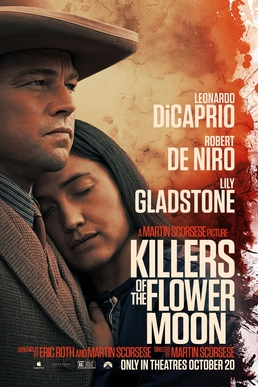
Behind the film
- Year
- 2023
- Director
- Martin Scorsese
- Writers
- Martin Scorsese, Eric Roth
- Runtime
- 3h 26m
- Genres
- Thriller, Drama, Detective, Western
- Production
- Appian Way Productions, Apple TV, Imperative Entertainment
- Country
- United States
- Cast
- Leonardo DiCaprio, Robert De Niro, Lily Gladstone, Jesse Plemons, Tantoo Cardinal, John Lithgow, Brendan Fraser, Cara Jade Myers
About the film
Contains story spoilers.
The story begins with the Osage discovering oil beneath their land, a source of wealth that the law places under the control of white guardians. After World War I, Ernest Burkhart comes to live near his uncle William King Hale, a rancher who cultivates an image of friendship with the Osage. Ernest courts Mollie Kyle and marries her, while Hale secretly arranges killings that will transfer family headrights to Ernest. As Mollie’s relatives die and she herself is poisoned, federal investigators expose the conspiracy. Ernest is arrested, gives testimony against Hale, and finally refuses to admit to Mollie that he poisoned her; she leaves him.
The film’s central unease comes from the distance between what Ernest says and what he does. Leonardo DiCaprio plays him as a man who can be tender at home and obedient to Hale’s schemes without resolving the contradiction. Mollie’s trust is not an abstract moral test: their marriage gives the plot an intimate daily setting, with children, meals and medical routines placed beside the machinery of theft. The camera’s attention to ordinary life makes the conspiracy feel less like a distant criminal puzzle than a threat entering a household that already has its own rhythms.
Lily Gladstone gives Mollie a quiet authority that changes the balance of the story. She notices that illness and death are being treated as misfortune by people who benefit from them, and her requests for help persist even when others dismiss or manipulate her. Her scenes with Ernest carry affection, but the film does not let affection erase the unequal ground beneath the relationship. Mollie’s family wealth is visible as both a source of choice and a target; guardianship, medical access and local influence determine who can act on that wealth and who can claim to protect it.
Hale’s public persona is part of his method. Robert De Niro makes his friendliness socially fluent: he knows names, speaks as a benefactor and appears comfortable among the people whose deaths he arranges. That performance matters because the crime depends on institutions and relationships, not simply on a secret villain hiding in a remote lair. Ernest has access to Hale’s private instructions, while the town’s officials and financial structures create cover. The open prairie and ranch buildings do not signal freedom here; land is precisely what makes the Osage vulnerable to people who believe a legal entitlement can be converted into personal property.
The investigation arrives after the film has made the audience inhabit the Burkhart household and the Osage community. Jesse Plemons’s agent Thomas White works through a network of witnesses, records and interrogations, but the procedural strand never turns into a simple contest between a clever detective and a criminal mastermind. What needs to be uncovered has been allowed to persist through local complicity and the assumption that Osage testimony can be discounted. The investigators can gather evidence, yet their arrival cannot restore the people already lost or undo the conditions that made the murders possible.
Scorsese’s staging frequently puts several kinds of information in one frame: a family conversation can carry both emotional warmth and an unspoken financial calculation. Rather than isolate every clue in a close-up, the film allows faces, rooms and pauses to make the audience register how people behave when they think they are safe. The long duration supports that accumulation. The crimes feel repetitive because the perpetrators rely on repetition, while small differences in Mollie’s condition and Ernest’s responses become increasingly difficult to ignore.
The production’s Oklahoma landscapes are not decorative wilderness. Oil derricks, roads, homes and ranch property mark a lived-in region where wealth is extracted and organized through contracts, inheritance and outside authority. The film’s attention to Osage ceremony and family presence places a community on screen beyond the murder plot, though the narrative’s perspective remains a dramatic construction rather than a complete account of Osage history. That distinction matters: this story draws from documented events, but the film’s chosen scenes and viewpoint cannot stand in for every person or consequence in the historical record.
The final movement refuses an easy emotional release. Ernest’s cooperation helps establish Hale’s crimes, but the intimate question Mollie asks him is not answered with the confession she deserves. His words and actions remain separated, and the separation has a cost that a courtroom outcome cannot resolve. Mollie leaves Ernest, but the film continues into a radio-drama epilogue that turns the crimes into a public account. That shift asks who controls memory: after hours spent with a family and community, the events are packaged for an audience through a format that cannot restore those lives. The epilogue makes storytelling itself visible, while the losses remain beyond the reach of a tidy retelling. The film ends by holding that gap between public narration and the lived consequences it can only partially contain.