
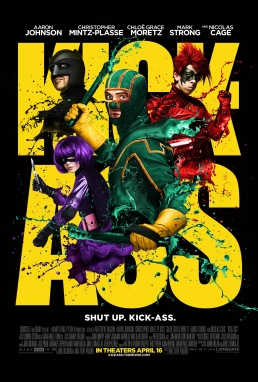
Behind the film
- Year
- 2010
- Director
- Matthew Vaughn
- Writers
- Matthew Vaughn, Jane Goldman
- Genres
- Action, Teen, Comedy, Superhero
- Production
- Plan B Entertainment, Marv Studios
- Country
- United Kingdom, United States
- Cast
- Christopher Mintz-Plasse, Mark Strong, Nicolas Cage, Aaron Taylor-Johnson, Chloë Grace Moretz, Lyndsy Fonseca, Michael Rispoli, Clark Duke
About the film
Contains story spoilers.
Dave Lizewski puts on a homemade superhero costume and discovers that enthusiasm cannot protect him from a knife. Surgery leaves him less sensitive to pain, but gives him no superpowers. After a filmed confrontation makes Kick-Ass famous, he encounters Big Daddy and Hit-Girl, a father and daughter pursuing mob boss Frank D'Amico. Frank's son Chris adopts the identity Red Mist to gain Dave's confidence and trap the vigilantes. A televised assault kills Big Daddy; Hit-Girl rescues Dave. Together they attack Frank's headquarters, and Dave kills him with a rocket launcher. Mindy enters a more ordinary life, while Chris prepares revenge. The apparent superhero breakthrough has produced grief, new enemies and consequences that a costume cannot contain.
The film starts with a familiar adolescent desire: being somebody extraordinary would make ordinary awkwardness bearable. What complicates that desire is the distance between imagining a role and possessing the skills it demands. Dave treats the superhero as an available social identity, something a person might adopt through an outfit and an act of will. The city does not agree to the conventions of the story he wants to inhabit. That mismatch supplies both comedy and injury. Matthew Vaughn's film keeps the promise of fantasy attractive while making its early practical failures difficult to overlook, so identification with Dave remains inseparable from recognising his dangerously limited preparation.
Aaron Taylor-Johnson's Dave belongs to a recognisable world of school friends, romantic uncertainty and the hunger for attention. His civilian life matters because it gives the mask something to interrupt. The appeal of an invented identity is partly that it appears to bypass all the negotiation involved in being known by other people. Yet concealment creates fresh misunderstandings rather than an uncomplicated escape from them. The performance allows youthful self-consciousness to survive inside the action film. Dave's imagined transformation can be much more impressive than the person carrying it out, and the difference gives the film a vulnerable centre beneath its swagger.
Chloë Grace Moretz's Mindy makes that centre harder to hold comfortably. Her competence is exhilarating within the choreography and disturbing within the family arrangement that produced it. A child who can perform the genre's impossible work exposes how implausible Dave's aspiration was, but she also raises a question about what has been sacrificed to make someone so effective. Nicolas Cage's Big Daddy turns parental instruction into an extension of a revenge mission. Their closeness cannot by itself make that education benign. The film places affection and instrumentalisation in the same relationship, leaving the viewer to notice how easily devotion can be used to justify narrowing a child's world.
The criminal side also contains a father and child, giving the conflict a second inheritance. Chris is not simply Dave's opposite in costume; he belongs to an established structure of power that Dave initially understands through an invented persona. Christopher Mintz-Plasse's presence helps connect social insecurity with the attraction of status, while Mark Strong supplies a more settled, threatening authority. These family arrangements complicate the apparent division between amateur heroes and professional villains. Young people are discovering who they might become inside scripts that adults have already written for them, and the costumes can conceal that dependence even while announcing individual identity.
Publicity changes the meaning of heroism here. An event can acquire a reputation because it circulates as an image, long before anyone has understood the participant's limits or motives. The online audience helps make a superhero possible as a public figure, but attention is not training, protection or moral judgment. This makes the film's contemporary setting integral to its premise. A homemade legend can spread quickly enough to outrun the person attached to it. The gap between visibility and competence also explains the unstable tone: an episode that looks impressive from a safe distance can be frightening when the film returns to the exposed body inside the costume.
Vaughn's action style takes pleasure in comic-book exaggeration without consistently protecting the characters from brutality. Bright identities and emphatic movement can make a confrontation look like fantasy entertainment, while the consequences intrude with a much harsher register. The resulting experience includes graphic violence, strong language and deliberate provocation. It is an adult comic action film whose central child character makes that combination especially confrontational. The screenplay by Vaughn and Jane Goldman uses recognisable superhero patterns as material to distort. Knowing those patterns helps explain the jokes, but the underlying disagreement between the desired fantasy and the vulnerable person pursuing it remains easy to grasp.
What stays unresolved is whether the excitement of the spectacle can be separated from its critique. The film allows the audience to enjoy feats whose human cost it has also made visible. That tension belongs to its account of escapism: fictional heroism can supply confidence, style and a way to imagine resisting injustice, yet it can also turn damage into an attractive identity. Dave and Mindy embody very different routes into that problem. One begins by longing for a larger life; the other has been trained into a life with alarmingly few alternatives. Kick-Ass leaves those differences in view even when its action invites the exhilaration of a triumphant superhero ending.