
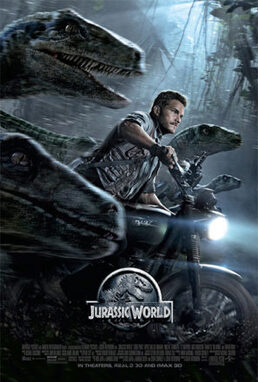
Behind the film
- Year
- 2015
- Director
- Colin Trevorrow
- Writers
- Rick Jaffa, Amanda Silver, Colin Trevorrow, Derek Connolly
- Runtime
- 2h 4m
- Genres
- Science fiction, Adventure, Action
- Production
- Amblin Entertainment, Legendary Pictures, The Kennedy/Marshall Company
- Country
- United States
- Cast
- Chris Pratt, Bryce Dallas Howard, Irrfan Khan, Vincent D’Onofrio, Ty Simpkins, Nick Robinson, Omar Sy, BD Wong
About the film
Contains story spoilers.
Jurassic World begins with the extraordinary becoming routine. Isla Nublar now supports a functioning resort, complete with queues, shops, guided attractions and visitors who expect more than a glimpse of a living dinosaur. That success gives the film its problem: once a miracle becomes a product, management needs a new reason for people to keep paying attention. Claire Dearing oversees the park through numbers, schedules and presentations, while her nephews Zach and Gray arrive hoping for a holiday with her. The difference between the younger boy's excitement and his brother's distraction introduces the challenge the park has chosen to solve through escalation.
The Indominus rex is the answer to that demand, an engineered animal whose combined traits have been selected to produce a larger attraction. Its enclosure makes it look like something already understood because it has walls, sensors and a name. Owen Grady's visit challenges that confidence. His work with the raptors depends on repeated contact and recognition, not a belief that animals become obedient once humans assign them a purpose. Chris Pratt makes that distinction practical rather than scholarly: Owen notices the conditions of confinement and asks about the creature's experience. Claire initially hears those concerns within the framework of an operational problem she expects the park to manage.
The apparent disappearance from the enclosure reveals the danger of measuring an unfamiliar animal with familiar tools. The Indominus has capabilities its handlers do not anticipate, and the attempt to confirm its escape becomes an opportunity for it to leave. Once loose, it does not simply behave like another hungry predator. Its attacks expose a creature whose development and isolation have produced something the park has never properly observed. Tracking technology and armed response offer information without dependable control. The progression from a contained anomaly to an island-wide emergency turns the park's impressive infrastructure into routes the threat can exploit rather than proof of safety.
Zach and Gray's excursion in a gyrosphere places the visitors' confidence inside a literal transparent shell. The ride encourages the feeling that close contact can remain entirely separate from risk, until the boys cross into an area where that promise no longer holds. Their escape carries them toward the abandoned remains of the original park, where familiar objects have become overgrown evidence of an earlier failure. The contrast gives the adventure a sense of historical repetition without requiring the children to know that history. Their relationship also becomes more direct under pressure: the older brother's detachment gives way to practical concern as an entertaining outing becomes an effort to survive together.
The crisis has different meanings for the adults managing it. Simon Masrani wants the park's achievement protected, Henry Wu defends the genetic work, and Vic Hoskins sees a chance to demonstrate the raptors' military usefulness. Those interests prevent the emergency from becoming a straightforward shared effort to protect guests. The attack on the aviary and the release of flying creatures carry danger into the crowded visitor centre, collapsing the division between distant paddocks and the commercial heart of the resort. Claire's priorities change as the people she has treated as visitor figures become individuals she must find, beginning with the nephews she delegated to someone else.
Using the raptors to track the Indominus briefly makes Owen's relationship with them appear transferable to a larger operation. The encounter instead reveals another part of the hybrid's design: its raptor ancestry gives it a means of communicating with the pack. The animals' shifting allegiance exposes the weakness in Hoskins' assumption that a bond can be purchased as a weapons system. Owen must work to restore recognition, while Wu's evacuation with genetic material shows that commercial interest can survive even as the park fails. The threatened people and the protected research are being moved according to different priorities, making the escape more than an isolated accident.
The final confrontation gathers the park's competing spectacles into a struggle its designers can no longer direct. Claire releases the Tyrannosaurus and brings it toward the Indominus, while Blue's return alters the balance of the fight. The Mosasaurus ends the hybrid's attack at the lagoon, making the surrounding environment decisive rather than granting any human a complete victory over it. The sequence uses familiar animal silhouettes as dramatic personalities, but it also preserves the danger of the setting. Survivors can leave because one confrontation has ended, not because the park has been repaired or the animals have accepted its original arrangement.
Colin Trevorrow's film places that spectacle beside a clear change in Claire and Owen's understanding of one another. Bryce Dallas Howard's movement from formal management to direct action gives the rescue a personal line through the collapsing systems, while the boys' reunion with their parents returns the enormous disaster to a recognisable family concern. The island's closing image belongs to a dinosaur rather than its operator. Jurassic World's world is built around the idea that technology can keep wonder available on demand, and its story follows what happens when that demand outruns attention to the life supplying it. The creatures remain extraordinary; the failure comes from assuming extraordinary life can be treated as ordinary inventory.