
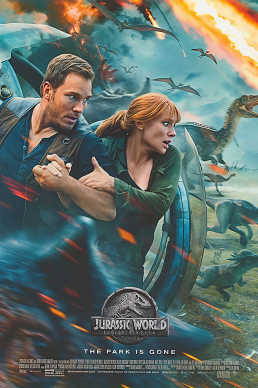
Behind the film
- Year
- 2018
- Director
- J. A. Bayona
- Writers
- Derek Connolly, Colin Trevorrow
- Genres
- Science fiction, Adventure, Action
- Production
- Universal Pictures, Amblin Entertainment, Perfect World Pictures
- Country
- United States
- Cast
- Chris Pratt, Bryce Dallas Howard, Rafe Spall, Jeff Goldblum, Daniella Pineda, Justice Smith, Isabella Sermon, B. D. Wong
About the film
Contains story spoilers.
Three years after Jurassic World’s collapse, a volcano threatens the surviving dinosaurs on Isla Nublar. Claire Dearing organizes a rescue and brings Owen Grady to find Blue, the last raptor he trained. Their mercenary guides betray them: Blue is shot, Owen is left unconscious, and Claire and Franklin escape the eruption aboard a ship carrying captured animals. The dinosaurs are taken to Benjamin Lockwood’s California estate for a private auction, where Eli Mills plans to sell a weaponized Indoraptor. Maisie learns Mills murdered Lockwood and uncovers her own origin as a clone. Owen and Claire disrupt the sale and evade the Indoraptor through the mansion to its roof, where Blue confronts it. Maisie opens the cages when toxic gas threatens the animals. The dinosaurs escape into the world; Malcolm declares a new era of coexistence.
J. A. Bayona gives the film a clear two-part shape. Isla Nublar is an exposed landscape where the volcano makes every choice urgent; Lockwood’s mansion compresses the danger into rooms, corridors and glass cases. The change of setting makes the rescue premise unstable. Owen and Claire first believe the animals are being moved to safety, then discover that transport itself is part of a commercial scheme. The film shifts from disaster adventure to gothic-house thriller without abandoning the same moral question: who has the right to decide what happens to a living creature created by human intervention?
Claire’s return changes the character established by the earlier park story. She is no longer the executive who sees the island through operational systems; the Dinosaur Protection Group gives her a public cause and a practical network. Yet the film does not make advocacy automatically wise. Claire still accepts a deal whose terms she cannot fully control, and the rescue team’s apparent expertise conceals a motive to capture rather than protect. Bryce Dallas Howard plays her commitment as conviction mixed with imperfect judgment, which keeps her from becoming a simple spokesperson for the film’s theme.
Owen and Blue bring an asymmetrical relationship into the story: familiarity can resemble trust without becoming ownership. Chris Pratt's physical assurance gives Owen the look of someone equipped to handle danger, but that assurance is more interesting when the creature remains beyond complete human command. The film's ethical tension lies inside the attractive fantasy of a special bond. Caring for an animal requires attending to something that cannot simply speak its agreement to a plan. A confident handler and a sophisticated organisation can therefore seem capable of rescue while still misunderstanding what protection would require beyond the immediate emergency.
The island's visual scale makes human planning look painfully small. Smoke, ash and enormous bodies overwhelm the idea that an operation can proceed through tidy stages. The disaster-film register supplies urgency, while the animals make the image more complicated than a landscape people merely need to flee. They can be threats, victims and magnificent spectacles within the same sequence. That unstable position is part of the franchise's appeal and its moral difficulty. Looking at an astonishing creature is pleasurable even when the story is asking whether the habits of possession behind such a spectacle are defensible.
Isabella Sermon's Maisie changes the emotional scale of the mansion material. A child's perspective makes an impressive household look like an institution whose adult rules are difficult to understand and impossible to negotiate. That perspective connects the story's interest in protection with its interest in confinement. A place can be presented as a refuge by the people managing it and still feel like a prison to the person living there. Maisie's significance lies in how she troubles neat distinctions between natural life, manufactured life and the rights adults presume to exercise over both.
Rafe Spall gives Mills the confidence of a man who regards ambition as a form of competence. That smoothness suits a world in which terrifying possibilities can be described through reassuring commercial language. The auction aesthetic turns rarity into value and spectatorship into participation, making the surrounding adults more than witnesses to an isolated villain. A polished presentation encourages people to overlook what the transaction assumes about life. Scientific sophistication cannot answer that moral problem on its own. The film brings technical ability and business fluency together to ask how expertise becomes dangerous when success is measured chiefly through the capacity to sell its results.
The mansion borrows the visual language of a gothic creature feature. Corridors imply hidden movement, glass creates unequal knowledge, and domestic rooms lose their promise of safety. Bayona's shift from open disaster to enclosed suspense changes how the same danger is experienced: the island dwarfs people, while the house places it close enough to invade personal space. The movement makes the rescue question harder to settle with a successful departure. Saving life has consequences beyond removing it from an immediate hazard, and the story leaves care, containment and responsibility in an uneasy relationship after its largest confrontation has passed.