
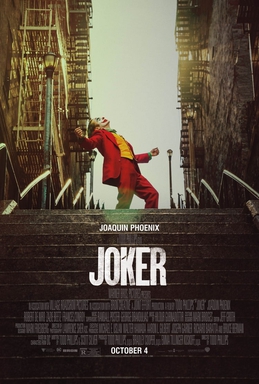
Behind the film
- Year
- 2019
- Director
- Todd Phillips
- Writers
- Todd Phillips, Scott Silver
- Runtime
- 2h 1m
- Genres
- Crime, Thriller, Drama, Psychological thriller
- Production
- Warner Bros. Entertainment, DC Entertainment, Village Roadshow Pictures
- Country
- United States
- Cast
- Joaquin Phoenix, Robert De Niro, Zazie Beetz, Frances Conroy, Brett Cullen, Shea Whigham, Bill Camp, Marc Maron
About the film
Contains story spoilers.
Todd Phillips’s Joker is set in a fictional Gotham City during an economic downturn. Arthur Fleck works as a party clown, cares for his mother Penny and hopes to become a stand-up comedian. A neurological condition causes uncontrollable laughing fits, and the city’s social services program supplies the medication and counseling he depends on. When budget cuts close the program, Arthur loses that support at the same time that crime and public anger seem to be worsening around him. The film’s early scenes keep him moving through buses, apartment corridors and narrow streets, placing his private distress within a city that appears to have little patience for it.
After street youths attack Arthur at work, a co-worker gives him a revolver for protection. The gun accidentally falls from his pocket during a children’s hospital performance, and he loses his job. On the subway, three wealthy Wayne Investments employees mock and assault him. Arthur shoots them, then follows and kills the last man as he tries to escape. The killings become public news, and protesters begin wearing clown masks. Arthur sees his actions transformed into a political symbol, even though the people adopting the image do not know what happened or what he intended. The distance between an act and its public meaning becomes a central tension in the film.
Arthur begins spending time with Sophie, a neighbor he imagines as a romantic partner who understands him. Later scenes reveal that much of their relationship has taken place in his fantasy, rather than in shared encounters. His stand-up performance at a club goes badly, and host Murray Franklin shows a clip of it on television for ridicule. Arthur’s mother has told him that Thomas Wayne may be his father, so he tries to approach Wayne and is rebuffed by the family butler, Alfred. After Penny is hospitalized following questioning about the subway murders, Arthur visits her medical records and learns that she adopted him, that he suffered severe abuse as a child and that her account of his parentage was not reliable. The discovery destabilizes his remaining belief that his life has a hidden explanation.
Arthur confronts Penny and later kills her in the hospital. He also kills Randall, the colleague who supplied the gun and lied about it, while sparing their co-worker Gary. Murray invites Arthur onto his show after airing the humiliating stand-up clip. Arthur accepts and plans to use the broadcast to make a statement, arriving in a clown costume and asking to be introduced as Joker. When Murray continues to mock him, Arthur shoots and kills the host on live television. Police arrest him, but the city’s unrest escalates, and a masked rioter crashes into the police car carrying Arthur. He is pulled free and lifted onto a vehicle as a cheering crowd surrounds him. During the riots, another masked man corners Thomas and Martha Wayne outside a cinema and kills them in front of their son Bruce. Arthur’s celebrity and the Wayne family’s tragedy emerge from the same night of violence, without the film turning their connection into a personal encounter between Arthur and the child.
The film’s final movement returns Arthur to an institutional setting, where he tells a therapist a joke she does not understand. It leaves the relationship between his memories and the scenes we have watched deliberately unsettled. The clown persona has become a public image, but the film does not present the crowd’s reaction as a stable political movement with a clear program. It ends with Arthur walking through the institution and leaving bloody footprints implying further violence without showing what happened to the therapist, followed by an attempt to escape a staff member. The scene resists a neat account of what was real, and it closes on a character who has turned performance into a form of power.
Lawrence Sher’s cinematography and Mark Friedberg’s production design emphasize cramped interiors, dirty stairwells and the scale of the city beyond Arthur’s apartment. Hildur Guðnadóttir’s cello-led score gives his solitary movement a pulse that can feel intimate before it becomes ominous. The film’s dances and performances are not separate from the plot: Arthur uses them to test a version of himself that the world might notice. Joaquin Phoenix’s physical transformation makes the character’s changing posture visible, but the surrounding scenes keep him socially exposed rather than turning him into an invulnerable comic-book antagonist.
Joker is an original, standalone story based on DC characters, not a continuation of a specific Batman film series. It offers a fictional portrait of social neglect, media spectacle and a person’s unstable self-understanding. The movie presents Arthur’s accounts as unreliable, so scenes involving his supposed family history and relationship with Sophie should be read through that uncertainty rather than treated as objective facts. The protests in Gotham are part of the drama, not evidence about real political movements. By ending with a public persona and a private institutional frame, the film leaves the audience with the gap between who Arthur thinks he is and what others choose to make of him.