
Behind the film
- Year
- 2024
- Director
- Todd Phillips
- Writers
- Todd Phillips, Scott Silver
- Runtime
- 2h 18m
- Genres
- Crime, Drama, Thriller, Psychological thriller
- Production
- Warner Bros. Entertainment, Bron Studios, DC Entertainment
- Country
- United States
- Cast
- Joaquin Phoenix, Lady Gaga, Zazie Beetz, Brendan Gleeson, Catherine Keener, Jacob Lofland, Harry Lawtey, Steve Coogan
About the film
Contains story spoilers.
Joker: Folie a Deux opens with an animated short that reworks the end of the first film as a showbiz cartoon, with Arthur Fleck and the Joker presented almost like competing performers. The story then returns to Arkham State Hospital, where Arthur waits for trial after the murders that made him a public symbol. He has grown thin, quiet and dependent on medication. The guards treat the inmates as entertainment, with Jackie Sullivan repeatedly demanding that Arthur tell a joke. Arthur's lawyer, Maryanne Stewart, is preparing to argue that the Joker was a separate personality, a defence that might make Arthur legally insane rather than responsible for the crimes.
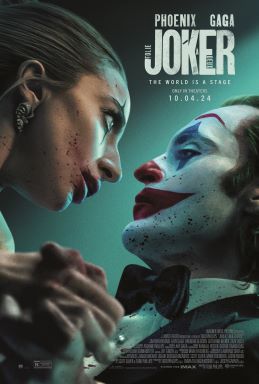
A visit through the hospital introduces Lee Quinzel, who sings in a music class and catches Arthur's attention. The songs that follow do not turn Arkham into a conventional musical world; they give Arthur a way to imagine the relationship and fame he wants. In a fantasy, the guards' umbrellas become colourful, while familiar standards become scenes where Arthur can stand beside Lee as an equal. Through songs and imagined duets, Arthur begins to picture a life beyond the locked ward. For him, the romance is both private comfort and a return to the Joker's public identity, which makes it difficult to separate what he feels from what the audience expects him to perform.
Lee says she grew up near Arthur's old neighbourhood and has watched the television film about his crimes again and again. She presents herself as someone who understands him because she loves the Joker. During a screening for Arkham's inmates, she starts a fire that creates a brief chance for them to get outside, but they are quickly recaptured. Arthur is sent to solitary confinement, while Lee is released and allowed to visit him. She urges him to embrace the Joker again, bringing makeup into the cell and promising that they can build a life together. Their closeness grows through these visits, but the promise rests on an image of Arthur that he is beginning to question.
When Arthur is returned to the general ward, Lee's attention helps him act bolder. He faces a televised interview with journalist Paddy Meyers, and when the questions press on his past, he breaks into song rather than answer in the terms the interviewer demands. The music supplies a release from rooms where every conversation is watched or recorded, but the performance also feeds the public's fascination with the Joker. Lee follows the trial from outside, while Arthur starts to mistake her support for proof that the persona is the only version of himself worth loving. The more he performs, the harder it becomes for him to tell whether he is choosing the role or being directed by it.
The courtroom turns that conflict into the film's central contest. Maryanne argues that Arthur and Joker are separate, while prosecutor Harvey Dent insists the man on trial is responsible for his actions. Arthur first goes along with the defence, then fires Maryanne and represents himself, arriving in court dressed as the Joker. A fantasy sequence gives him the courtroom spectacle he imagines: songs, applause and sudden violence reshape the proceeding into his own show. Outside that imagined performance, witnesses bring the consequences back into view. Sophie, his former neighbour, describes her real relationship with him, and Gary Puddles recalls seeing Arthur kill their co-worker. Gary's testimony unsettles Arthur because he had convinced himself that he only hurt people he considered bad, while Gary had always been kind to him and was still frightened by what he saw.
Lee's history becomes another crack in the story Arthur has built. Maryanne tells him that Lee came from a wealthy family, that her parents are alive, and that she admitted herself to Arkham to meet the Joker. She had not been a patient who shared his experiences; she had pursued the famous figure she wanted him to become. Lee later says she is pregnant after their encounter in solitary, and Arthur holds onto the claim as he tries to preserve their future. Yet her affection remains tied to his performance. When he begins to step away from the Joker identity, the romance loses its shape for her, leaving Arthur to confront how much of it depended on the crowd's version of him.
The guards' violence makes the choice harder rather than clearer. At Arkham, the guards assault Arthur in the shower and kill his friend Ricky in a neighbouring cell; Arthur hears what happens from his own cell. The next day, he tells the court there is no separate Joker: he has always been Arthur, and he admits killing his mother as well as the victims whose deaths were already part of the case. The jury finds him guilty. A car bomb explodes outside the courthouse before the verdict is fully read, opening a hole through which Arthur escapes with Joker followers. He finds Lee on the steps from the first film, but she rejects him after hearing his confession. She wanted the role he had refused to claim, so she leaves him to be arrested again.
Back at Arkham, Arthur follows a guard who says he has a visitor. A younger inmate asks him for a joke, then stabs him repeatedly in an empty corridor. As Arthur dies, the attacker cuts a smile into his own face. The final image shifts the Joker idea away from Arthur and toward the next person willing to inhabit it. Todd Phillips and cinematographer Lawrence Sher continue the earlier film's world, then distinguish Arthur's inner musical scenes from the restrictive hospital and courtroom through changes in colour and staging. Phillips described the fantasy world as the one Arthur imagines when he thinks he has found love. That contrast keeps the songs attached to his longing, even as the trial and Lee's rejection strip away the audience he hoped would stay.