
Behind the film
- Year
- 2003
- Director
- Peter Howitt
- Writers
- Neal Purvis, Robert Wade, William Davies
- Runtime
- 1h 28m
- Genres
- Action, Spy, Parody
- Production
- Working Title Films, StudioCanal
- Country
- United Kingdom, France
- Cast
- Rowan Atkinson, Ben Miller, John Malkovich, Natalie Imbruglia, Tim Pigott-Smith, Kevin McNally, Greg Wise, Oliver Ford Davies
About the film
Contains story spoilers.
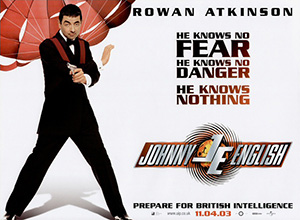
Johnny English begins with a man who has already imagined the heroic version of his career. Rowan Atkinson's English works for MI7 but dreams of the confidence, romantic appeal and professional authority of a leading field agent. His actual abilities are considerably less impressive. A series of disastrous security failures leaves the service without its experienced operatives, and the institution turns to him because it has nobody suitable left. That premise gives every expensive piece of equipment and official introduction a double meaning: English receives the outward signs of competence before demonstrating that he can responsibly use any of them.
His assignment concerns the Crown Jewels, which are being presented at an event connected with Pascal Sauvage, a wealthy French businessman. The jewellery disappears during a blackout at the Tower of London. English reacts to the confusion by injuring the wrong person and constructing an elaborate account of an assailant he has not actually encountered. His assistant, Bough, has to deal with the consequences while helping investigate the genuine theft. English can be sincerely committed to solving the crime and equally committed to preserving his own image. The second commitment keeps interfering with the first, turning an ordinary admission of error into another unnecessary performance.
Bough supplies the practical observation English so often lacks. Their pursuit of the thieves leads through a tunnel and into a chase involving hearses, with English's certainty taking him towards the wrong vehicle and an unrelated funeral. Those mistakes have a recognizable pattern: he settles on an interpretation, treats it as established fact and only notices the surroundings after acting upon it. Ben Miller's Bough rarely needs to compete for attention. His quieter responses keep the practical reality visible beside English's version of events. Their relationship makes the comedy more than a succession of accidents because somebody remains present to understand what the accident has actually done.
English suspects Sauvage despite the businessman's influence and his friendship with MI7's head, Pegasus. Lorna Campbell, a woman English encounters during the investigation, also becomes an object of suspicion before revealing that she is an Interpol agent following the same target. Sauvage's ambitions extend beyond stealing expensive regalia. He intends to take the British throne and use control of the country for a gigantic prison enterprise. Royal ancestry, ceremony and the possibility of impersonating an important religious official become mechanisms in a criminal scheme. The film enlarges a jewel theft into a fantasy about selling an entire national institution to somebody who regards it as a business opportunity.
An infiltration of Sauvage's headquarters gives English and Bough information but also exposes English's inability to handle the tools he carries. A muscle relaxant leaves him barely able to manage his own body while he attempts to make a serious accusation at a reception. Losing the case officially does not end his involvement: Campbell brings him into a further investigation at Sauvage's French château. Bough again proves essential when the operation collapses. English's bravery is not entirely imaginary, even when his preparation and execution are unreliable. He remains willing to enter dangerous places, but the willingness does not spare other people the work of getting him out.
The climax brings the investigation into the coronation ceremony, where English's intended revelations become further public embarrassments. His evidence disc contains a private recording of his own behaviour, and his attempt to expose an impostor proves disastrously misplaced. He eventually disrupts Sauvage's attempt to take the crown and lands in the position himself. The accidental elevation gives him enough authority to have Sauvage arrested before returning the throne to Elizabeth II. A romantic conclusion with Campbell does not suddenly make him proficient: the car's equipment supplies one more opportunity for a gesture to produce the wrong result. Success closes the conspiracy while leaving the character's habits intact.
Peter Howitt directs the comedy around the distance between English's formal presentation and Atkinson's physical performance. A dignified stance, a carefully arranged face or an apparently decisive movement can persist even as the situation becomes impossible to control. The character usually needs an extra moment to acknowledge what everyone else can already see. That delay allows embarrassment to accumulate without requiring him to become deliberately foolish. John Malkovich's Sauvage supplies a contrasting confidence, grounded in money, planning and a willingness to exploit the institutions around him. Both men understand the usefulness of appearances, but only one initially has a workable operation behind his.
Natalie Imbruglia's Campbell provides another kind of competence, giving English a colleague whose professional ability does not depend on indulging his fantasies. The screenplay by Neal Purvis, Robert Wade and William Davies places recognizable spy-film pleasures within reach: guarded buildings, covert entrances, gadgets, a grand conspiracy and a threatened country. Their familiarity helps make the misuses legible. English can behave as though the scene has been arranged for an effortless hero while encountering the resistance of doors, other people and his own limbs. His eventual usefulness comes through persistence and the support of better observers, rather than a transformation into the agent he imagines. The film consequently lets an unlikely hero accomplish something substantial while preserving the ordinary, inconvenient weaknesses that have made his assignment so hazardous.