
Behind the film
- Year
- 2023
- Director
- Chad Stahelski
- Writers
- Shay Hatten, Michael Finch
- Runtime
- 2h 49m
- Genres
- Action, Action thriller, Neo-noir, Adventure
- Production
- Summit Entertainment, Thunder Road Films, 87Eleven Entertainment
- Country
- United States
- Cast
- Keanu Reeves, Donnie Yen, Bill Skarsgård, Ian McShane, Hiroyuki Sanada, Shamier Anderson, Rina Sawayama, Laurence Fishburne
About the film
Contains story spoilers.
John Wick: Chapter 4 enlarges the assassin world while giving its central character a more definite problem than surviving another evening. John wants a route out of a system whose rules continually turn endurance into another obligation. Chad Stahelski's film makes that system elaborate enough to feel ceremonial: status can be withdrawn, places of sanctuary can be abolished, and a chance at freedom can depend on observing a ritual. The contradiction gives the action its larger shape. A man extraordinarily capable of moving through danger remains constrained by an institution that claims the right to decide what all that movement means.
The High Table empowers the Marquis to destroy John and punish those who shelter him. Old friend Caine is forced to hunt him under a threat to his daughter. John regains the standing needed to challenge the Marquis to a duel, which is arranged in Paris. The Marquis uses an escalating bounty to prevent him arriving on time, but allies help him reach the appointed place. Caine fights as the Marquis's proxy. After John is wounded, the Marquis steps forward to finish him without realising John still has a shot. John kills him and secures freedom, then collapses. A later graveside scene marks his apparent death, while another threatened act of revenge leaves the world beyond him unsettled.
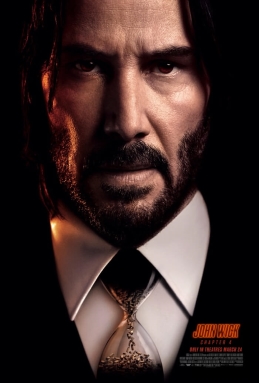
Keanu Reeves's performance makes exhaustion part of the action rather than something the film needs to hide between set pieces. John remains precise and determined, but the repeated impacts make persistence visibly costly. The relatively sparse speech keeps attention on what he can still do and how much effort the next movement demands. That physical emphasis is particularly important in a story about escape from endless service. Winning one encounter does not restore him to an untouched starting point. The body carries the accumulation, giving each new obstacle a relationship to the ones the audience has already watched him overcome.
Donnie Yen's Caine complicates the clean division between friend and enemy. He can oppose John while sharing knowledge, history and an interest in ending the institution's hold over their lives. His threatened daughter supplies a reason for compliance that is different from the Marquis's appetite for control. The character therefore gives combat a conflicted meaning: an opponent can be dangerous without wanting the world arranged in the way that makes the fight necessary. Yen's precision also offers another physical rhythm beside Reeves's burdened persistence. Their encounters make loyalty a practical question with consequences for people who are not standing in the immediate arena.
Bill Skarsgård's Marquis exercises a more detached form of power. Clothes, rooms and delegated violence give him a presentation of authority that contrasts with the bodily risks other characters face. He can raise a bounty or remove protection without sharing the danger his decision creates. Ian McShane's Winston operates within the same world through a different mixture of strategy, grievance and negotiation. Their exchanges make rules part of the dramatic action, not simply decorative mythology attached to the fights. A formal provision can become useful, but using it still requires understanding how people with power will try to preserve the advantage it appears to threaten.
The locations supply markedly different kinds of movement. Hotel interiors, a nightclub and Paris streets place bodies among thresholds, crowds and traffic, so the choreography has to remain legible within spaces that do not behave alike. The film's extended sequences use duration to make adaptation visible: a character cannot simply repeat the same solution in every environment. Geography becomes a source of fresh obstacles, while lighting and colour give each setting a heightened identity. The result is a world recognisable enough to navigate and stylised enough to belong to the series' ritualised criminal fantasy, rather than an ordinary account of urban violence.
The long approach to the duel turns punctuality into an action-film deadline. An apparently orderly agreement has a condition that the Marquis can attack without openly abandoning its rules. That distinction exposes the practical weakness of relying on a system's formal fairness when one participant controls the dangers surrounding it. John must win passage as well as the eventual contest, making the climb toward the appointed place a measure of the institution's reach. The screenplay by Shay Hatten and Michael Finch connects the physical ordeal to that logic, giving the audience a clear destination while complicating almost every route toward it.
The ending separates freedom from an uncomplicated future. The duel's result can release obligations, but it does not undo the costs incurred on the way or eliminate the grievances held by others. The graveside scene gives John's journey an apparent conclusion without proving that the surrounding world has learned to stop producing retaliation. That unresolved pressure is central to the film's scale: its institutions can extend far beyond any one combatant, while its most meaningful moments remain tied to particular relationships. Chapter 4 makes its spectacular action serve a question about whether leaving such a world can be achieved without carrying its consequences to the end.