
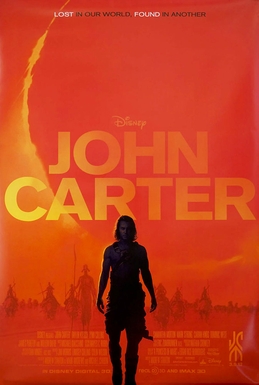
Behind the film
- Year
- 2012
- Director
- Andrew Stanton
- Writers
- Andrew Stanton, Mark Andrews, Michael Chabon
- Genres
- Fantasy, Science fiction, Action, Adventure
- Production
- Walt Disney Pictures
- Country
- United States
- Cast
- Taylor Kitsch, Lynn Collins, Willem Dafoe, Thomas Haden Church, Samantha Morton, Dominic West, James Purefoy, Mark Strong
About the film
Contains story spoilers.
John Carter takes a man who wants distance from conflict and gives him an unfamiliar world in which his physical presence immediately matters. On Barsoom, Carter can do things the people around him cannot, but the ability does not tell him whom to trust or what a victory should accomplish. That distinction supplies the adventure's underlying problem. Exceptional strength can make somebody useful to several competing causes at once, leaving the person carrying it to decide what use is acceptable. Andrew Stanton's film wraps that decision in an expansive planetary fantasy, where discovery, romance and political danger keep changing what going home would mean.
In nineteenth-century Arizona, former Confederate captain Carter activates an alien medallion and reaches Mars, called Barsoom. He encounters the Tharks and princess Dejah Thoris, whose city faces a forced political marriage. Hidden Therns are manipulating the conflict to exploit the planet. Carter chooses to help, wins the Tharks' support and defeats the immediate threat at Helium. He marries Dejah, but a Thern sends him back to Earth. Years later he stages his death, using a journal left to nephew Edgar Rice Burroughs to lure another Thern. Carter takes the medallion and returns. The apparent ending on Earth becomes the final move in his attempt to regain the life he has chosen elsewhere.
Barsoom gives the story several different ways of belonging. Carter arrives with an identity formed on Earth, yet that identity does not automatically make sense within Martian institutions. His strength changes the terms on which others approach him, sometimes making him valuable before they know anything about his wishes. The film can consequently be read as a fantasy about status arriving too quickly for understanding. Recognition is not always a gift. Being identified as someone capable of changing a conflict can expose a newcomer to claims from people whose accounts of that conflict remain incomplete. Learning the world matters as much as surviving it.
Taylor Kitsch's Carter and Lynn Collins's Dejah provide two positions within that learning process. He has unusual bodily advantages without the local knowledge to interpret everything they permit. She understands more of the political situation while facing obligations that constrain what she can choose. Their cooperation gives each access to something the other can supply, making the romance part of the adventure's exchange of knowledge rather than a reward added after the fighting. The surrounding threat matters because their private wishes cannot be separated easily from the fate of the societies in which those wishes might be realised.
The Tharks enlarge that social world beyond the rival humanlike cities. Carter has to encounter a people with their own relationships and authority rather than treating Mars as one uniform community. Tars Tarkas and Sola make those differences personal, allowing the adventure to move through loyalty and conflict within a group as well as between groups. The physical scale of the green Martians also gives the film another way to make Carter's altered abilities visible. A newcomer who looks comparatively small can become significant, yet that reversal does not erase the need to understand the people whose help he wants.
The Therns introduce a more distant form of power, concerned with manipulating communities rather than simply winning an open battle. Their presence changes how an apparent local conflict can be understood. A ruler may seem to act independently while benefiting another authority, and a proposed settlement may serve interests its subjects cannot see. The film's planetary spectacle therefore has an extractive logic beneath it. Destruction can be encouraged by people who expect to profit from the aftermath. Carter's choice to intervene becomes more specific once he recognises that the available account of the war conceals who is directing it and what they want from the planet.
The framing journal makes storytelling part of the plot's machinery. Edgar Rice Burroughs is both the author associated with the source material and a fictional recipient inside the film, allowing the account to move between an apparent record and an active plan. Reading is not only a means of learning what Carter has experienced. It helps create the conditions for the next action. The frame also lets the film reconsider what seemed to be a final departure: a body on Earth can conceal an intention that leads elsewhere. That device suits an adventure repeatedly concerned with appearances that acquire another meaning once additional information arrives.
Adapted from Burroughs's A Princess of Mars, John Carter gives its hero a journey from withdrawal towards a commitment he must actively maintain. Returning to Barsoom is not simply a way to recover a place where he is stronger. It is a way to rejoin people whose future has become important enough to organise his own. The film's large world gives that change several forms, from fighting beside allies to constructing a plan across years and planets. Its ending makes the chosen home something he has to reach again, leaving belonging as an action undertaken rather than a title automatically granted by extraordinary ability.