
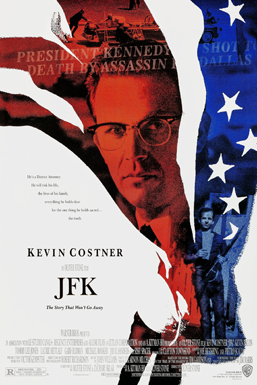
Behind the film
- Year
- 1991
- Director
- Oliver Stone
- Writers
- Oliver Stone, Zachary Sklar
- Runtime
- 3h 9m
- Genres
- Historical, Drama, Crime, Mystery
- Production
- Regency Enterprises, StudioCanal, Warner Bros. Entertainment
- Country
- United States
- Cast
- Kevin Costner, Joe Pesci, Gary Oldman, Tommy Lee Jones, Sissy Spacek, Laurie Metcalf, Michael Rooker, Jay O. Sanders
About the film
Contains story spoilers.
JFK is organised around the experience of believing that a public explanation has left something essential out. Oliver Stone's film gives Kevin Costner's Jim Garrison a determination that turns the search for answers into a consuming moral purpose. The drama's intensity comes from the feeling that every detail may connect to another, and that refusing the connection could amount to accepting an injustice. That feeling is a cinematic construction rather than a substitute for historical verification. Understanding the film means recognising the force of its argument while keeping the argument distinguishable from the events it depicts. Its confidence is part of what the audience is being asked to examine.
The story follows Garrison after Kennedy's assassination and Lee Harvey Oswald's death. Years later, the prosecutor reopens his inquiry and develops a conspiracy theory from interviews, apparent inconsistencies and accounts involving David Ferrie and Clay Shaw. A mysterious informant called X offers an explanation reaching into government and security structures. Garrison's staff disagree about aspects of the investigation, while his wife Liz questions the effect of its demands on family life. He brings Shaw to trial and presents his interpretation of the assassination to the jury. Shaw is acquitted. The film ends with Garrison maintaining his commitment, giving his conviction emotional weight without turning the verdict into confirmation that the prosecution's claims were established. These are the drama's positions and events, not an independent adjudication of the historical controversy.
Costner provides the argument with a reassuring centre. His measured manner makes the prosecutor's accumulating suspicions feel anchored to a person who regards his work as a duty. That relationship between temperament and persuasion matters. An audience may find someone credible because he appears steady, even when the propositions surrounding him require separate scrutiny. The performance gives the film room to become formally agitated without losing a familiar point of identification. Garrison's moral seriousness holds the investigation together emotionally, but seriousness cannot settle whether a particular inference is warranted. The tension between those things runs through the film's appeal.
The editing makes the inquiry feel larger than any single conversation. Images, recollections and reconstructions gather into a succession whose momentum encourages the viewer to search for a pattern. A cut can make two details feel related before their relationship has been demonstrated, and repetition can give an unresolved possibility the weight of something already encountered. Stone uses that capacity energetically. The film's world becomes one of competing fragments that seem to demand an organising explanation. Its technique is essential to what it is doing: persuasion emerges through the experience of assembly, allowing the viewer to feel the attraction of a theory as well as hear it stated.
Joe Pesci's Ferrie and Tommy Lee Jones's Shaw bring sharply different kinds of presence into that assembly. Unease, composure and apparent evasiveness can all become material for a protagonist who believes he is looking beneath a surface. The film makes the act of interpretation dramatic by placing people in situations where speech and behaviour invite suspicion. Yet an unsettling impression is not equivalent to proof. Shaw remains an accused person, rather than a character whose guilt should be assumed because the film positions him within its argument. Keeping that distinction clear allows the performances to be understood without granting the protagonist's certainty authority over every question they raise.
Sissy Spacek's Liz gives the search a domestic cost that cannot be answered with another piece of the case. Her perspective asks what happens when a public mission absorbs the attention through which a private relationship is maintained. The conflict is more interesting when neither commitment nor care is reduced to a convenient obstacle. A person may regard his purpose as indispensable while failing to notice the demands it places on those around him. The family scenes make that imbalance tangible. They bring the investigation back to the limits of a human life, where time spent pursuing one obligation must be taken from somewhere else.
The breadth of the supporting cast adds to the sensation of entering a network whose boundaries keep receding. Different voices and faces offer claims that appear to widen the inquiry, while their accumulation can make uncertainty feel like evidence of concealment. The drama repeatedly turns incomplete knowledge into a reason to continue. That is an effective engine for a political thriller, but it is also the point at which the audience's attention needs to remain active. An account can be internally compelling because it explains why counterarguments or missing evidence would occur. Such coherence makes a story persuasive without automatically making it a sound description of the world.
JFK ultimately leaves a strong impression of the emotional appeal of dissent: the willingness to keep asking questions when others regard a matter as settled. Its force does not require treating every proposed answer as correct. The distinction becomes especially important because the film draws on recognisable public figures and events while arranging them through a committed dramatic viewpoint. Stone's cinema can be understood as an argument about power, trust and the difficulty of obtaining an answer, rather than a neutral documentary record. The experience is most revealing when its urgency remains visible as a choice, and when the viewer can recognise both the value of inquiry and the responsibility to test what an inquiry claims.