
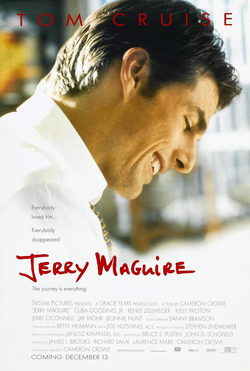
Behind the film
- Year
- 1996
- Director
- Cameron Crowe
- Writers
- Cameron Crowe
- Genres
- Romance, Comedy, Drama, American football
- Production
- Gracie Films, Vinyl Films, TriStar Pictures
- Country
- United States
- Cast
- Tom Cruise, Cuba Gooding Jr., Renée Zellweger, Regina King, Bonnie Hunt, Jonathan Lipnicki, Kelly Preston, Jay Mohr
About the film
Contains story spoilers.
Sports agent Jerry Maguire writes a mission statement calling for fewer clients and more genuine care. His employer fires him, leaving football player Rod Tidwell as his sole surviving client and single mother Dorothy Boyd as his only colleague. Jerry loses a promising prospect to rival Bob Sugar, ends his engagement and grows close to Dorothy and her son Ray. He marries Dorothy, but their relationship struggles while his business remains uncertain. Rod's decisive game brings an injury scare, followed by recovery and public recognition. Jerry recognises the limits of success without Dorothy and returns to reconcile with her. Rod receives a substantial contract, and Jerry's career begins recovering on terms that make a client relationship more than a transaction.
Cameron Crowe's film begins with a seductive professional fantasy: saying the right thing might transform the way an industry works. Jerry has the language, energy and persuasive confidence to make that fantasy sound possible. What follows places those skills under different pressures. A principled statement can win admiration without providing the money needed to sustain a new business, and conviction becomes harder to maintain when its practical rewards disappear. The film's romantic and commercial stories grow together because both ask whether Jerry can move beyond the exhilarating performance of sincerity and become dependable when another person's needs interrupt his preferred image of himself.
Tom Cruise gives Jerry the speed of someone who has made urgency into a professional method. He can appear completely engaged while also searching for the next opening through which to regain control. That energy is attractive, but it has an uneasy side when conversation requires listening rather than winning agreement. The role makes charm part of the problem as well as part of the appeal. Jerry can convince others that he understands what matters before he has fully understood it himself. The comedy comes from watching a highly capable operator encounter situations that cannot be resolved through another burst of professionally assured enthusiasm.
Cuba Gooding Jr.'s Rod turns the client into an active participant rather than a grateful recipient of the agent's transformation. His demands have a practical basis: the risks of athletic labour belong to a person with a family, not merely to a marketable name. Confidence and frustration can occupy the same performance. Rod's insistence on being valued makes the relationship difficult enough for Jerry's principles to mean something. A smaller client is not automatically easier to care for, and personal attention involves exposure to a person's pride, anger and fear. Their exchanges give the film a second kind of intimacy beside the developing romance.
Renée Zellweger's Dorothy introduces the consequences of believing in someone's promise. Her decision has an economic setting as well as an emotional one, because admiration cannot make the demands of supporting a child disappear. That makes her more than proof that Jerry is lovable. The relationship asks how easily a person's generosity can become the infrastructure supporting another person's reinvention. Jonathan Lipnicki's Ray adds warmth without resolving that imbalance on his mother's behalf. Family life offers Jerry contact that feels less conditional than the professional world, but the film still has to ask whether he can participate in that life without merely enjoying its reassurance.
Regina King's Marcee and Bonnie Hunt's Laurel give the surrounding relationships different measures of commitment. Their presence prevents every conversation from being organised around Jerry's account of what he needs. A partner or relative can recognise a difficulty that the central character would prefer to narrate as temporary adversity. The film's ensemble therefore helps distinguish aspiration from evidence. Someone may speak convincingly about becoming a better person, while people close to the situation continue asking what has actually changed. Those alternative viewpoints create a social texture around the romance, giving affection practical witnesses rather than letting grand declarations float free of daily obligations.
The sports setting turns personal worth into something publicly measured and financially negotiated. Performance, reputation and injury can change what an organisation is willing to pay, often on a timescale that leaves little room for security. The film draws energy from that instability without requiring a detailed knowledge of American football. Its essential stakes concern who carries risk and who receives recognition. A televised moment can generate an enormous audience, but its human meaning depends on relationships formed outside the frame. The business and the emotional story meet where a public achievement finally becomes something two people can share rather than something one sells for the other.
Crowe combines workplace comedy, sporting drama and romance through a belief that professional behaviour cannot be sealed away from personal character. The film's hopeful resolution does not make money irrelevant; it makes the way money is pursued part of a larger account of care. Jerry's new direction remains attractive because success is allowed to accompany his changed priorities, yet the emotional argument has already shown why applause alone would be insufficient. What gives the story its weight is the demand to mean something after the persuasive speech has ended. Love and professional loyalty both require a person to remain present when the next conversation offers no easy applause.