
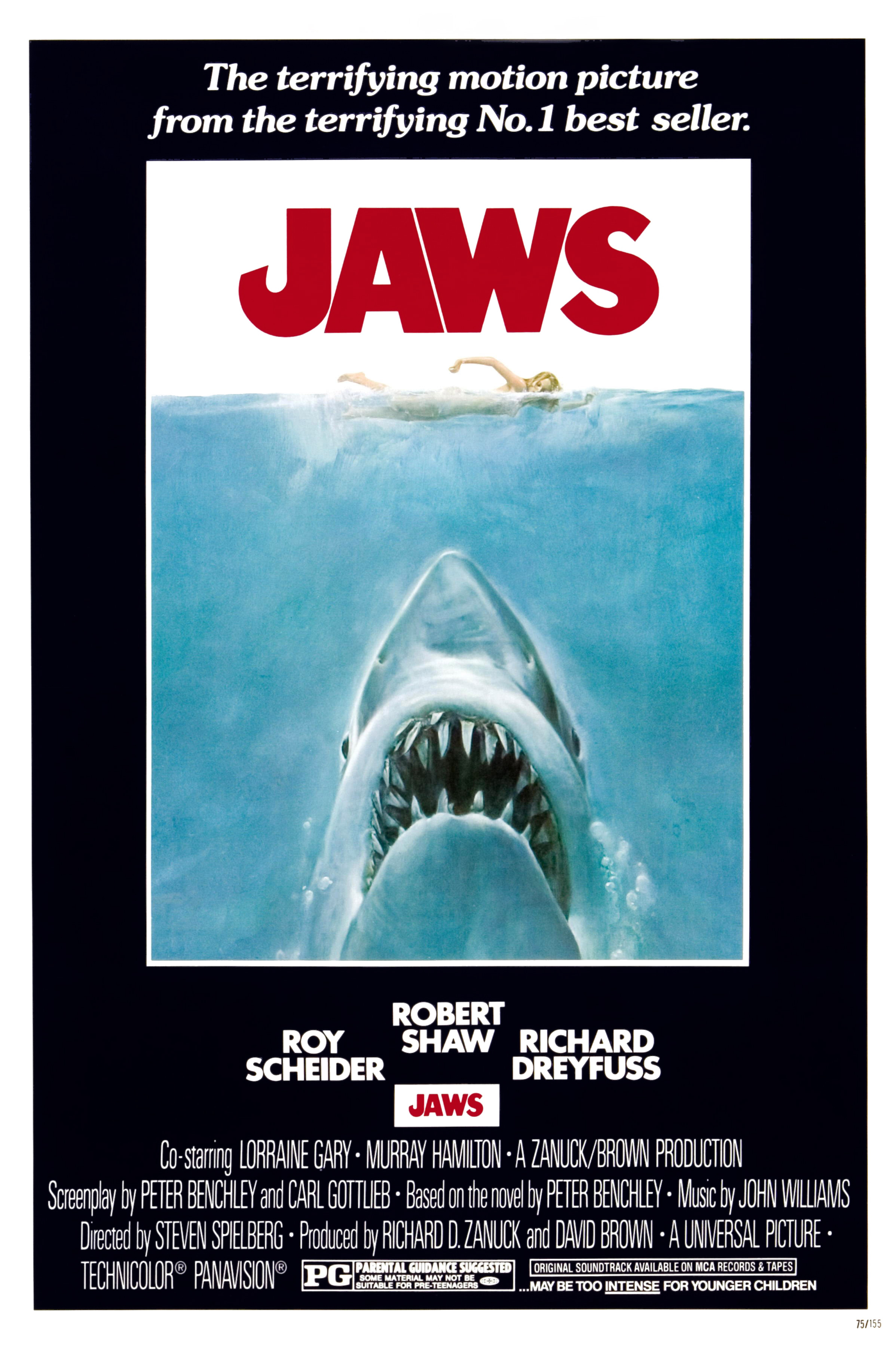
Behind the film
- Year
- 1975
- Director
- Steven Spielberg
- Writers
- Peter Benchley, Carl Gottlieb
- Runtime
- 2h 4m
- Genres
- Thriller, Horror, Adventure, Suspense
- Production
- Universal Pictures
- Country
- United States
- Cast
- Roy Scheider, Robert Shaw, Richard Dreyfuss, Lorraine Gary, Murray Hamilton, Carl Gottlieb, Steven Spielberg, Craig Kingsbury
About the film
Contains story spoilers.
Jaws begins with an ordinary summer-night swim that turns the ocean into a space no one can see clearly. The story is set on Amity Island, a fictional resort community where crowded beaches are both a seasonal attraction and the basis of local business. When a shark kills a swimmer, police chief Martin Brody, played by Roy Scheider, pushes to close the beach. Mayor Larry Vaughn worries about the town's livelihood and resists a decision that could drive holidaymakers away. That conflict gives the danger a public face: even before the shark is fully visible, the island has to decide whether protecting people is worth disrupting the season. Brody is not an action hero arriving from elsewhere. He is a family man and a new island resident, uneasy in the water and responsible for keeping the community safe.
The early stretch builds suspense through the gap between what the characters know and what the audience fears. A fin, a disturbance beneath the surface, or a sudden reaction at the edge of the frame can carry the threat without giving it a full-body reveal. Spielberg withholds a sustained look at the shark for much of the story; the practical mechanical shark, nicknamed Bruce, was famously difficult to operate. That production problem became a formal advantage: the camera could make empty water feel occupied. The attacks are shaped by editing and John Williams's score, which can transform a quiet stretch of beach into a countdown. The effect depends on restraint. The film gives viewers time to scan the water themselves, then interrupts that watchfulness with a fast, sharply staged burst of violence.
Brody eventually leaves the beach and joins marine scientist Matt Hooper, played by Richard Dreyfuss, and shark hunter Quint, played by Robert Shaw. The three men take the Orca out to sea, changing the film from a community crisis into a confined expedition. Their boat is a small working space surrounded by an immense landscape. Brody's practical authority, Hooper's scientific knowledge, and Quint's hard-earned experience do not fit together neatly. Their arguments are not simply competing bits of exposition: each man has a different way of understanding the animal and the risk. Quint treats the hunt as an occupation that has shaped his whole life; Hooper approaches it through equipment and research; Brody is trying to do a job for people who cannot see what is coming. As they move away from land, the competing methods become interdependent.
Once the hunt begins, the Orca becomes a stage for increasingly physical encounters. The barrels attached to the shark turn it into something the men can track, but they do not make it controllable. The ropes pull, the boat strains, and the ocean repeatedly threatens to overwhelm the crew's equipment and confidence. The boat sequence reveals Spielberg's carefully controlled geography as the stakes increase: the viewer sees where the harpoon, barrel, rope and men are, so every change in their arrangement carries suspense. This clarity lets the danger grow without confusing action for noise. Williams's music shifts with the chase, while Verna Fields's editing helps the pursuit feel like a sequence of decisions and consequences rather than disconnected attacks. The boat's small scale makes every practical failure immediate.
The three performances give the story its human scale. Scheider's Brody is watchful and cautious, and his discomfort with water remains part of the action rather than a trait the plot conveniently erases. Dreyfuss makes Hooper bright and technically confident, though confidence does not make him invulnerable. Shaw gives Quint a rough, commanding presence, with the character's history emerging in the rhythms of his speech and conduct. Their changing relationships make the boat journey more than a monster hunt. The men have to rely on one another even when they mistrust each other's judgment. Quiet intervals matter because conversation and work establish a fragile social order that the shark can disrupt with one impact. The ocean also strips away the community's systems of authority: beyond the island, these three must answer for their own choices.
Jaws is often remembered as a landmark summer thriller, but its craft is rooted in precise control of attention. The island scenes establish the cost of keeping the beaches open; the sea voyage narrows the conflict to three men and a dangerous animal; camera and score make the unseen part of the spectacle. Spielberg moves between public decisions, family stakes and physical action while keeping the basic geography legible. The film adapts Peter Benchley's novel, with screenplay contributions from Benchley, Carl Gottlieb and others, shaping the material around a steadily tightening hunt. The shark can be read as a force that exposes Amity's priorities, but that is an interpretation of how the story works, not a claim that the creature stands for only one thing. At its most effective, Jaws lets civic pressure, character conflict and suspense operate together, each making the others more consequential.