
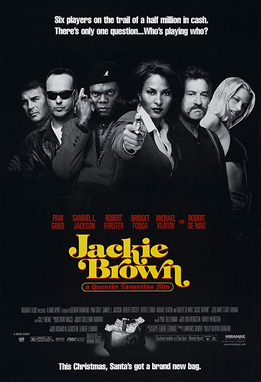
Behind the film
- Year
- 1997
- Director
- Quentin Tarantino
- Writers
- Quentin Tarantino
- Genres
- Heist, Blaxploitation, Crime, Drama
- Production
- A Band Apart
- Country
- United States
- Cast
- Pam Grier, Samuel L. Jackson, Robert Forster, Bridget Fonda, Michael Keaton, Robert De Niro, Chris Tucker, Michael Bowen
About the film
Contains story spoilers.
Flight attendant Jackie Brown carries money for gunrunner Ordell Robbie, who murders associate Beaumont after his arrest. Investigators intercept Jackie with cash and cocaine, and Ordell hires bail bondsman Max Cherry to release her. She protects herself from Ordell and appears to cooperate with both him and the authorities while planning to keep most of his money. A department-store exchange lets Max collect the concealed fortune. Ordell's accomplice Louis kills Melanie after a quarrel; Ordell then kills Louis when he realises the cash is missing. Max brings Ordell to his office, where waiting police shoot him after Jackie announces his gun. Cleared of charges, Jackie prepares to leave for Madrid. Max declines her invitation to come along. Her successful escape carries the sadness of a possible future they will not share.
The attraction of the scheme is inseparable from the life Jackie already has. Pam Grier's character cannot assume that another attractive opportunity will arrive if this one fails. Time and money are practical pressures rather than background decoration. That makes her attention to detail feel purposeful: she needs to understand what each person expects to see, then decide how much of herself to reveal. The film gives intelligence an unshowy form. Jackie can be frightened without being helpless, polite without being submissive and apparently cooperative without handing over her entire plan. Her authority develops through preparation, making the audience watch for the difference between what she knows and what others think they know.
Max's presence gives that calculation a different emotional texture. Robert Forster's character works in a business built around assessing risk, yet his interest in Jackie exceeds a professional judgment. His quiet manner leaves room for a relationship which cannot be measured solely in financial returns. Both characters bring the sense of having lived before this story began; affection is shaped by established habits as much as immediate attraction. That gives their connection a particular tension. Changing a life can involve leaving familiar responsibilities behind, and an invitation does not erase the hesitation attached to doing so. Their conversations allow suspense and tenderness to occupy the same scene without demanding that one displace the other.
Ordell's power depends on making violence sound like routine business. Samuel L. Jackson's character treats his own confidence as evidence that he understands everyone around him. The film lets that certainty become a vulnerability. It is possible to know how to threaten people and still misunderstand their capacities, loyalties or endurance. He approaches relationships through usefulness, which makes betrayal seem like something he can manage by staying intimidating. Jackie's difficulty is that this is not a harmless miscalculation: the cost of exposing his error could be lethal. The threat therefore remains present even during talkative, apparently casual exchanges. A social performance can conceal danger without removing it.
The supporting criminals complicate any image of a smoothly functioning operation. Robert De Niro's Louis and Bridget Fonda's Melanie belong to a world where irritation, distraction and contempt can matter as much as elaborate planning. Cooperation is fragile when people regard each other primarily as obstacles or opportunities. That gives the ensemble a distinctive comic unease. Conversation can drift, but the drift may reveal an important limit in somebody's temperament. The contrast with Jackie's patience is especially useful: her plan depends on allowing others to remain comfortable with their assumptions. The audience can follow the transaction while also recognising how ordinary failures of attention threaten to derail it.
The exchange is built from everyday commercial spaces rather than an exotic criminal hideout. Public movement, shopping and apparently insignificant errands offer cover because nobody can give equal attention to everything happening around them. That makes observation a central pleasure of the film. An action may be visible without its purpose being clear; following one participant does not provide the whole picture. Tarantino's arrangement invites viewers to revise their understanding of the same operation as different perspectives become available. Suspense grows from the management of knowledge, not merely the question of whether someone will draw a weapon. The routine environment becomes a place where small differences in timing can redirect a life.
Music gives these people a cultural and emotional existence beyond their usefulness to the scheme. A song can suggest taste, memory or a private rhythm that somebody else has not noticed. Miramax's own film materials foreground the music alongside its conversations and confrontations, fitting a story which makes space for both business and interior life. The contrast is valuable: criminal plots tend to make every object a clue and every exchange an instruction, but these characters also have preferences that are not entirely strategic. That helps keep Jackie and Max from becoming simply the clever people in a cleverly assembled story. Their possible connection has to survive outside the mechanics of the con.
Adapted from Elmore Leonard's Rum Punch, Jackie Brown turns a crime narrative into a question about what a person is prepared to do with the years ahead. Winning the money is important, but financial escape does not resolve every uncertainty. Risk can make an unfamiliar future possible without making it comfortable, and loyalty can mean more than joining somebody else's adventure. The film holds those tensions alongside the satisfaction of a plan that depends on being underestimated. Its world is populated by people who expect to control the situation through force, position or professional experience. Jackie finds leverage in listening carefully to those expectations and deciding that they need not dictate the rest of her life.