
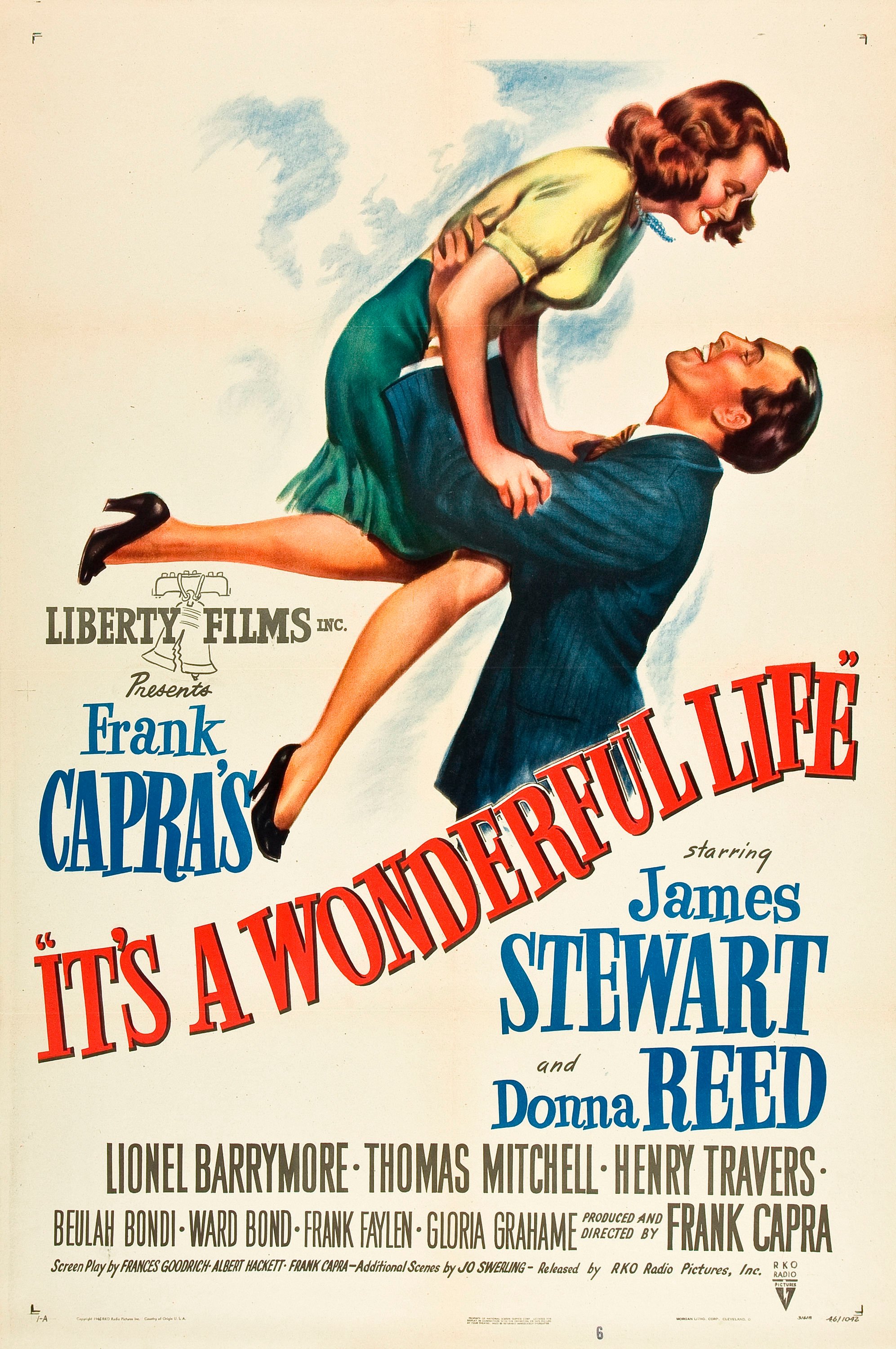
Behind the film
- Year
- 1946
- Director
- Frank Capra
- Writers
- Frances Goodrich, Albert Hackett, Frank Capra, Jo Swerling
- Genres
- Romantic comedy, Fantasy, Drama, Flashback
- Production
- Liberty Films, RKO Pictures
- Country
- United States
- Cast
- James Stewart, Donna Reed, Lionel Barrymore, Thomas Mitchell, Henry Travers, Samuel S. Hinds, Beulah Bondi, H. B. Warner
About the film
Contains story spoilers.
It's a Wonderful Life begins on Christmas Eve 1945, with George Bailey at a breaking point and prayers from people who love him reaching heaven. Clarence, an angel still working toward his wings, is shown George's life so he can understand the man he must help. The recollections start with George as a boy: he saves his younger brother Harry from drowning in an icy pond, an accident that leaves George deaf in one ear, and later prevents pharmacist Mr. Gower from poisoning a customer. These episodes establish his instinct to look after others, but also show how early that instinct redirects his own plans.
George imagines leaving Bedford Falls for travel and college, yet family duty repeatedly intervenes. After his father dies, he postpones college to keep the Bailey Brothers Building and Loan alive against Henry Potter, a wealthy banker who wants to eliminate it. George gives his tuition money to Harry, expecting his brother to take over after graduation, but Harry returns with a job and a wife, so George remains. He and Mary Hatch marry and use their honeymoon savings to keep the company open during a bank run. Later, George builds Bailey Park as an alternative to Potter's slum housing. Each decision makes the community better while narrowing the life George thought he would have.
The crisis arrives when Uncle Billy accidentally wraps the Building and Loan's missing $8,000 in a newspaper that Potter keeps. With an auditor due, George retraces Billy's steps and tries to borrow the money from Potter, who refuses and tells him he is worth more dead than alive. George's frustration turns inward: he resents the obligations, his family and the town that have defined him. After drinking and praying for help, he goes to a bridge intending to jump. Clarence falls into the water first, and George rescues him. When George says he wishes he had never been born, Clarence takes him through a version of Bedford Falls where he never existed.
In that altered town, now called Pottersville, the absence of George has consequences beyond his own unhappiness. His mother does not recognize him, Mary has become an isolated unmarried librarian, and the Building and Loan failed, leaving Billy institutionalized. Mr. Gower was jailed after poisoning a customer, Harry drowned as a boy, and the soldiers Harry later saved died because he was not there to do so. The journey changes George's perspective not by granting him a perfect life, but by letting him see how ordinary acts have formed an interdependent town. The contrast also makes Potter's influence visible: without George's alternative housing and business, the town's public life is harsher and more commercialized.
George begs to live again and returns to the bridge, overjoyed to be himself even while the missing money still threatens him. Mary and Billy have gathered neighbors and townspeople, who contribute enough to replace the funds. Harry arrives and calls George the richest man in town, meaning the friends and relationships he has built rather than his finances. A copy of Tom Sawyer arrives from Clarence with a note about friendship, and Zuzu hears the bell on the Christmas tree and recalls that an angel has earned his wings. The resolution does not show Potter returning the money or facing legal consequences; it shows George surrounded by a community that answers his need.
Frank Capra structures the story as a long recollection revealed to Clarence, so scenes that seem like detours become evidence about George's character and the town's interconnectedness. Bedford Falls and its alternate counterpart are sharply differentiated through street life, businesses and the way neighbors respond to one another. The fantastical device makes the stakes legible without changing the film into a claim that George's sacrifices were simple or painless. He does feel trapped, and the alternate world does not erase that feeling; it gives him new knowledge about the impact of a life whose importance was hidden from him.
The war years give Harry's earlier rescue a further consequence. George's damaged hearing keeps him out of military service, while Harry becomes a decorated pilot whose actions save other servicemen. George remains involved in civilian work at home. In Clarence's alternate world, Harry's grave makes the chain of dependence brutally concrete: without the boy George pulled from the ice, those later rescues could not happen. The family house supplies a quieter continuity. Mary takes the neglected old building and makes it their home, creating the life George first overlooks when he measures himself against the travel he never managed. Its broken fittings irritate him during the crisis and delight him when he returns. Zuzu's flower petals, which he had kept in his pocket, become another test that ordinary reality has come back. These familiar objects give his relief something tangible before the neighbors arrive with money. The restored world is recognizable through its imperfections as well as through the people who welcome him.