
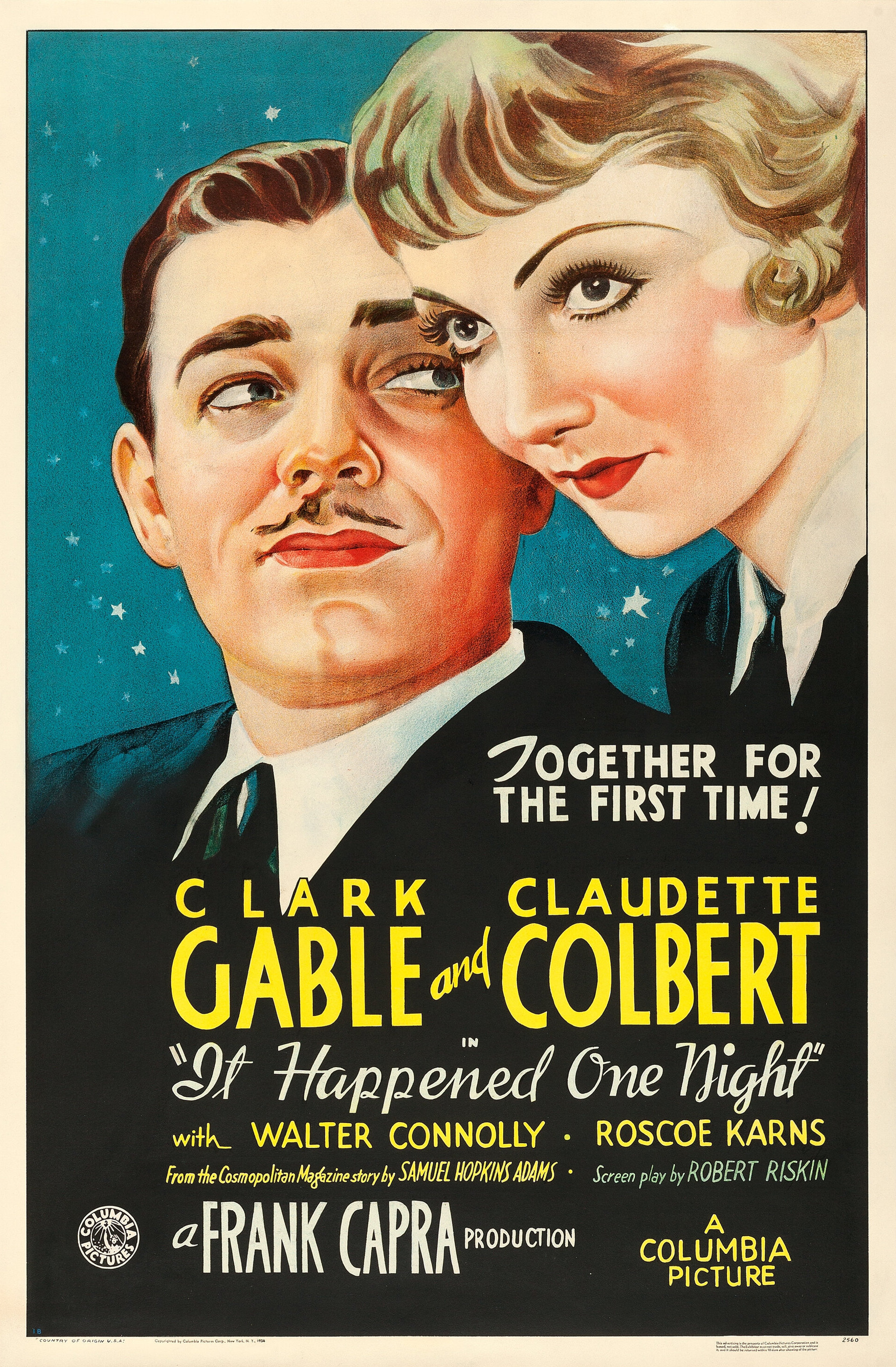
Behind the film
- Year
- 1934
- Director
- Frank Capra
- Writers
- Robert Riskin
- Runtime
- 1h 45m
- Genres
- Romantic comedy
- Production
- Columbia Pictures
- Country
- United States
- Cast
- Clark Gable, Claudette Colbert, Walter Connolly, Roscoe Karns, Jameson Thomas, Alan Hale, Blanche Friderici, Charles C. Wilson
About the film
Contains story spoilers.
Ellie Andrews escapes from her wealthy father's yacht after he has kept her there to challenge her elopement with aviator King Westley. Disguised among ordinary passengers, she boards a bus bound for New York, where she hopes to join Westley and make their marriage public. Peter Warne, a recently fired newspaper reporter, recognizes that the runaway heiress could restore his career with an exclusive story. Their shared journey later becomes a bargain neither entirely trusts: Ellie needs to reach her husband, while Peter wants to sell the account of her flight.
The trip repeatedly strips away the money and privacy Ellie expects to rely on. A thief takes her suitcase, and Peter fails to recover it; when Ellie misses a bus at a stop, Peter waits with her ticket and a newspaper that has exposed her identity. A washed-out bridge forces the passengers to stop, and Ellie and Peter share a modest roadside cabin. To save money they pretend to be married, with Peter stringing a blanket between the beds as a barrier. The arrangement is practical, but it also makes their growing attraction visible through the rules they invent. The makeshift bedding arrangement is less a romantic shortcut than a comic negotiation of limited space; Peter's rope-and-blanket solution gives the bus trip a recurring visual joke that returns when the journey finally ends.
Peter agrees to help Ellie reach New York only if she gives him her exclusive story. That bargain turns their journey into a contest over who controls the account of her life. A fellow passenger, Oscar Shapeley, reads about the reward Ellie's father has offered and tries to split the money with Peter. Peter frightens him away by pretending to be a kidnapper, but the attention makes them less safe. The couple leaves the bus and tries hitchhiking; Ellie stops a passing driver after Peter's own efforts fail, and their ride ends when the driver steals Peter's suitcase.
The film uses these delays to let Ellie and Peter become partners before they admit affection. Peter can talk to strangers and improvise a plan, but his pride and temper keep turning small reversals into quarrels. Ellie has been sheltered by wealth, yet she learns to read people and make practical choices, including stopping the car that takes them onward. Their different social positions are not erased by the trip: Peter knows what it means to need a job, while Ellie is accustomed to family power and public attention. Their shared discomfort gradually replaces the hostility of their first encounter.
When Ellie and Peter are only a short distance from New York, she sees a report of Westley's public appeal and hides it from Peter. She asks them to stop at another roadside lodge, then confesses that she loves him. Peter rejects her and leaves while she sleeps, rushing to New York to write and sell his story so he can afford to begin a life with her. The choice is sincere but badly timed: the lodge owners turn Ellie out when she cannot pay, and she calls her father believing Peter has abandoned her.
Ellie's father meanwhile has accepted that his daughter may go through with the marriage. Before the ceremony, she tells him she loves Peter but thinks Peter despises her. Alexander summons the reporter, who arrives with an itemized bill for the trip rather than a demand for the reward. Her father recognizes that Peter's account is not a scheme to profit from Ellie and pushes the two to face what each has chosen. He tells Ellie the car is waiting if she changes her mind; she leaves the wedding and runs toward Peter.
Frank Capra's film turns the bus journey into a sequence of compact social spaces: the crowded seats, roadside stops, cabin and improvised hitchhiking rides keep Ellie and Peter in conversation with strangers as well as each other. Robert Riskin's screenplay builds comic escalation from their practical problems, while Clark Gable's relaxed confidence plays against Claudette Colbert's heiress learning to travel without a private entourage. The blanket between the beds becomes the best-known prop because it gives their flirtation a visible boundary that changes meaning over the trip. Roadside rooms and bus stops are filmed as temporary stages where class and gender expectations can be tested in public; the couple cannot retreat into the privacy or staff of Ellie's former life.
The romantic ending depends on a choice Ellie makes for herself. Her father helps by giving her a way out of the ceremony, but she is the one who leaves it and returns to the man she has come to understand. The last image returns to the roadside room: the barrier between the beds is finally gone, and a signal from inside announces the couple's reunion. The film resolves its chase with a private comic flourish instead of a public spectacle, bringing the physical journey to rest at the place where their relationship first changed.