
Behind the film
- Year
- 2002
- Director
- Christopher Nolan
- Writers
- Hillary Seitz
- Runtime
- 1h 58m
- Genres
- Crime, Neo-noir, Thriller, Drama
- Production
- Alcon Entertainment
- Country
- United States
- Cast
- Al Pacino, Robin Williams, Hilary Swank, Maura Tierney, Martin Donovan, Nicky Katt, Jonathan Jackson, Paul Dooley
About the film
Contains story spoilers.
Insomnia begins with a detective who should know how to read a difficult situation. That expectation is the source of its unease. Experience can make a person capable, but it can also supply the language needed to justify a decision that a less accomplished colleague might question. The murder investigation places professional authority under pressure until it is difficult to separate competence from self-protection. The film's central fear is not simply that an exhausted man might miss a clue. It is that a respected man might recognise the truth and still arrange matters so that the truth cannot be used against him.
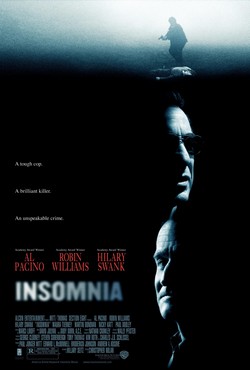
Christopher Nolan directs this 2002 remake of the Norwegian thriller, with a screenplay by Hillary Seitz. Al Pacino plays Will Dormer, Robin Williams plays Walter Finch and Hilary Swank plays local officer Ellie Burr. The setting is an Alaskan summer, when persistent daylight unsettles the visiting investigator's sense of rest and time. That seasonal condition is important; the film is not suggesting that Alaska remains sunlit throughout the year. In the story, an environment that should illuminate everything becomes oppressive. Light continues to arrive, yet clarity becomes harder to maintain. The detective has little refuge from either the investigation or himself.
Dormer and partner Hap Eckhart investigate Kay Connell's death. During a foggy pursuit, Dormer shoots Eckhart, then conceals his involvement. Finch, the killer, has witnessed enough to blackmail him and seeks to frame Kay's boyfriend. Burr discovers evidence against the detective she admires. At a lakeside confrontation, Dormer admits he cannot be certain whether shooting Eckhart was accidental; Finch and Dormer fatally shoot each other. Burr considers discarding the incriminating evidence, but Dormer tells her to preserve it. The ending leaves the uncertainty about his intention unresolved while making his final advice much less ambiguous.
That refusal to settle intention neatly is essential to the character. People are not always reliable witnesses to their own motives, especially when a possible motive is something they cannot bear to acknowledge. The film can therefore ask a more difficult question than whether a gun was deliberately aimed. What happens after the shot becomes another measure of responsibility. Confusion may explain the initial event, but it cannot automatically explain every later choice. A cover-up adds decisions to whatever uncertainty existed at the beginning, making the attempt to control the narrative a form of evidence in itself.
Finch's role brings that problem into conversation. He does not need the investigator to believe that he is innocent; he needs the investigator to become invested in a mutually useful account. The result is a grotesque imitation of professional cooperation. Two people who should occupy opposite sides of an inquiry begin to share an interest in directing it away from uncomfortable facts. That arrangement is disturbing because it uses recognisable habits of discussion and negotiation. Wrongdoing need not appear as an entirely foreign language. It can borrow the calm tone of practical problem-solving and make an unethical compromise sound like the sensible next step.
The lost sleep makes every attempt at control more fragile. Rest is ordinarily the interval in which a person stops performing a role, and the title suggests what happens when that interval cannot be reached. Dormer's professional identity has no easy place to loosen. Reading the daylight as a moral exposure is useful, but it should not reduce the setting to a simple symbol of truth. Visibility is not the same as understanding. A person can be surrounded by light while thinking badly, seeing selectively and misreading an encounter. The film turns that contradiction into an atmosphere in which being awake offers no assurance of being alert.
Burr provides a different relationship to evidence because admiration initially links her judgement to someone else's reputation. A mentor's example can give a younger officer confidence, but it can also make questioning that example feel like a personal betrayal. Her task is to discover whether professional values survive when the person representing them proves unreliable. That is harder than merely choosing a better hero. Integrity must become something she practises, including when practice costs her an uncomplicated story about a man she respects. The inquiry thus produces an education, though it is far removed from the education she might have expected.
The final advice does not wipe away Dormer's actions or convert death into acquittal. Its importance lies in interrupting a pattern that might otherwise pass to the next officer. A person who has compromised evidence can still recognise what preserving it would demand, even if that recognition arrives too late to repair his own life. Insomnia closes around that limited possibility. It is a crime thriller in which solving the external case cannot fully solve the internal one, and in which the most useful legacy of experience may be a warning against repeating the experienced person's mistakes.