
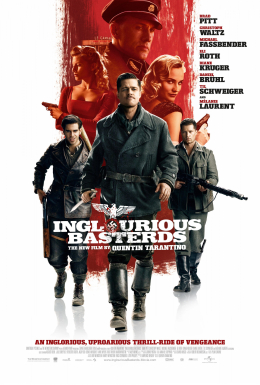
Behind the film
- Year
- 2009
- Director
- Quentin Tarantino
- Writers
- Quentin Tarantino
- Runtime
- 2h 32m
- Genres
- War, Alternate history, Drama, Adventure
- Production
- The Weinstein Company, A Band Apart, Universal Pictures
- Country
- Germany, United States
- Cast
- Brad Pitt, Christoph Waltz, Mélanie Laurent, Daniel Brühl, Michael Fassbender, Eli Roth, Diane Kruger, Til Schweiger
About the film
Contains story spoilers.
In 1941, SS officer Hans Landa arrives at the farmhouse of Perrier LaPadite and questions him about a Jewish family hiding nearby. LaPadite eventually reveals that the Dreyfuses are concealed beneath the floorboards. Landa’s men shoot through the floor, killing the family, but their daughter Shosanna escapes. The opening establishes Landa as a patient interrogator who turns politeness into pressure, and it gives Shosanna a direct reason to remember him. The story then jumps forward three years, when another strand of the film is already operating in occupied France.
Lieutenant Aldo Raine leads a squad of Jewish American soldiers known as the Basterds. Their mission is to attack German forces and make survivors carry visible evidence of their Nazi affiliation. Sergeant Donny Donowitz, Hugo Stiglitz, Omar Ulmer and Wilhelm Wicki are among the group. Raine is blunt about what he expects from the men and treats fear as part of the operation. Their scenes take a different tone from Shosanna’s quieter Paris life, but both stories are aimed at the same German power structure, even before their characters know how they will intersect.
Shosanna now runs a cinema under the name Emmanuelle Mimieux. She meets Fredrick Zoller, a celebrated German sniper whose exploits have been turned into the propaganda film Nation’s Pride. Zoller persuades Joseph Goebbels to hold the premiere at Shosanna’s theater. Landa, appointed head of security for the event, questions Shosanna over strudel in a restaurant; the conversation leaves her unsure whether he recognizes her. She and Marcel, her lover and projectionist, plan to use the theater’s stock of flammable nitrate film to set the building alight while the German leadership watches the screening.
At the same time, British Lieutenant Archie Hicox is recruited for Operation Kino, a separate plan to bomb the premiere. He is a former film critic who speaks German and is meant to meet the Basterds and Bridget von Hammersmark, a German film star working as an Allied agent. Their operation nearly collapses before the premiere: Hicox, Stiglitz and Wicki meet Bridget in a tavern crowded with German soldiers. Hicox’s accent draws suspicion, and a hand gesture gives away that he is not German. A gunfight leaves everyone dead except the wounded Bridget and Sergeant Wilhelm, whom Raine negotiates with before Bridget shoots him.
Raine initially suspects Bridget has betrayed the group, but she explains that Hitler himself will attend the screening. The Basterds proceed, disguising Raine, Donowitz and Ulmer as Italian filmmakers. Landa investigates the tavern and finds a shoe and a signed napkin linking Bridget to the scene. At the cinema, he recognizes the Basterds’ cover and confronts Bridget privately, then strangles her. He has Raine and Utivich arrested, while Donowitz and Ulmer remain inside. Landa offers the Allied commanders a bargain: he will allow the attack to continue in exchange for his own safety and wealth after the war.
During the screening, Zoller visits Shosanna in the projection booth. When she cannot get him to leave, she shoots him in the back. When she approaches his fallen body, he shoots her, and both die. The film continues, and Shosanna’s recorded image appears on the screen to warn the audience that the Nazis are about to be killed by a Jewish woman. Marcel sets the nitrate films alight, while Donowitz and Ulmer open fire on the German leaders from inside the theater. The two plans have become one chaotic assault, and the cinema itself turns into the instrument Shosanna chose for revenge.
The ending is deliberately an alternate history. Hitler and the assembled Nazi leadership die in the theater, unlike their real historical counterparts, and the film does not pretend this is a documentary account of the war. Landa’s attempted deal does not give him the clean escape he expects: after Landa and his radio operator surrender, Raine shoots the operator and carves a swastika into Landa’s forehead so he cannot hide his former allegiance. The film’s chapter structure, multilingual scenes and long conversations let suspense build through what characters understand or fail to understand. That approach makes the tavern and farmhouse feel as consequential as the climactic attack.
Cinema is woven into the story at several levels: Shosanna owns a theater, Zoller is celebrated through a propaganda movie, and Operation Kino treats the premiere as a target. The characters use language and performance as tools, whether Hicox tries to pass as a German officer or Landa tests what Shosanna knows. Those details make the final plan depend on more than explosives and weapons. Shosanna’s theater gathers the people she wants to confront in one room, while the story’s invented ending gives her and the Basterds a decisive victory inside a history that otherwise remains recognizably brutal and occupied. The suspense often turns on a small gesture or a pause in conversation, as when Hicox’s hand movement exposes him in the tavern.